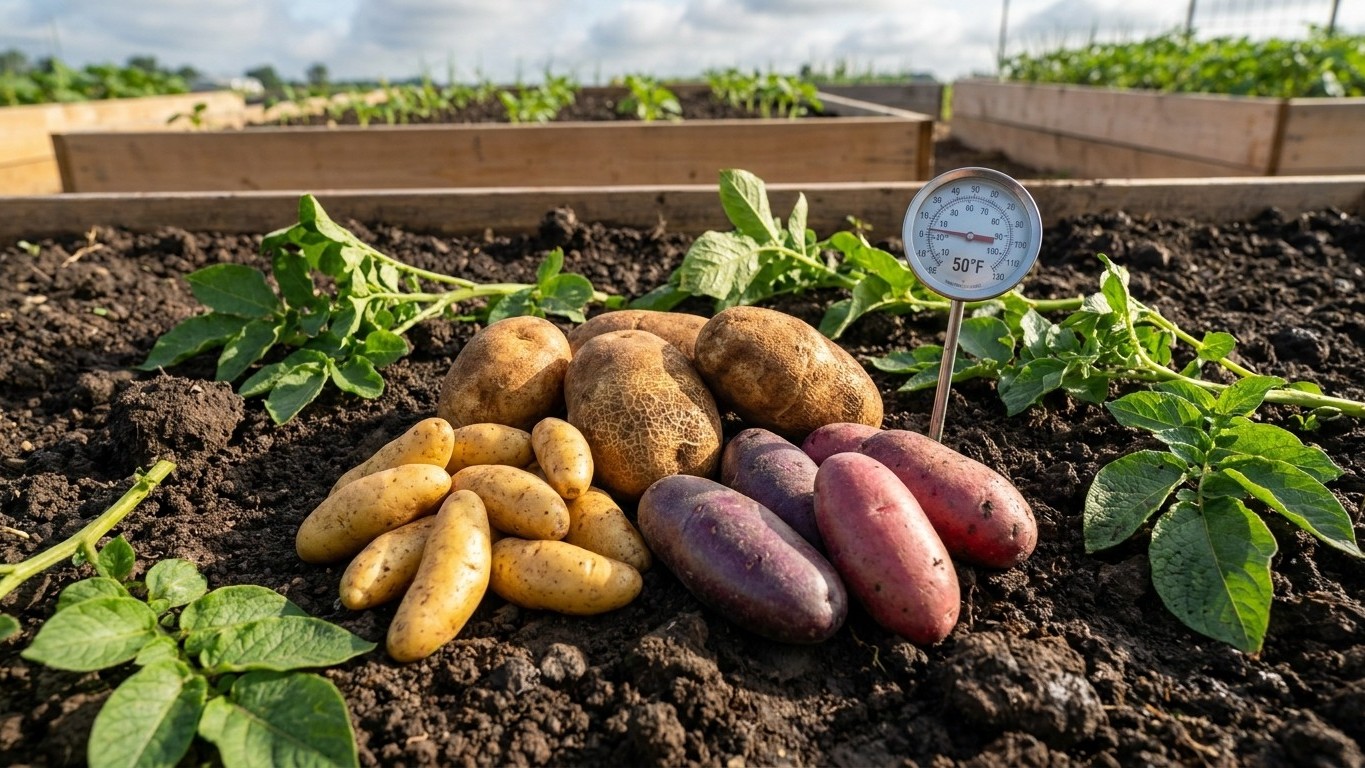

Early-season and mid-season potatoes are the safer bet across most of Missouri, planted as soon as soil hits 50°F, which lands 14 to 21 days before the last spring frost of April 6 to April 20 near Kansas City International Airport (NOAA NCEI 1991-2020 Climate Normals). Late-season types can work in the state’s cooler northern counties, but where summer heat arrives fast, that extra time underground works against the tubers, not for them.
The short answer
The frost window itself, April 6 to April 20 at the Kansas City International Airport station, is the number to plan around, but it needs a caveat right away: that station sits well north of the city. Downtown Kansas City typically clears frost about five days earlier in spring, and southern Missouri, from the Ozarks down to the Bootheel, runs milder still. A gardener in Joplin or Poplar Bluff working off the MCI dates alone is planting later than necessary.
What decides whether a variety “suits” Missouri isn’t its name. It’s its season class, early, mid-season, or late, matched against how fast the state’s soil heats up once spring arrives. Utah State University Extension and the University of Maine Cooperative Extension, in Bulletin #2077, both describe potatoes as planted the moment soil reaches 50°F, which in Missouri typically falls two to three weeks ahead of that last frost date. That’s an early planting by most garden logic, but potatoes tolerate a light frost on the foliage in a way tomatoes and peppers don’t, so the risk calculus is different.
The other half of the answer is the heat ceiling. Both extension sources agree that soil temperatures above 90°F inhibit tuber set and fill, and no amount of irrigation reverses that once it happens. Missouri summers push soil past that mark well before Labor Day across the southern two-thirds of the state, which is exactly why early and mid-season classes, harvested before peak heat, outperform late-season classes here. A late-season type still bulking tubers in July soil is fighting a mechanism, not a shortage of water or fertilizer.
So the practical short answer: pick early or mid-season classes for reliable sizing, plant them as soon as the ground is workable and above 50°F, and treat late-season classes as a northern-Missouri option rather than a statewide default. Certified seed potatoes matter here too, uncertified seed carries virus that no amount of good soil or timing will fix, and that single fact does more for a Missouri potato patch than most of the advice written about fertilizer schedules.
What actually decides it
The heat ceiling underground
Tubers form and fill underground, where the plant can’t do much to regulate temperature the way leaves regulate themselves with transpiration. Once soil crosses 90°F, according to Utah State University Extension, the biological process that sizes tubers slows and effectively stops. This is not a wilting problem you can see and correct with a hose. It is a threshold. A gardener two counties apart from another can have the same rainfall and the same fertilizer program and get completely different yields, because one soil crossed 90°F in June and the other didn’t cross it until August.
The frost-to-heat window
Missouri’s growing season is really defined by the gap between “soil warm enough to plant” and “soil too hot to size tubers.” That gap is wider in northern counties, where summer heat builds more slowly and evenings cool more, and narrower in the southern half of the state, where the heat ceiling arrives earlier relative to the frost date. A variety that performs well in a longer window further north can run out of room in a shorter one further south, even though both places share a state name.
Season class over cultivar name
Neither Utah State nor the University of Maine publishes a days-to-maturity figure for individual varieties, and for good reason: maturity speed shifts with soil temperature, day length, and moisture, none of which are fixed numbers. What both sources do publish is season class, early, mid-season, or late, and end use, whether a potato is suited to baking or to boiling. That’s the framework worth reasoning from. An early-season type bred for boiling and a mid-season type bred for baking are choices about kitchen use and timing, not about a fixed calendar count that would let a gardener plan around a date that doesn’t actually exist in the research.
Why uncertified seed derails all of it
None of the timing or heat-threshold logic matters if the seed piece itself carries virus. Uncertified seed, often held over from a grocery store potato or a neighbor’s leftover stock, can carry disease that stunts growth regardless of how well the planting date and soil temperature were managed. This is the one part of the decision that isn’t about climate at all.
How to do it
- Check a soil thermometer at a 4-inch depth in the planting bed, not the air temperature, until it holds at or above 50°F.
- Confirm the local last-frost expectation for your part of the state, adjusting from the April 6 to April 20 Kansas City International Airport window: earlier for downtown Kansas City, earlier still for southern Missouri.
- Choose an early-season or mid-season class for most of the state; reserve late-season classes for northern counties with a longer cool stretch before summer heat sets in.
- Buy certified seed potatoes rather than saving or sourcing uncertified tubers, since certification is the only reliable way to avoid starting with a virus-carrying seed piece.
- Plant 14 to 21 days ahead of the expected last frost, once the 50°F soil threshold is met, accepting that light foliage frost is tolerable in a way it wouldn’t be for a tomato transplant.
- Hill soil over the developing plants as they grow, keeping tubers covered and shielded from direct sun exposure that can green the skin.
- Track soil temperature again as the season progresses; once it approaches 90°F, understand that tuber sizing is slowing regardless of watering, and plan the harvest around that reality rather than around a calendar guess.
- Dig the crop as a spring-timed harvest in the hotter parts of the state, rather than trying to stretch a summer crop through the heat ceiling.
What goes wrong
- Planting a late-season class in southern Missouri. The tubers are still trying to size when soil crosses 90°F, and growth effectively stops. The remedy is matching class to region before buying seed: early or mid-season for southern and central Missouri, late-season reserved for the cooler north.
- Using uncertified, saved, or grocery-store seed potatoes. These commonly carry virus that stunts the plant no matter how well the timing and soil conditions are managed. The remedy is sourcing certified seed potatoes, which is the one safeguard neither soil temperature nor watering can replace.
- Assuming the whole state shares one frost date. The April 6 to April 20 window comes from the Kansas City International Airport station, and that station sits well north of the city itself, let alone southern Missouri. The remedy is treating that window as a reference point to adjust from, not a fixed date for every county.
- Trying to water past the heat ceiling. Once soil crosses 90°F, irrigation does not restart tuber sizing, because the inhibition is a temperature response, not a moisture deficit. The remedy is planning the harvest date around the soil temperature trend, digging before the ceiling is reached rather than after.
- Planting too close to the last frost instead of ahead of it. Waiting for frost risk to fully pass wastes the 14- to 21-day head start that both extension sources describe as tied to the 50°F soil threshold, not the frost date itself. The remedy is planting by soil temperature, accepting minor frost tolerance in the foliage.
Common questions
Do potatoes need to wait until after the last frost to go in the ground?
No. Both Utah State University Extension and the University of Maine Cooperative Extension describe potatoes as planted once soil reaches 50°F, which typically falls 14 to 21 days before the last frost date, since foliage tolerates light frost in a way more tender crops don’t.
Is one frost date accurate for the entire state of Missouri?
No. The April 6 to April 20 window comes from the NOAA NCEI station at Kansas City International Airport, which sits well north of the city. Downtown Kansas City clears frost roughly five days earlier, and southern Missouri is milder still, so the window should be adjusted toward earlier dates further south.
What happens if soil gets too hot during the growing season?
Once soil passes 90°F, tuber set and fill are inhibited, according to Utah State University Extension. This is a temperature threshold, not a watering problem, so irrigation doesn’t reverse it once it happens.
Why does certified seed matter more than variety choice?
Uncertified seed potatoes can carry virus that stunts a crop regardless of how well the planting date and soil temperature are managed. Certification is the safeguard against that specific failure, separate from any decision about season class or end use.