
Fourteen to twenty-one days before your last spring frost, once the soil itself hits 50°F. That’s the window, and it moves depending on where in Missouri you’re standing. For the Kansas City International Airport station, NOAA puts that last frost date between April 6 and April 20. Everything else on this page exists to help you translate that range into a real planting day for your own yard.
The short answer
NOAA’s National Centers for Environmental Information, using 1991-2020 Climate Normals for station USW00003947 near Kansas City International Airport, puts the 30 to 70 percent probability band for a 32°F freeze between April 6 and April 20. That’s the reference window this page works from, and it’s the only frost data source cited here.
Count back 14 to 21 days from whichever end of that window applies to your location, and you land on a planting date somewhere in the second half of March to the first week of April for the Kansas City area. That count-back isn’t a rule of thumb someone made up. It comes from Utah State University Extension and the University of Maine Cooperative Extension, both of which describe potatoes as a crop planted as soon as the soil reaches 50°F, which typically falls two to three weeks ahead of the last frost date.
There’s a catch worth stating plainly before you touch a shovel. The Kansas City International Airport station sits well north of the city itself. Downtown Kansas City tends to run about five days earlier in spring than the airport reading, and southern Missouri, well south of the Kansas City metro entirely, is milder still. If you garden in Springfield or the Bootheel, the April 6-20 window is a starting reference, not your local answer. If you garden in St. Joseph or along the Iowa line, you may be looking at the later edge of that window or beyond it.
What none of this tells you, and what NOAA’s frost data was never built to tell you, is when the ground itself is ready. Air temperature and soil temperature aren’t the same thing, and a potato doesn’t care what the calendar says. It cares what’s happening six inches down, which is the mechanism the next section actually explains.
What actually decides it
Soil temperature, not the calendar
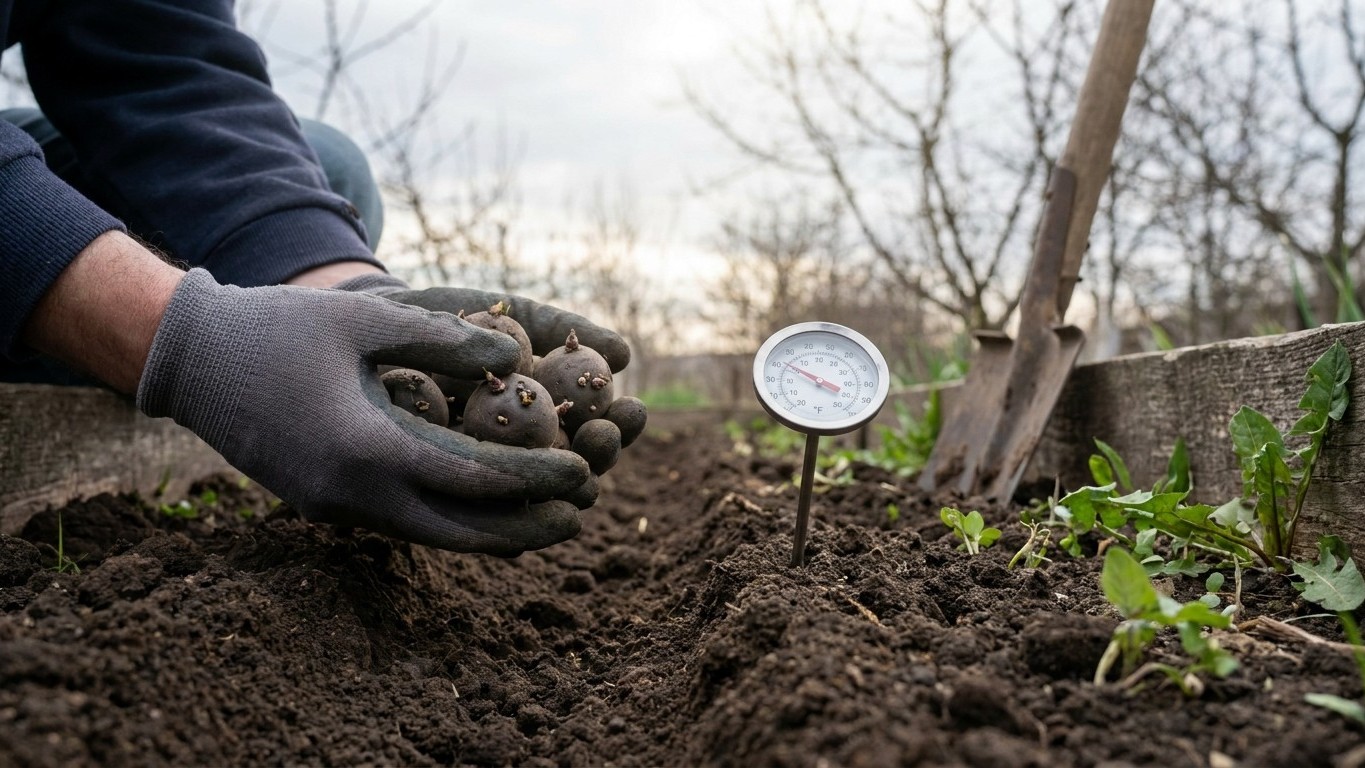
Potatoes go in the ground based on soil temperature, not a fixed date. Utah State University Extension is specific about this: seed potatoes are planted once soil reaches 50°F, and that point tends to arrive 14 to 21 days before the last frost date for a given location. This is why two gardens forty miles apart in Missouri, both technically inside the same NOAA frost window, can have different correct planting days. A sandy, south-facing garden bed warms faster than a heavy clay plot in a low spot that holds cold air and moisture. The frost date tells you the risk of a killing freeze. The soil thermometer tells you whether the tuber will actually break dormancy and grow instead of sitting inert and rotting in cold, wet ground.
The heat ceiling that ends the season early
The other side of this equation gets less attention, and it matters more in Missouri than in a place with a longer, cooler spring. Both Utah State and University of Maine Cooperative Extension describe tuber set and tuber fill, the two stages where the plant actually builds the potatoes you’ll dig, as inhibited once soil temperatures climb above 90°F. This isn’t a yield dip you can water your way out of. Once that threshold is crossed during the critical window, the plant stops sizing tubers, and irrigation doesn’t reverse it.
That single fact is what should drive your Missouri planting decision more than the frost date does. Missouri summers push soil past 90°F reliably, and the earlier you plant relative to your local 50°F soil threshold, the more of the tuber-bulking period happens before that heat ceiling arrives. A gardener who plants at the correct early date is essentially racing the summer, not the frost. A gardener who plants two or three weeks late because they were watching the calendar instead of the thermometer is shortening the plant’s productive window from the other end, and no amount of extra water in July fixes a ceiling that’s already been crossed.
How to do it
- Identify your local last-frost reference: use the Kansas City International Airport window (April 6 to April 20) as a baseline only if you’re near that metro; adjust several days earlier for downtown Kansas City, and expect an earlier window still the farther south you are in Missouri.
- Count back 14 to 21 days from that local last-frost estimate to get your target planting window, per the Utah State University Extension guidance on soil-temperature-based planting.
- Check actual soil temperature at planting depth rather than relying on the count-back alone; proceed once it reads at or near 50°F, consistent with University of Maine Cooperative Extension’s fact sheet on potato planting.
- Source certified seed potatoes rather than grocery-store tubers or leftover seed of unknown origin.
- Choose a season class, early, mid-season, or late, based on how much cool growing time you have before soil temperatures climb toward the 90°F ceiling, since neither source publishes a specific days-to-maturity figure for any variety.
- Plant into soil that has been worked and is well drained, since cold, waterlogged soil at the 50°F threshold is still a poor environment for a seed piece to sprout in.
- Monitor soil temperature through the tuber-set and tuber-fill stages, since that’s the period Utah State and Maine identify as vulnerable once soil crosses 90°F.
What goes wrong
- Planting by frost date alone, ignoring soil temperature. The last-frost window tells you about air temperature risk, not whether the ground is warm enough for a seed piece to grow instead of rot. Check soil temperature directly and wait for something close to 50°F before planting, even if the calendar date has already arrived.
- Using uncertified seed potatoes. Tubers from a grocery store or an unknown source can carry viruses that certified seed programs are specifically built to screen out. Buy certified seed potatoes; it’s the single change that most protects the crop before it’s even in the ground.
- Waiting too long and hitting the heat ceiling during tuber fill. If soil crosses 90°F while the plant is still trying to size its tubers, growth stops and doesn’t resume with more water. In Missouri, this means planting on the early side of your local window rather than the late side, and treating potatoes as a spring crop to dig before peak summer heat rather than a season-long planting.
- Assuming one frost date applies to the whole state. The Kansas City International Airport figure is a reference point for that specific station, not a Missouri-wide number. Downtown Kansas City runs earlier, and southern Missouri earlier still. Adjust from the named reference rather than treating it as universal.
- Trying to water through heat stress instead of avoiding it. Once soil exceeds 90°F during tuber set or fill, extra irrigation doesn’t restore sizing. The fix has to happen earlier, at the planting-date decision, not later at the hose.
Common questions
Does the NOAA frost date mean it’s safe to plant potatoes that day?
No. The April 6-20 window from NOAA NCEI describes the probability of a 32°F freeze for the Kansas City International Airport station, not soil readiness. Potatoes go in 14 to 21 days before that date, based on soil reaching 50°F, per Utah State University Extension.
What if my soil hits 50°F earlier than 14 to 21 days before my frost date?
Plant when the soil reads near 50°F rather than forcing a rigid count-back. The 14-to-21-day figure is a general relationship Utah State University Extension and University of Maine Cooperative Extension describe between soil warming and the last frost date, not a fixed rule that overrides an actual soil thermometer reading.
Should I choose an early, mid-season, or late variety in Missouri?
Neither Utah State nor University of Maine publishes days-to-maturity figures, so this page won’t invent one. What matters given Missouri’s soil heat ceiling is giving the plant as much cool growing time as possible before soil crosses 90°F, which generally favors planting early and choosing a season class suited to a shorter cool window rather than counting on a long, mild summer to finish the crop.
Is it true that potatoes for baking and potatoes for boiling need different planting timing?
No, planting timing is governed by soil temperature and the frost window, not by what the potato is used for. Whether a variety is suited to baking or to boiling is a matter of what the tuber is described as being good for in extension references, not a separate planting rule.