
Missouri’s apple harvest runs from late August for the earliest varieties through late October for the latest ones, with the exact picking day set by variety choice and how the tree’s bloom timing lined up with spring, not by a fixed date on the calendar. Storage life splits just as sharply: some apples turn soft or mealy within two weeks, others hold in a cold, damp spot for four to six months.
When apples are ready to pick in Missouri
Harvest date follows the tree’s stage, and the stage traces back to bloom, and bloom traces back to spring frost risk. In the Kansas City area, NOAA’s 1991-2020 climate normals put the last spring freeze (32°F) between April 6 and April 20, based on the airport station north of downtown (USW00003947, MCI). That five- or six-week window matters more than any single date: it tells you when a tree can safely push blossoms without a hard freeze wiping them out. Downtown Kansas City runs about five days milder in spring than the MCI reading, and southern Missouri, the Ozark Plateau around Springfield and further south, is milder still. A grower near Joplin or West Plains can generally expect bloom and harvest to land a bit earlier than one near the Iowa line.
On the other end of the season, first fall frost at the same MCI reference station falls between October 18 and October 29. Everything between those two windows, roughly six months, is the frost-free stretch a Missouri apple tree gets to finish its fruit. Early varieties finish with weeks to spare. Late-season varieties are racing the October date, and a cold snap that arrives on the early edge of that window can catch fruit still hanging.
Two different filters, not one
Cold hardiness and winter chill answer different questions, and mixing them up leads to bad variety picks. Hardiness is about survival: at the Kansas City reference station, the coldest month’s mean daily minimum is 19.5°F (NOAA NCEI 1991-2020 normals). That’s a comfortably mild figure for apple trees, which as a group tolerate far colder winters than that without dying back. Chill is a different matter entirely, it’s about whether the tree flowers correctly at all, and no local extension source publishes a chill-hour requirement or accumulation figure for Missouri specifically, so that number isn’t stated here. What can be said is that Missouri’s winters run cold enough, for long enough, that under-chilling isn’t the state’s problem the way it is in mild-winter regions. Growers here don’t need to reach for low-chill, early-flowering varieties to satisfy dormancy, and that’s fortunate, because an early-flowering tree blooms sooner and sits exposed to that April 6-20 frost window for longer. In Missouri, the safer bet runs the other direction: standard-chill varieties that bloom closer to the tail end of the frost risk, not ahead of it.
Ripeness itself still gets read off the fruit, not the date. Background skin color shifting from green to yellow or the variety’s mature hue, seeds turning brown instead of white, and the apple separating from the spur with a gentle upward twist are the three checks growers lean on regardless of which week the calendar shows.
Which ones keep, and which must be eaten
Apple varieties fall into three rough harvest groups, and storage life tracks almost exactly with which group a tree belongs to. Early or summer apples ripen well ahead of any frost risk and were never bred to last. Midseason varieties buy a few extra weeks. Late-season varieties, picked closest to that October 18-29 frost window, are built to hold the longest, sometimes into spring.
| Season group | Common examples | Typical harvest timing | Typical storage life |
|---|---|---|---|
| Summer/early | Lodi, Gravenstein, early Ginger Gold | Early to mid-August, well ahead of fall frost | 1-2 weeks refrigerated; not suited to long storage |
| Midseason | Gala, Jonathan, McIntosh | Mid-September, weeks before first frost | 4-8 weeks in cold storage |
| Late-season | Fuji, Golden Delicious, Rome, Arkansas Black, Granny Smith | Late September into October, closer to the frost window | 3-6 months in cold, humid storage |
The practical takeaway is that a backyard planting with only early varieties will produce a rush of fruit that has to be eaten, baked, or canned within days, while a planting weighted toward late-season types spreads the eating window across the whole winter. Mixing a couple of each is the usual middle path, and it also spreads out the labor of picking rather than dumping the whole crop into one frantic weekend.
Bruised or insect-damaged fruit doesn’t belong in either storage plan. A bruise that looks minor at picking time turns into a soft, rotting spot within a few weeks in storage, and one bad apple in a bin does spread decay to its neighbors, so sorting before storage isn’t optional if the goal is months of shelf life rather than days.
Storing them through a Missouri winter
Long storage depends on three things holding steady: temperature near 32-40°F, humidity around 90-95%, and separation from other produce, especially potatoes and anything that gives off ethylene gas, which speeds ripening and shortens storage life. Getting those three conditions right is harder in a typical Missouri house than it sounds, because most homes don’t have a space that naturally sits in that range all winter.
Where that space actually exists
A basement corner away from the furnace, an unheated but insulated garage, or a genuine root cellar all come closer to that target than a kitchen pantry or a mudroom ever will. The complication is that Missouri’s coldest month averages a 19.5°F overnight low at the Kansas City reference station, and an uninsulated outbuilding will track close to outdoor air on a clear, calm night. That’s cold enough to freeze stored apples solid, which ruins texture even if it doesn’t cause obvious rot. A structure with some thermal mass, poured concrete walls, an earthen floor, insulation plus a small heat source that only kicks on near freezing, buffers those swings far better than a bare wooden shed does. Basements tied to a heated house rarely dip below the low 40s even in January, which makes them the most reliable option most homeowners already have.
Humidity is the piece people skip. Apples stored in dry basement air shrivel and go rubbery well before they’d otherwise spoil. A loosely closed plastic bag with a few air holes, damp sand layered in a wooden crate, or a humidity tray under the storage shelf all push moisture back toward that 90-95% target without soaking the fruit. Checking stored apples every couple of weeks and pulling any that have started to soften keeps one bad piece from taking down a whole crate. The University of Missouri Extension service, at extension.missouri.edu, is the state’s land-grant resource for home fruit storage and pest questions specific to Missouri growing conditions.
What goes wrong here
The biggest single risk in Missouri sits right at that April 6-20 frost window. A tree that blooms early in a warm March stretch, then gets hit by a freeze that arrives on schedule for the calendar but late relative to that year’s warm spring, can lose most or all of its blossom crop in a single night. Growers watching a warm early spring have reason to be nervous right through the back end of that window, not just the front.
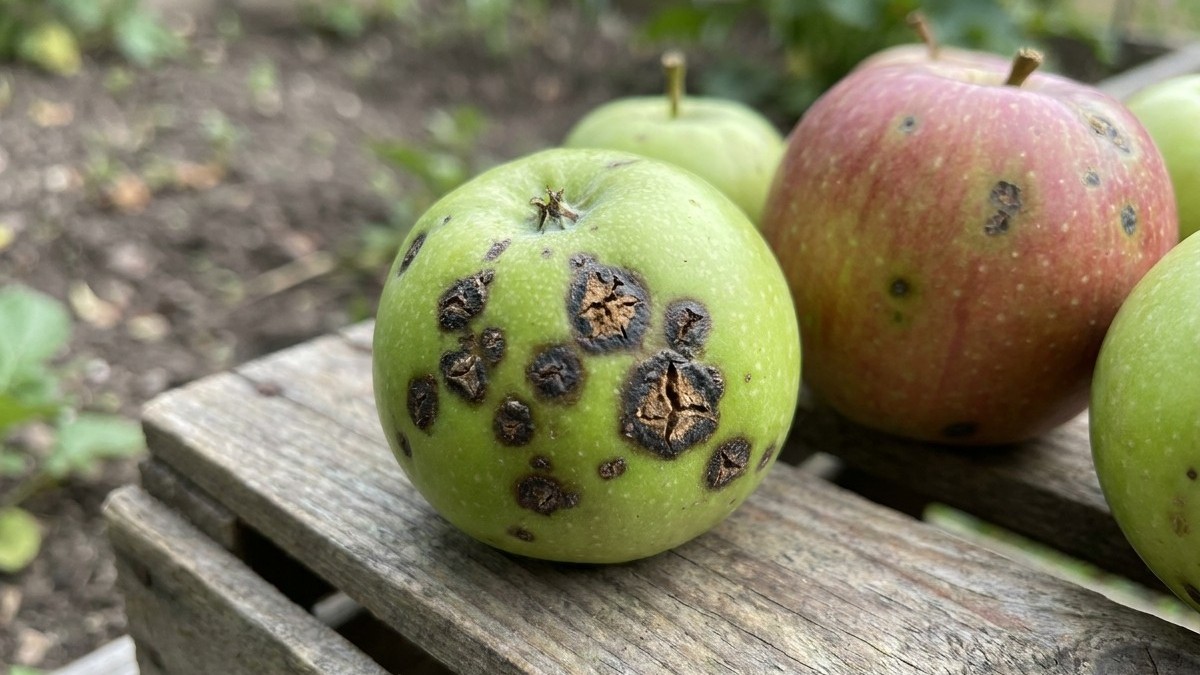
Fungal pressure is the other recurring problem, driven by Missouri’s humid summers rather than its winters. Cedar-apple rust and fire blight both find Missouri’s combination of warm, wet weather and (for rust) nearby eastern red cedar hospitable, and neither is a cold-climate problem the way frost timing is. Neither figure is quantified in a way that belongs on this page without a named source, but growers dealing with orange-spotted leaves or blackened, wilted shoot tips are looking at one of these two, and MU Extension’s pest resources are the right place to confirm which.
Storage failures tend to trace back to temperature swings rather than a single hard freeze. A stretch of unseasonably warm days in November or December, common enough in Missouri’s variable fall weather, can push an unheated storage space into the 50s for several days running, enough to jump-start ripening in apples that were otherwise settled into dormancy. That’s the argument for checking stored fruit on a schedule rather than assuming a cold room in October will stay cold clear through March.
Common questions
Do I need two apple varieties for pollination in Missouri?
Most apple varieties need a different variety blooming nearby to set fruit reliably; very few are truly self-fertile. Since bloom timing shifts with the same spring conditions discussed above, choosing two varieties with overlapping bloom windows matters more in a state with a variable spring like Missouri’s than the specific varieties chosen.
How do I know if my Missouri-grown apple is ripe without cutting it open?
Check background skin color away from any red blush, look for the fruit to separate with a gentle upward twist rather than tearing, and expect fully ripe seeds to have turned brown. Taste-testing one or two fruit from the tree is still the simplest confirmation.
Can I store Missouri apples in the refrigerator instead of a basement or cellar?
A refrigerator crisper drawer works for smaller quantities and generally holds temperature and humidity better than most home storage spaces, but it can’t handle the volume a mature backyard tree produces. It’s the practical choice for midseason varieties meant to be eaten within a couple of months.
Why did my apple tree bloom but produce no fruit this year in Missouri?
A late frost inside or just after the April 6-20 window is the most common cause, killing blossoms or young fruit before pollination could finish. A lack of a compatible pollinator variety blooming at the same time is the other frequent explanation.