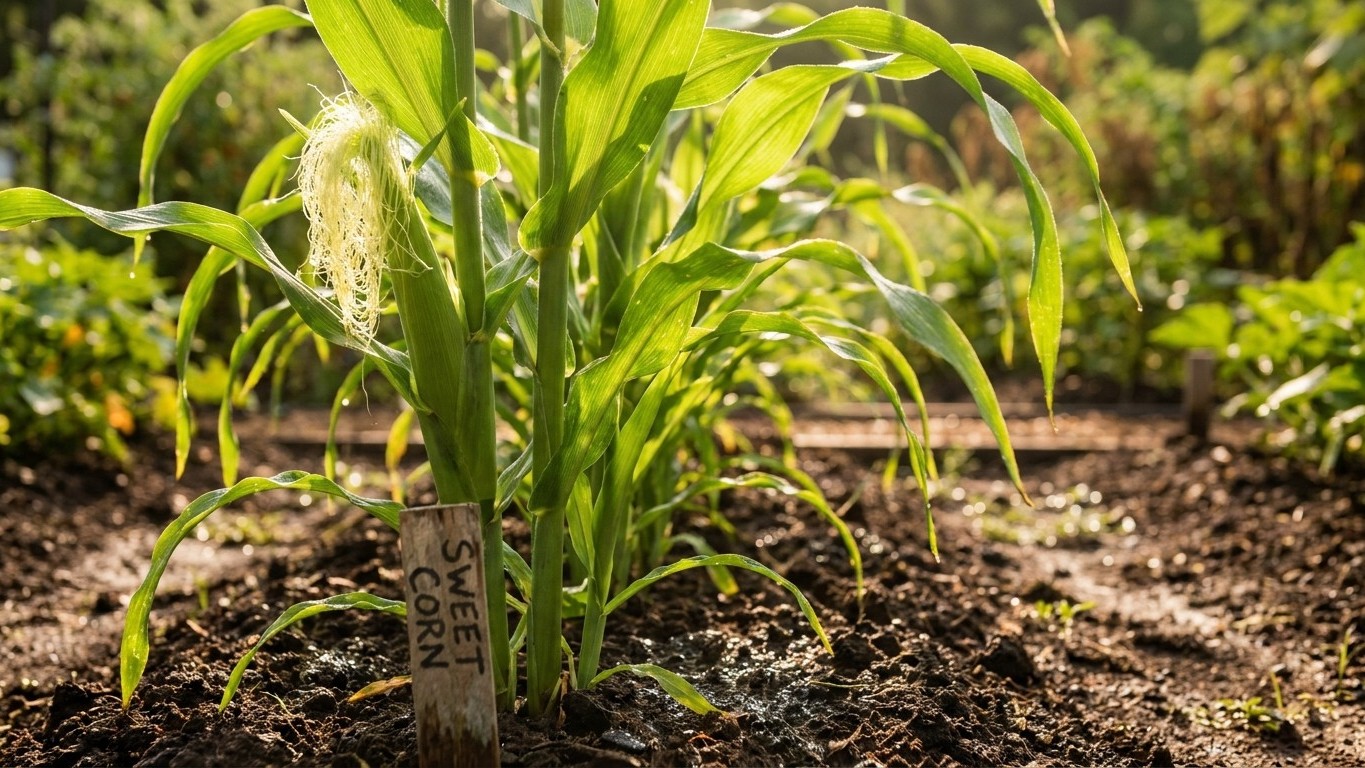

Yes, sweet corn will ripen in most of Missouri in a normal season, but the calendar that decides it isn’t the frost date, it’s how fast the soil warms and how many days sit between that warm-up and the first fall frost. Last spring frost typically falls April 6 to April 20, first fall frost October 18 to October 29, but sweet corn seed doesn’t care about frost-free ground. It wants soil above 60 F, a threshold that arrives well after frost has already cleared.
The short answer
Frost date and planting date are not the same day, and mixing them up is the single most common mistake gardeners make with sweet corn in Missouri. NOAA’s 1991-2020 climate normals put the last spring freeze (32 F) between April 6 and April 20 across the state, with the Kansas City area station running close to that window and stations further south trending milder. Sweet corn seed germinates poorly, or rots outright, in soil that’s merely frost-free. Utah State University Extension puts the real threshold at soil temperature above 60 F, and that mark doesn’t arrive the day frost leaves. It takes weeks of settled warmth for the top few inches of a Missouri garden bed to hold steady above 60 F, which is why the safe planting window for most of the state slides into the back half of spring rather than lining up with the last freeze on the calendar.
That delay matters less than it sounds, because Missouri’s growing season is long once it starts. First fall frost, per the same NOAA normals, lands between October 18 and October 29. Even after waiting out the soil-temperature lag, gardeners are typically working with somewhere close to five months of frost-free, warm-soil growing time before autumn’s first freeze shows up. Sweet corn needs 60 to 90 days from planting to harvest, depending on variety. Stack that requirement against a five-month runway and the arithmetic works comfortably in Missouri’s favor, with weeks left over on either end.
The heat load backs that up. The reference Kansas City station averages 32.7 days a year at 90 F or hotter, per NOAA’s climate normals, meaning summer here isn’t a brief, mild stretch, it’s a real, sustained heat season that pushes soil past 60 F early enough and keeps it warm long enough for corn to finish its cycle without racing the calendar. So the short answer holds: sweet corn ripens in Missouri in a normal year, and the limiting factor isn’t whether the season is long enough. It’s getting the timing of that early soil-temperature threshold right, and not confusing a frost-free calendar with a corn-ready one.
Does a late variety fit here?
Utah State University Extension frames sweet corn’s timeline as 60 to 90 days from planting to harvest, without naming which specific varieties fall where on that spectrum. What matters for a Missouri garden is simpler: does either end of that range fit the window between soil reaching 60 F and the first fall frost arriving October 18 to October 29?
A 60-day variety
A corn that finishes in 60 days is the low-risk choice almost anywhere in the state. Planted once the soil has held above 60 F for a stretch, it reaches harvest in roughly two months, leaving the entire back half of summer and most of fall as cushion before frost. That margin matters in a state where a cool, wet spring can push planting later than a gardener intended. A short-season crop absorbs that delay without ever threatening to run into October’s freeze. It also sidesteps the heaviest stretch of Missouri’s summer heat load. With the Kansas City reference station averaging 32.7 days a year at 90 F or above, a fast-finishing planting can slip its pollination window ahead of the worst heat, when silk and pollen are less likely to suffer from sustained high temperatures.
A 90-day one
The long end of the range also fits, and it fits with room to spare. Ninety days from a soil-temperature planting date still lands well before the first fall frost across Missouri, given the roughly five months of warm-soil growing time available. Where a 90-day corn runs into trouble isn’t the calendar, it’s the heat: a planting timed so that silking coincides with a stretch of 90 F-plus days can see pollination falter, since heat stress at silk emergence is a known cause of poor, gappy ears regardless of how much season remains afterward. The fix isn’t to abandon a late variety, it’s to plant early enough within the safe window that silking falls before the hottest run of summer rather than square in the middle of it. Once silks appear, the harvest clock shifts to a different count entirely, usually 17 to 24 days from silk emergence, a separate figure from the 60-to-90-day planting-to-harvest span and not one to confuse with it. Ripeness itself is confirmed by three signs together, not one: dry, browned silks, husks still moist and green, and milky (not clear, not pasty) juice from a punctured kernel.
What goes wrong here
Three failures account for most of the disappointing sweet corn patches in Missouri gardens, and only one of them has anything to do with the climate described above.
- Soil sown too cold. Seed planted the week frost clears, before the ground has actually crossed 60 F, sits and rots rather than germinating, or comes up thin and uneven. The remedy is patience rather than a calendar date: check the soil itself, with a simple soil thermometer pushed a few inches down, and hold off until it reads consistently above 60 F rather than planting on the strength of a frost-free forecast alone.
- A variety too late for the season. This is rarer in Missouri than in cooler states, since the roughly five-month gap between warm soil and first fall frost gives even a 90-day corn plenty of room. It still happens when a wet spring delays planting by several weeks and a gardener sticks with a long-season variety anyway, eating into the cushion that would otherwise protect the crop. The remedy is to shorten the variety’s day count, not stretch the season, whenever planting slips later than intended.
- Sweetness lost because two types tasselled together. This one has nothing to do with soil temperature or frost dates. Standard (su), sugary-enhanced (se) and supersweet (sh2) sweet corn types cross-pollinate freely, and when their tassels shed pollen at the same time, the se or sh2 ear ends up starchy instead of sweet. Utah State University Extension gives no isolation distance for this, so the fix isn’t measured in feet, it’s measured in timing and layout. Stagger planting dates so the types don’t tassel in the same window, or grow only one type per season, and plant in blocks of three or more rows rather than a single thin row, since block planting improves pollination on top of guarding against unwanted crosses.
Common questions
When should I actually plant sweet corn in Missouri?
Not on the last frost date itself. Wait until the soil, checked with a thermometer a few inches down, holds consistently above 60 F, which typically comes some weeks after the last spring freeze (April 6 to April 20 per NOAA normals). Planting on a frost-free forecast alone, before the soil has actually warmed, is the most common cause of poor germination.
Can a 90-day variety really ripen before frost in Missouri?
Yes. With soil-warmed planting typically well ahead of the first fall frost (October 18 to October 29 per NOAA normals), the state’s frost-free window comfortably covers the full 60-to-90-day range Utah State University Extension describes. The bigger risk for a long-season variety is summer heat during silking, not running out of days before frost.
Does Missouri’s summer heat hurt sweet corn?
It can, at a specific moment. The Kansas City reference station averages 32.7 days a year at 90 F or hotter. If silk emergence lands during one of those heat stretches, pollination often suffers, leading to gappy, unevenly filled ears. Timing planting so silking falls before the hottest weeks helps avoid it.
How do I know when to pick, once the ears look ready?
Check three signs together, not just one: the silks should be dry and browned, the husks should still be moist and green, and juice from a punctured kernel should run milky rather than clear or pasty. Once silks first appear, harvest generally follows in about 17 to 24 days, a separate count from the 60-to-90-day planting-to-harvest span.