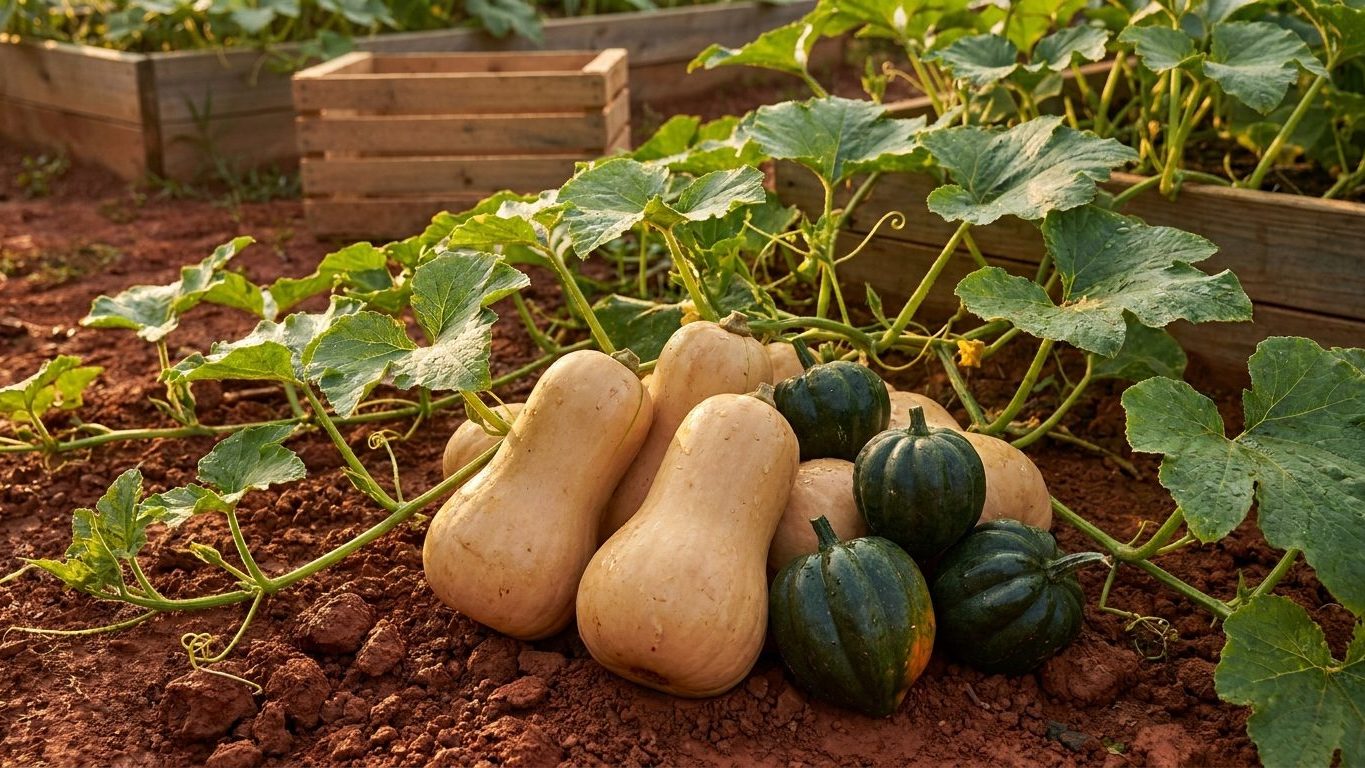

For Missouri gardens, the winter squash that consistently perform best are butternut, acorn, delicata and spaghetti squash. All four finish comfortably inside the state’s frost-free window and shrug off the summer heat that Missouri reliably delivers. Large trailing types like hubbard and giant pumpkin-squash hybrids are the ones that struggle, not from lack of time, but from what the peak of a Missouri summer does to their vines and their fruit set.
The short answer for Missouri
Missouri’s frost dates give the state a growing season that runs roughly 181 to 206 days, depending on where you sit inside the NOAA 30-70% probability band: last spring freeze between April 6 and April 20, first fall freeze between October 18 and October 29 (measured at the Kansas City-area reference station, with downtown Kansas City running about five days earlier in spring and southern Missouri milder still). That’s a generous window. Almost every winter squash sold in seed catalogs, whether it needs 80 days or 115, has time to mature before a hard freeze anywhere in the state.
So the decision isn’t really about time. It’s about what a squash has to survive to use that time well. Missouri averages 32.7 days a year at or above 90°F, concentrated in July and August, exactly when squash vines are flowering and setting fruit. Heat that intense causes pollen to go sterile and female flowers to abort, especially on varieties bred for cooler, shorter summers. And summer rainfall, about 14.1 inches across June, July and August, with August the driest month at 4.24 inches, tends to arrive as thunderstorm bursts rather than steady soaking rain. That combination of heat stress and irregular moisture is what separates the winter squash that thrive here from the ones that limp along.
| Type | Typical maturity window | How it handles Missouri heat and rain |
|---|---|---|
| Butternut | Mid-season | Tolerates heat well; thick skin resists August drought stress |
| Acorn | Shorter-season | Sets fruit quickly, often ahead of the worst July heat |
| Delicata | Shorter-season | Compact vines, easier to keep evenly watered |
| Spaghetti squash | Mid-season | Reliable fruit set even with erratic rainfall |
| Hubbard / giant types | Longer-season | Sprawling vines struggle with heat-driven flower drop and mildew |
Bush and semi-vining varieties of butternut and acorn also make sense for smaller Missouri lots, since they cut down on the sprawling vine mass that catches humidity and holds it against the leaves.
What will not work here
The clearest failure pattern in Missouri gardens is the long-vined, long-season squash planted with the assumption that a six-month growing season means unlimited room to work. It doesn’t. A hubbard or giant pumpkin-squash type that needs a long stretch of steady conditions to set fruit runs straight into the state’s 32.7 days of 90-degree-plus heat right in the middle of its flowering period. Pollen viability drops sharply in sustained heat, and a plant that aborts its first two or three flushes of female flowers may not get another good shot before the mid-October frost line closes in.
Watering on a fixed weekly schedule is the second common failure, and it’s a rainfall problem more than a heat problem. Missouri’s summer rain isn’t spread evenly: 5.25 inches in June, dropping to 4.58 in July and down to 4.24 in August, the driest month of the growing season and also one of the hottest. When that rain falls as a single thunderstorm, most of it runs off a dry, sun-baked garden bed rather than soaking down to the root zone. A gardener watering once a week on the calendar, rather than checking the soil, will find vines wilting by early afternoon in August even though the month’s rainfall total looks reasonable on paper.
Tight spacing is the third trap, and it interacts with the other two. Squash planted close together to save space holds humidity around the leaves after a thunderstorm rolls through, and that damp, still air is exactly what powdery mildew needs. Varieties with dense, sprawling foliage, again the hubbard and giant types, are the most exposed, because their leaf canopy blocks the airflow that would otherwise dry out quickly in Missouri’s heat. None of this means those varieties are impossible to grow in Missouri gardens. It means they need more room, more attention to soil moisture by feel rather than by schedule, and realistic expectations about flower drop during the hottest stretch of July and August.
What changes across Missouri
Missouri spans USDA Hardiness Zones 5b through 7b, a two-zone spread built on one measurement: the average annual extreme minimum temperature. That’s a wide range for a single state, and it means there is no one answer to “when does my squash season start and end” that applies from the Iowa border to the Arkansas line.
A gardener in the colder 5b pockets of northern Missouri is working with a later last frost and an earlier first frost than the state’s reference station reflects, which trims real growing days off both ends of the season. That’s the situation where a shorter-season acorn or delicata makes more sense than a 100-plus-day hubbard, simply because there’s less margin if a wet spring delays transplanting. A gardener in the warmer 7b areas of southern Missouri gets the opposite deal: a longer, milder shoulder season on both ends, which gives more room for slower-maturing types and a longer window to try a second succession planting if an early crop fails to set fruit.
The reference station behind the frost-date figures used here sits well north of downtown Kansas City, and even inside that one metro area the difference matters: the downtown station runs about five days earlier in spring than the airport reference station. Multiply that kind of local variation across a state the size of Missouri, with river bottoms, ridgetops and urban heat pockets all doing their own thing, and it’s clear a single statewide planting date is a starting point, not an instruction. This page can tell you what tends to work across Missouri’s zone range. It can’t tell you which zone your own yard sits in, and a few miles or a few hundred feet of elevation can move that answer more than you’d expect.
Where to check this for your own county
The University of Missouri Extension keeps the local numbers: county-specific planting calendars and lists of the winter squash varieties actually trialled in Missouri growing conditions, not just what performs well somewhere in the general zone 5b-7b range. That’s available at extension.missouri.edu.
Once there, look for two specific things. First, the county-level planting calendar, which will reflect the real local frost pattern rather than the statewide 30-70% probability band used here. A county in the Bootheel and a county on the northern border can be genuinely two or three weeks apart on safe transplant dates, and the extension office serving your county has worked that out from decades of local data, not a single reference station. Second, look for any variety trial results or recommended cultivar lists specific to your region. Missouri State University and the University of Missouri both run horticulture research plots, and county extension offices often pass along which butternut, acorn or spaghetti squash cultivars actually held up against local disease pressure and local rainfall patterns in real trial years.
A county recommendation will always beat a state-level one, for the simple reason that it’s built on your soil type, your local rainfall pattern and your actual frost history rather than a statewide range spanning two hardiness zones. This page is the state-level starting point: useful for understanding why butternut generally outperforms hubbard in Missouri conditions, but not a substitute for what your county extension office has already measured on the ground. If you’re deciding between two similar varieties, or trying to pin down a transplant date within a week or two, that’s the call to make before you buy seed.
Checking this against your own garden
Every date and average in this article describes a reference station, not your backyard, and your own garden will tell you more than any calendar once the season actually starts. Three things are worth watching directly.
Soil warmth by feel is the first. Press a bare hand a few inches into the planting bed in mid-spring; winter squash seed wants soil that feels warm, not just frost-free, since cold, wet soil rots seed before it ever sprouts. If the ground still feels cool and damp well after the average last frost date has passed for your area, that’s your own microclimate running behind the regional pattern, and it’s worth waiting rather than planting on the calendar alone.
The first flush of male flowers is the second signal. Squash plants typically produce male flowers before female ones, and a strong early flush tells you the plant has settled in and is building toward fruit set. If male flowers show up but stall out for weeks without any female flowers following, especially during a hot stretch, that’s a sign the heat is suppressing fruit set on your plants right now, regardless of what the seasonal averages say should be happening.
True leaves are the third. The first set of true leaves, distinct from the rounded seed leaves that appear first, shows whether the plant is actually establishing a strong root system or just limping along on stored seed energy. Slow, pale true-leaf growth after transplant usually points to either cool soil or uneven watering, both of which are easier to fix in the first few weeks than after the vines have sprawled across the bed.