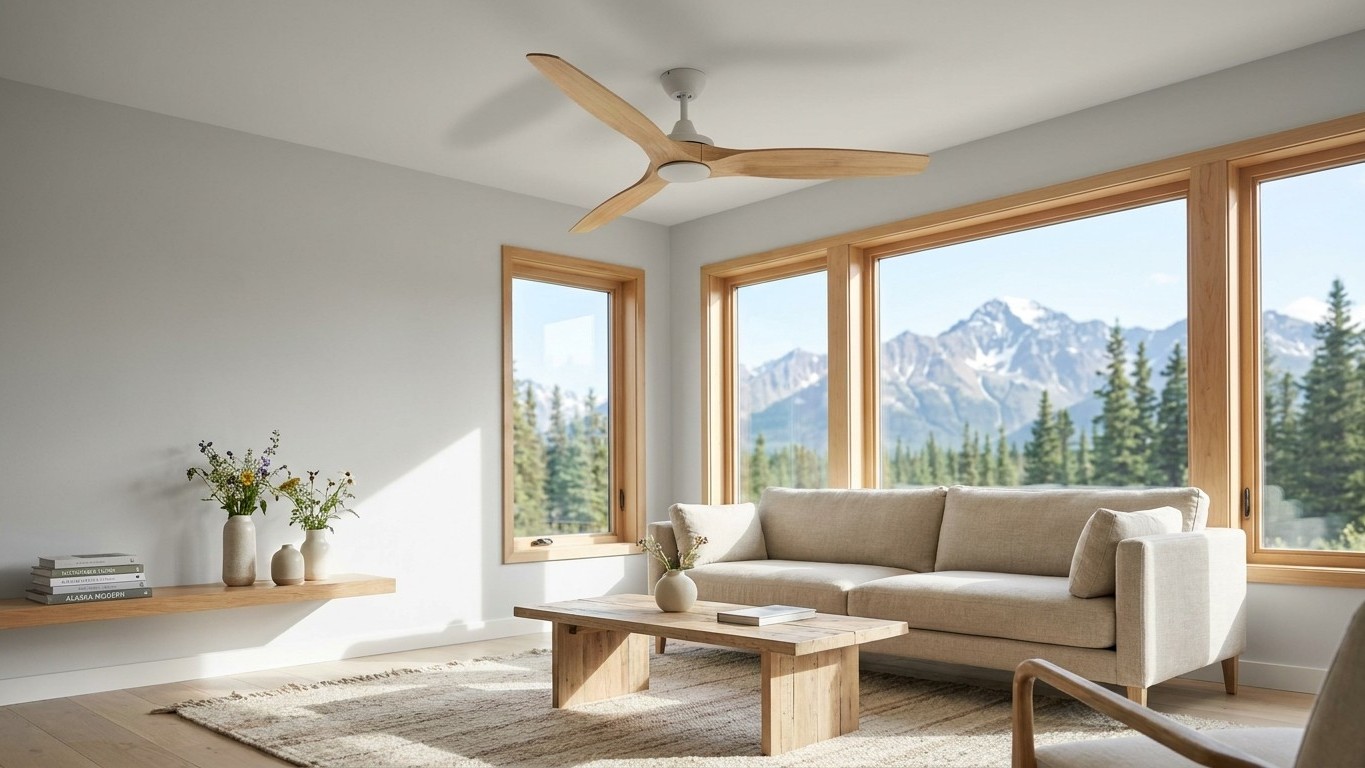

Nevada homes cool overwhelmingly with central air conditioning, but the number hides a real split. Ninety-two percent of homes here use some form of air-conditioning equipment, seventy-eight percent run a central unit, and fourteen percent rely on individual equipment: a ductless mini-split, a window or wall unit, or a portable. Ceiling fans turn up in seventy-seven percent of homes too. What follows is why that mix looks the way it does, and what it means for upkeep.
What homes in Nevada actually cool with
Start with the numbers as the survey publishes them: 92% of Nevada homes use air-conditioning equipment, 78% use a central air-conditioning unit, and 14% use an individual unit, meaning a mini-split, a window or wall unit, or a portable. Ceiling fans sit at 77%, which tells you air movement is doing real work alongside the compressor in a lot of houses, not just spinning for looks.
The gap between the first two figures, 92% with air conditioning against 78% on a central system, is the share of homes running on individual equipment. In Nevada that gap is 14 points, and it lines up almost exactly with the 14% figure the survey reports directly for individual units. That is not always how it works nationally. The U.S. Energy Information Administration’s Residential Energy Consumption Survey shows some states where the story is nearly all central, and others where it is not close.
| State | Has air conditioning | Has central air |
|---|---|---|
| Nevada | 92% | 78% |
| Alabama | 94% | 81% |
| Connecticut | 90% | 34% |
Connecticut has air conditioning in 90% of its homes but a central system in only 34% of them, meaning most Connecticut homes with cooling are running window units or mini-splits, not ducted systems. Nevada sits closer to Alabama’s pattern: high adoption of air conditioning generally, and most of that adoption running through a central system. That split is not a matter of taste. A share like this reflects what was affordable and what made sense when the housing stock went up, and in a fast-growing state built largely in the era of production-home central AC, that shows in the data.
It is worth being precise about what a “Q” would mean if you saw one in this kind of table: a sample too small for the survey to publish a reliable figure, never a zero. Nevada does not carry a Q on either the air-conditioning or central-air line, so the figures above stand as published, not as approximations.
How much cooling the year actually asks for
The heat load figure for Nevada, drawn from NOAA’s 1991-2020 Climate Normals at the Las Vegas reference station, is 131.3 days a year reaching 90°F or more. That is a count of days at one weather station, not a statewide average and not a measure of how hot those days actually get. It is the number that drives how hard cooling equipment has to work and for how long, season after season.
The reason this figure matters here is that it does not always match the equipment mix in a given state. A state can rack up plenty of hot days and still lean on individual units because the houses were built before central systems were standard, or because retrofitting ductwork into an older home costs more than adding a window unit or a mini-split. The reverse happens too: a milder state can be almost entirely central because the housing stock is newer and ducted systems went in from the start.
Where Nevada lands
Nevada is one of the states where the two figures point the same direction. A heat load of 131.3 days a year at 90°F or above is substantial, among the higher counts reported anywhere in the Climate Normals dataset, and the equipment mix matches that reality: 78% of homes run a central system, the kind built to handle sustained, day-after-day cooling rather than the occasional hot afternoon. The 14% on individual equipment likely covers additions, rentals, and older or smaller dwellings rather than representing a state-wide alternative to central air. When heat load and equipment mix line up like this, it is a sign the housing stock was largely built, or substantially retrofitted, with the local climate in mind rather than against it.
Wet heat or dry heat, and what it changes
Summer rainfall at the same reference station averages about 0.7 inches across June, July, and August combined, against 4.2 inches for the full year. June is the driest month of the three, at just 0.04 inches, with July at 0.38 inches and August at 0.32 inches. That is a measurement of precipitation, not of humidity or dew point, and Nevada’s summers read as dry by that measure, not merely mild on rain.
The mechanism that matters here is simple but easy to miss: an air conditioner does two jobs at once. It lowers air temperature, and it pulls moisture out of the air as that air passes over a cold coil. Removing moisture takes run time, because water has to condense out gradually rather than all at once. In a summer this dry, the moisture-removal side of the job is small to begin with, so most of the equipment’s work is straightforward temperature reduction. That is a very different situation from a humid-summer state, where a large share of every cooling cycle goes toward wringing water out of the air, and where an oversized unit can leave a room cold and clammy because it satisfies the thermostat before it has run long enough to dehumidify.
In a dry climate like Nevada’s, oversizing is still wasteful, but the failure mode looks different: short cycling wears on the compressor and drives up energy use without the clammy side effect a humid state would show. Given that, three things are worth prioritizing:
- Run time over short bursts: let equipment cycle for longer stretches at a moderate setting rather than blasting and shutting off, since dehumidification is a minor factor here and the main gain is just steady temperature control.
- Fan setting on “auto,” not “on,” for central systems: continuous fan operation in a dry climate mostly just moves already-dry air around without a comfort payoff.
- Correct sizing over margin: a system sized to the space, not oversized “to be safe,” avoids the short-cycling pattern common in hot, dry states with large temperature swings between day and night.
These are normals for the reference station over 1991-2020, not a forecast, and a given yard or block can run drier or wetter depending on elevation, slope, or shade. A rain gauge on the actual property is what settles it for gardening purposes, though for cooling equipment, the state-level pattern of dry summers holds fairly consistently across most of Nevada’s populated valleys.
Sizing a room unit, from the published chart
For anyone relying on a window unit, wall unit, or portable, which describes the equipment behind that 14% figure, ENERGY STAR publishes a straightforward starting chart matching room area to cooling capacity in BTU per hour:
| Area to be cooled (square feet) | Capacity needed (BTU per hour) |
|---|---|
| 100 up to 150 | 5,000 |
| 150 up to 250 | 6,000 |
| 250 up to 300 | 7,000 |
| 300 up to 350 | 8,000 |
| 350 up to 400 | 9,000 |
| 400 up to 450 | 10,000 |
| 450 up to 550 | 12,000 |
| 550 up to 700 | 14,000 |
| 700 up to 1,000 | 18,000 |
| 1,000 up to 1,200 | 21,000 |
| 1,200 up to 1,400 | 23,000 |
This chart is a starting point published by ENERGY STAR for a single room unit. It is not how a central system gets sized, and it should not be treated as one; a central system is sized through a load calculation that accounts for the whole house, its insulation, windows, and ductwork, not a single room’s square footage. In a state where 78% of homes run central air, that distinction matters more than it might elsewhere, because the temptation to eyeball a central system using a room-unit chart leads to real mistakes.
Where this chart earns its keep in Nevada is with that 14% running individual equipment. An oversized unit here is not a safety margin, it is a fault: it cools the room quickly, shuts off, and never runs long enough to do the secondary work of pulling moisture out of the air, leaving the space cold in bursts rather than evenly comfortable. In a dry climate that dehumidification issue is less pronounced than it would be in a humid one, but the short-cycling and wasted energy remain, so matching the unit to the room using this table, rather than sizing up “just in case,” is the more reliable approach.
What actually needs looking after here
With 78% of Nevada homes running central air, the maintenance that matters most here centers on ducted systems, though the basics apply across every type of equipment. ENERGY STAR is direct about the single highest-value habit: “Inspect, clean, or change air filters once a month in your central air conditioner, furnace, and/or heat pump.” That is a monthly task, not a seasonal one, and it covers all three pieces of equipment together, which matters for anyone assuming filter care is only a furnace chore.
Skipping that habit has a measurable cost. ENERGY STAR notes that “airflow problems can reduce your system’s efficiency by up to 15 percent,” which means a unit can be running, cooling, and showing no obvious fault while still quietly underperforming because of something as simple as a clogged filter restricting airflow.
For the majority of Nevada homes on central systems, there is a second issue worth checking that a window-unit household never has to think about: the ductwork itself. ENERGY STAR states that “in a typical house, however, about 20 to 30 percent of the air that moves through the duct system is lost due to leaks, holes, and poorly connected ducts.” That is air, and the cooling paid for, disappearing into an attic or crawlspace before it ever reaches a vent, which is why a system in good working order can still leave certain rooms warmer than the thermostat suggests they should be.
A practical seasonal pass, given Nevada’s mix of mostly-central equipment and a long, hot cooling season, looks like this:
- Check or replace the filter on a monthly schedule through the cooling season, for central systems, mini-splits, and window units alike.
- Have ductwork inspected for leaks and poor connections before the hottest stretch of the year, since Nevada’s 131.3 days above 90°F leave little room for a system losing a fifth to nearly a third of its output before it reaches the vents.
- Confirm the thermostat fan setting is on “auto” rather than continuous “on,” which suits the state’s dry summers better than constant air movement.
- For any room relying on individual equipment, recheck sizing against the ENERGY STAR chart before replacing a unit, rather than defaulting to a larger capacity.
For equipment-specific detail, the guides on central air conditioners, mini-splits, and window units on this site go deeper into installation and troubleshooting for each type.