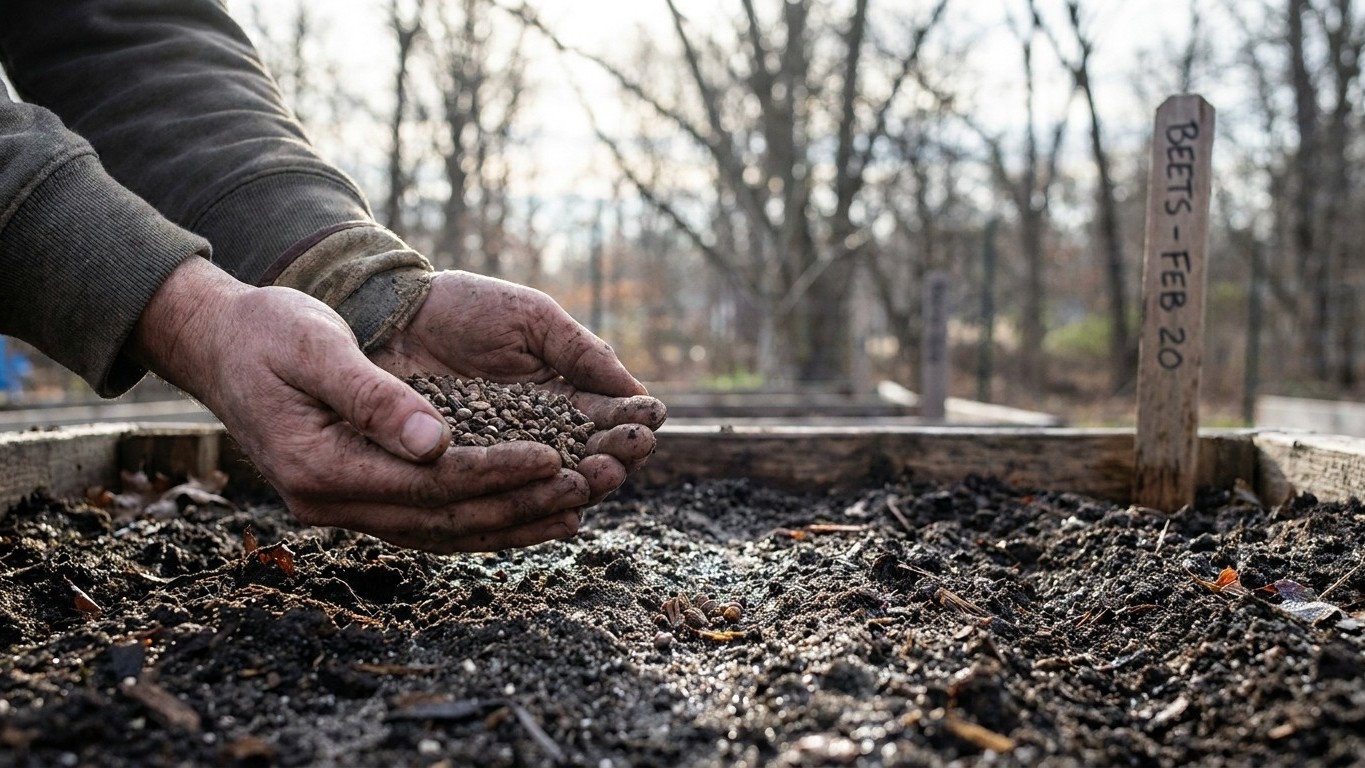

Nevada’s answer depends more on elevation than on any calendar page. In the low desert valleys around Las Vegas, gardeners get into the ground weeks, sometimes months, before growers in Reno or Carson City even think about it. The rule stays the same everywhere in the state: sow beet seed directly in the ground 2 to 3 weeks before your local last frost date, so the first six weeks of growth land in cool, steady soil rather than a heat spike. Your county extension office holds the actual date for your yard.
The short answer
What the state soil tells you
Nevada’s official state soil, the Orovada series, is an Aridisol, the kind of dry-climate soil that tends toward alkaline and often carries salts near the surface. Sampled across 223 components in the USDA’s soil survey database, the surface horizon runs about pH 7.5, which is alkaline, and it’s sandy: 66 percent sand, 8 percent clay, and 26 percent silt, with organic matter around 1.4 percent. It drains well.
For a beet, that combination cuts two ways. Utah State University Extension notes that beets want deep, sandy, well-drained soil rich in organic matter, and Orovada matches the sand and drainage part almost exactly. What it doesn’t match is the organic-matter target: 1.4 percent is thin, and thin organic matter means the soil holds less water between irrigations. That’s the detail that matters for the six weeks that follow sowing, because a beet under water stress in that window tends to flower early instead of building a root.
What this page can’t tell you
Nevada’s climate splits sharply by elevation, from desert valley floors to mountain-basin towns, and no single figure for days above 90 F applies to the whole state. That number isn’t published in the data behind this page, so it would be a guess to print one. What is documented is the mechanism: Utah State University Extension states that heat above 85 F combined with water stress is what turns a beet root woody, and Nevada’s range of elevations means some gardens hit that threshold constantly in summer while others at altitude may barely see it. Treat the Orovada figures as a starting point, not a diagnosis. Nevada spans hundreds of mapped soil series, and a garden a mile from a river bottom, or one built on fill dirt, can differ from Orovada completely. A soil test is the only way to know your own numbers.
The six weeks that decide it here
A frost date that only fits one corner of the state
NOAA’s 30-year climate normals put the last spring freeze at the Las Vegas airport between January 7 and February 1, based on the 30 to 70 percent freeze-probability band. That’s an extreme low-desert reading shaped by urban heat, and it is not usable as a Nevada-wide planting guide. Reno, Carson City, and anywhere at elevation see frost months later in spring, and again months earlier in fall, than that Las Vegas window suggests. If you garden outside the low desert basin, that January date will mislead you badly. County extension offices track the local figure; this page can only describe the pattern, not hand you a single number for the whole state.
What spring tends to do once seed is in the ground
Sowing 2 to 3 weeks ahead of the local last frost lands the first six weeks of a beet’s life squarely inside Nevada’s spring, and that season in most of the state runs dry. Low annual precipitation and frequent wind are common across Nevada’s desert and high-desert basins, and both pull moisture out of a sandy, low-organic-matter surface like Orovada faster than they would from heavier ground. That’s the setup Utah State University Extension is describing when it warns that water stress in the first six weeks pushes a beet toward premature flowering, called bolting. The risk in Nevada isn’t a wet spring drowning young seedlings; it’s a dry, windy one letting the root zone dry out between waterings before the plant has built enough root to buffer it. That’s a different problem from the woodiness that shows up later, when established roots meet sustained heat above 85 F under water stress. One happens at the seedling stage from thirst; the other happens closer to harvest from heat. Confusing the two leads to fixes that solve the wrong problem.
What goes wrong here
- Beds dry out between waterings and beets bolt. Sandy, well-drained, low-organic-matter ground like the Orovada profile sheds water quickly, and Nevada’s dry, windy spring pulls what’s left out of the top few inches fast. The fix is a steady watering schedule through the first six weeks after sowing, not just watering when the surface looks dry, plus mulch to slow evaporation.
- Thin organic matter starves the root of what it needs to bulk up. At roughly 1.4 percent organic matter, Orovada-type ground has little reserve. Utah State University Extension’s guidance caps the fix at no more than 1 inch of composted organic matter per 100 square feet worked into the bed before sowing; more than that isn’t recommended.
- Alkaline, salt-prone soil limits nutrient uptake. A surface pH near 7.5, common in Aridisols like Orovada, can tie up certain nutrients beets need. A soil test for your specific garden, not the statewide series figure, tells you whether amendment is actually needed.
- Heat spikes late in the season turn mature roots woody. This is separate from early bolting: it happens when temperatures push past 85 F while the root is already water-stressed, a real risk in Nevada’s lower-elevation valleys through summer. Consistent irrigation through the whole growing period, not just the first six weeks, is the remedy.
- Using a low-desert frost date in a high-elevation garden. Applying a Las Vegas-area window to a Reno or Carson City garden risks sowing far too early into ground that’s still freezing. Confirm the local last-frost date with your county extension office before counting backward 2 to 3 weeks.
Common questions
Can I use the Las Vegas frost date for the rest of Nevada?
No. NOAA’s January 7 to February 1 window applies to the Las Vegas airport specifically, an extreme low-desert, urban-heat-shaped reading. Higher-elevation towns like Reno and Carson City freeze later in spring and earlier in fall, sometimes by months. Check with a local county extension office for your actual last-frost date.
How long do beets take to mature once sown?
Beets are direct-seeded, not transplanted, and the maturity window runs from the day seed goes in the ground, not from any seedling stage. Count your harvest target from sowing, not from a transplant date, when planning around Nevada’s frost windows.
Does the Orovada soil series describe my actual garden?
Not necessarily. Orovada is Nevada’s designated state soil, a representative Aridisol used to describe how the region’s ground tends to behave: sandy, alkaline, well drained, low in organic matter. Nevada maps hundreds of distinct soil series, and river-bottom ground, hillside ground, or anything a builder has graded or filled can differ entirely. A soil test is the only accurate reading of your own bed.
What’s the difference between bolting and woody roots?
They’re two separate failures with two separate causes. Bolting happens early, when water stress in the first six weeks after sowing pushes the plant to flower instead of growing a root. Woodiness happens later, when established roots face temperatures above 85 F combined with water stress. Watering consistently through the entire season, not just the early weeks, addresses both.