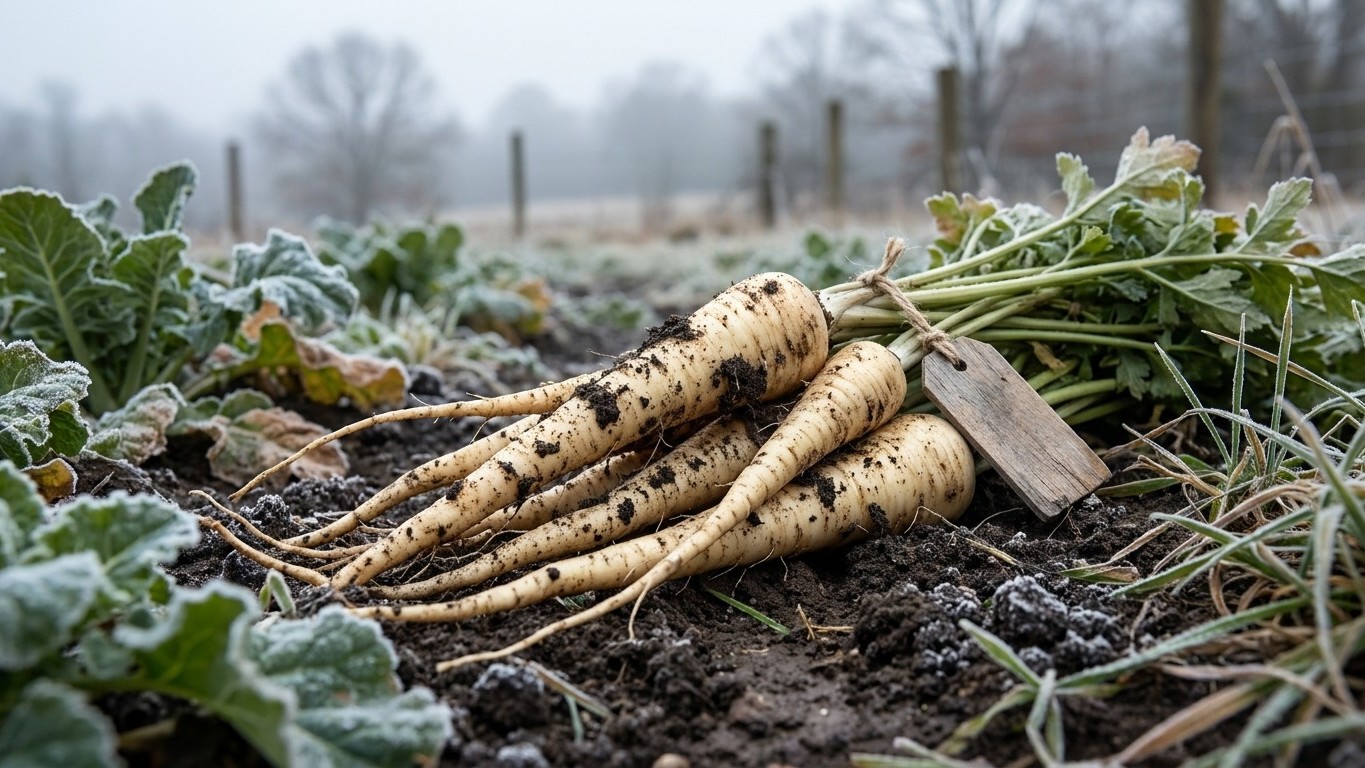

Nevada splits into two very different growing worlds for parsnips. Down in the low desert around Las Vegas, NOAA’s 1991-2020 climate normals put the coldest month’s mean daily minimum at 39.6°F, a reading that signals a mild winter rather than the sustained frost exposure parsnips need to turn starchy roots sweet. Head up toward Reno, Carson City, or any higher valley, and the cold arrives sooner, stays longer, and likely changes that answer, though the figures for those spots aren’t published here.
The short answer
The question that actually decides this isn’t how cold Nevada gets on its coldest night. It’s whether the territory delivers several consecutive frosty weeks, the kind that stress a parsnip root enough to break down stored starch into sugar. The reference station data available for this state, drawn from the Las Vegas area, puts the mean minimum of the coldest month at 39.6°F. That’s a monthly average of overnight lows, not a record cold snap, and 39.6°F sits comfortably above freezing.
What that means in practice: a mean minimum above 32°F tells you the coldest month, on balance, isn’t spending most of its nights below freezing. Frost still happens in a desert valley like this one, but it’s not the dominant, weeks-long condition that pushes a parsnip past “edible” into “sweet.” A root grown in that kind of winter will size up fine, cook up fine, and taste like a decent parsnip. It won’t have the deep, almost caramelized sweetness that gardeners in colder climates get after a hard freeze or two.
This is where the hardiness zone gets confused with frost exposure, and the two aren’t interchangeable. A zone tells you whether a perennial plant survives winter where you live. It says nothing about how many hard-frost nights your vegetable bed actually experiences, and that frost count is the only thing that sweetens a parsnip. Nevada’s low desert can carry a warmer zone rating while still getting the occasional dip below freezing, and neither number alone answers the sweetening question. Only the accumulated frosty weeks do.
So for the reference conditions this page has numbers for, the honest answer leans toward “grows well, sweetens only lightly.” A parsnip left in Las Vegas-area ground through the coldest weeks will likely see some frost, just not the sustained run of cold that heavier-winter regions provide. Gardeners in Nevada’s colder valleys, at higher elevation, are working with a different winter entirely, one this dataset doesn’t quantify. If that’s your area, the general pattern (more elevation, more cold, more sweetening potential) holds, but the specific mean minimum for your county isn’t part of the record cited here. A call to your county extension office fills that gap with a number specific to your ground.
Does the season fit?
Parsnips are sown directly in the ground where they’ll grow, not started indoors and transplanted, and the clock that matters runs from that seeding date, not from germination or from any later thinning. Utah State University Extension puts full maturity at 100 to 120 days from seeding, with the recommended sowing window falling 2 to 3 weeks before the last expected spring frost. Stack that against a Nevada frost calendar and here’s how the arithmetic works out.
- Start with the frost window, not the calendar date. NOAA’s 1991-2020 normals for the Las Vegas reference station put the last spring frost between January 7 and February 1, and the first fall frost between December 8 and December 23. Those numbers describe an unusually mild desert urban-heat-island site and should not be read as a Nevada-wide planting guide, since Reno, Carson City, and anywhere at elevation will frost months earlier in fall and months later in spring.
- Add the 2-to-3-week head start. If a gardener in that Las Vegas-type microclimate sowed 2 to 3 weeks ahead of the January-to-February frost date, seeding would fall in mid-December to mid-January, an unusually short lag typical only of that mild desert reference point.
- Count forward 100 to 120 days. From a seeding in that window, maturity lands sometime in spring, well ahead of the following winter’s frost, which suggests the season length itself isn’t the constraint in a mild low-desert spot like the reference station.
- Remember germination eats into that window before growth even starts. Parsnip seed is notoriously slow, taking 14 to 21 days just to sprout. A gardener who doesn’t account for that stretch often assumes the seed failed and re-sows, effectively restarting the 100-to-120-day clock and pushing harvest later than planned.
- Check the fit for your actual elevation. In the mild reference conditions, the frost-free season is long enough to comfortably fit 100 to 120 days twice over. In Nevada’s colder valleys, where frost data specific to those towns isn’t part of this dataset, the window is almost certainly tighter, and a local frost date from a county extension office is the only reliable way to confirm the fit.
The practical takeaway: season length is rarely the failure point in Nevada’s low desert. The bigger question, covered above, is whether that same mild winter delivers enough frost exposure to sweeten what the season had plenty of time to grow.
What goes wrong here
- Forked roots in heavy or stony ground. Parsnips push a single taproot straight down, and anything that splits its path, compacted clay, caliche, or a bed full of rock, will fork that root into two or three thin legs. Utah State University Extension recommends deep, sandy soil, and where the native ground is heavy, double digging the bed before sowing so the root has loose soil to travel through.
- Forked roots from overwatering. This is a separate cause from soil texture, not a variation on it. Too much water, especially inconsistent heavy watering after dry stretches, can also split a developing root even in decent soil. The fix is steady, moderate moisture rather than feast-or-famine watering, particularly relevant in a desert climate where gardeners sometimes overcorrect with heavy irrigation.
- A season that runs out before maturity. This shows up more in Nevada’s colder, higher valleys than in the mild low desert. If the local frost-free window is shorter than the 100-to-120-day requirement, plus the 14-to-21-day germination lag, roots get pulled underdeveloped. Confirming actual local frost dates before sowing, rather than assuming a statewide average, is the remedy.
- A winter too mild to sweeten. In a low-desert climate where the coldest month’s mean minimum sits near 39.6°F, roots can mature fully and still taste flat, because the frost exposure that converts starch to sugar simply doesn’t accumulate. There’s no soil fix for this one; it’s a climate limit. Leaving roots in the ground through every cold snap the winter does offer, rather than harvesting early, at least captures whatever frost exposure is available.
Common questions
Do parsnips need a hard freeze to taste good?
They need repeated exposure to frosty weather, not necessarily one severe hard freeze. It’s the accumulated cold over several weeks that converts stored starch into sugar, which is why a single cold night rarely makes much difference on its own.
Can I sow parsnips indoors and transplant them in Nevada?
Utah State University Extension’s guidance describes parsnips as a direct-seeded crop, sown in place. The taproot doesn’t transplant well, so starting seed indoors and moving seedlings later isn’t the recommended approach regardless of climate.
Why haven’t my parsnip seeds sprouted after a week?
That’s normal. Germination takes 14 to 21 days, considerably slower than most garden vegetables. Digging up the bed or re-sowing before that window closes usually just delays the harvest further.
Should I harvest parsnips before winter in Nevada’s low desert?
Where winters run mild, as reflected in the 39.6°F mean minimum for the coldest month, leaving roots in the ground through whatever cold does arrive still gives the best chance at some sweetening. Pulling them early guarantees a mature but under-sweetened root.