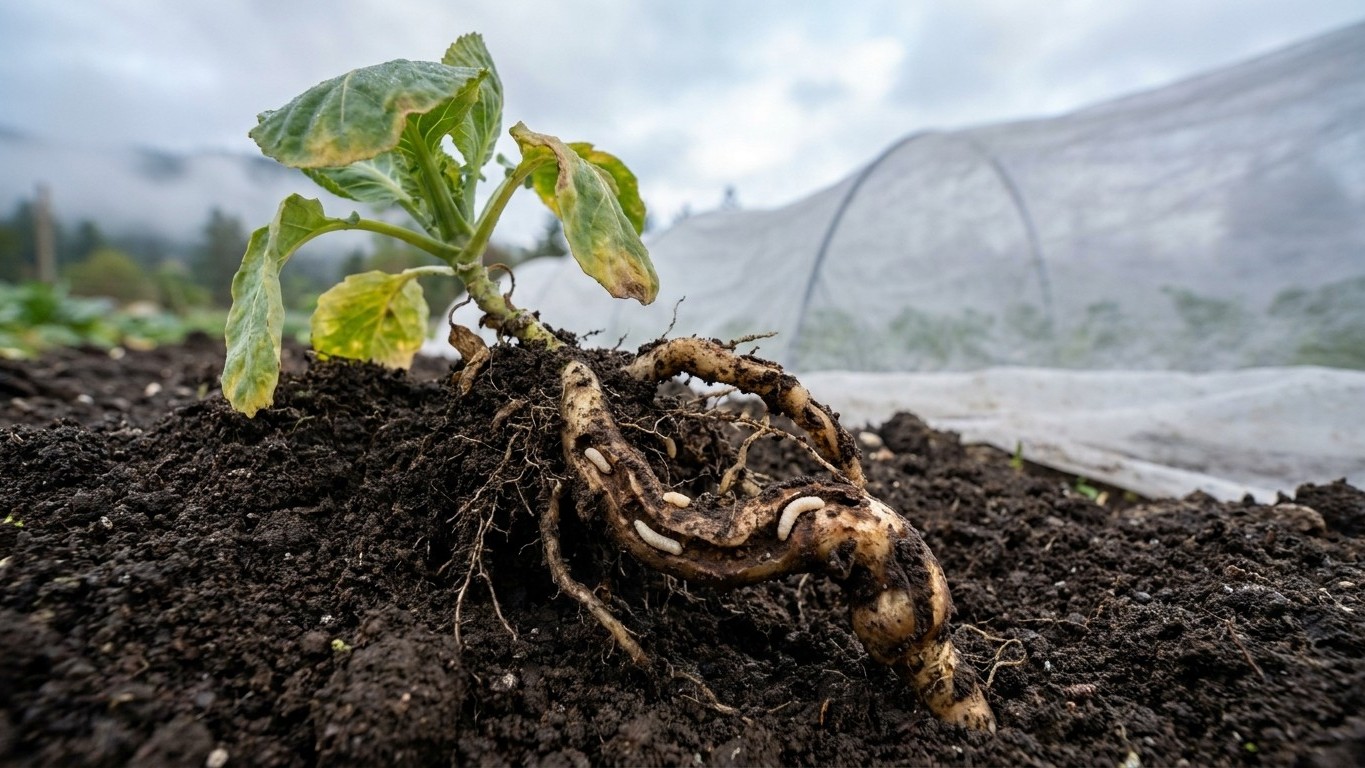

Yes, sweet potatoes can grow in Nevada, but the state is really several climates under one name. In the Las Vegas valley the crop is a routine summer job. In Reno, Carson City and the high valleys it takes plastic, ridges and an early type. Warm soil sets the planting date, not the calendar. Below are the sourced climate numbers, and where they stop applying.
When the soil is warm enough in Nevada
The only frost data this page can source comes from the Las Vegas airport, and it is a ceiling, not a recipe. NOAA’s 1991-2020 U.S. Climate Normals (station USW00023169) put the last spring 32°F freeze, in the 30 to 70 percent probability band, between January 7 and February 1. A frost date is a probability, not a promise.
Why that date is not your date
That airport sits in a desert urban heat island, which makes it the mildest corner of the state. Reno, Carson City and anywhere at elevation see their last freeze months later. The USDA Plant Hardiness Zone Map (2023 edition, built on 1991-2020 normals) runs from zone 4a to 10a across Nevada. Zones track the average annual extreme minimum temperature, so they say little about summer warmth, but the spread tells you how different the state’s gardens are. Treat January 7 to February 1 as a Las Vegas number and nothing more. Everyone else should ask their county extension office for the local last-freeze date.
Frost is only a proxy
Even a perfect frost date would answer the wrong question. Sweet potatoes come from tropical stock and sulk in cool ground. Soil lags behind air, so the ground warms after the frost risk ends, not with it. In high desert, where nights drop fast once the sun goes down, the lag can stretch for weeks. Slips set into cold soil stall, and a stalled slip is one that can rot before it roots.
The test is the ground itself. Read a soil thermometer at planting depth on several mornings in a row, since morning is the coolest the soil has been all day, and plant once the readings hold steady instead of bouncing back with each cold snap. The full method, from slips to heat to curing, is in Growing Sweet Potatoes: Slips, Heat, and a Careful Cure.
One label fix while we are here. The “yam” on a supermarket bin is a sweet potato, and neither is a true potato. It belongs to the morning glory family, not the nightshades, so it has no place in your potato rotation and shares no relatives with your tomatoes or peppers. For types that have actually been trialed in your county, your state extension service is the source (more on that at the end).
How long the season lasts here
The same Las Vegas station puts the first fall 32°F freeze, in that same 30 to 70 percent band, between December 8 and December 23. Subtract, and the frost-free stretch runs from 310 to 350 days: February 1 to December 8 at the short end, January 7 to December 23 at the long end. That is a desert ceiling. Northern and high-elevation Nevada lose months at both ends, and I cannot give you a sourced figure for those places, so ask your county extension office for the local dates.
What a long window allows
Frost-free days are not the same as warm days, and sweet potatoes count only the warm ones. Even so, the southern valleys have room that most of the country never sees. A gardener there can stagger two plantings of slips instead of betting everything on one. The second planting spreads out the harvest, or covers for a first batch that stalled in a late cold snap. The succession sowing guide on this site explains how to space those plantings.
A failed slip also costs little when the window is that long. You pull it, buy or grow another, and you have lost a week.
What a short window changes
Higher up, the first planting is the only planting. That changes the math on transplanting. When you have no time for a redo, every slip needs a root check before it goes in the ground: look for firm, pale roots, and discard anything slimy, dark or shriveled. A weak slip in a short season costs you the whole crop, not a week. Gardeners in Wyoming face the same arithmetic, and Growing Sweet Potatoes in Wyoming shows how a short window reshapes the whole plan.
The other end of the window matters too. Frost kills the vines, and a cold snap can damage roots still in the ground. Where fall freezes come early, plan the harvest ahead of the first hard freeze, and keep an eye on the forecast once nights start dropping.
Heat and water in Nevada
The Las Vegas reference station averages 131.3 days a year at 90°F or more (NOAA NCEI Climate Normals 1991-2020). That figure measures heat load, not the average summer temperature, and it is a count at one station, not a portrait of the state. Sweet potatoes want accumulated warmth and warm nights, not just warm days. Where the count runs that high, the crop is routine. Where it runs low, growing it becomes a project.
Where the heat runs short
Northern valleys and high ground have far fewer hot days and much cooler nights, and I have no sourced figure to put on that. What a cool summer brings instead is slow root set, slow ripening and small roots at harvest. If a cool spell turns damp as well, mildew and rot follow. The standard workarounds are clear or black plastic laid over the bed to warm the soil ahead of planting, raised ridges that drain and heat faster than flat ground, and the earliest type you can find. Do not copy a southern Nevada schedule to Reno and expect it to work.
Rain that barely counts
At that same station, summer brings about 0.7 inches of rain across June, July and August, out of 4.2 inches for the whole year. Month by month it runs June 0.04 inches, July 0.38, August 0.32 (NOAA NCEI Monthly Climate Normals 1991-2020). June is nearly bone dry. These are normals for one reference station over 30 years, not a forecast and not your garden, and a slope, a rain shadow or a city block can change them.
In practice, water is whatever comes out of your irrigation line. Even the rain that does fall tends to arrive as a single thunderstorm, and on hard, hot ground most of that runs off instead of soaking in. What the ground does with water depends on the soil: a sandy bed drains within the day and may need water often, while clay holds it for a week. With so little rain, the hose sets the rhythm. Roots that swell steadily need even moisture, and a long dry stretch followed by a heavy soaking is the classic recipe for splitting. Drip lines on a timer beat the sprinkler for that reason. A rain gauge and a finger pushed into the soil on your own plot will tell you more than any regional average.
Which sweet potatoes suit Nevada
Choose by type, and let the state’s own facts steer. In the hot southern valleys, heat itself is not the problem. Look for types that put out vines vigorous enough to shade the soil over the roots, and give them room for airflow. In the north and at elevation, the season is the limit, so the earliest-maturing types come first, paired with plastic and ridges. Disease resistance leads the list in humid places. Growing Sweet Potatoes in Tennessee shows why. Nevada’s dry air makes it a lower worry, but clean, disease-free slips are still worth the effort.
This page names no varieties, and that is deliberate. Cultivar names only mean something when a local trial stands behind them, and I have no Nevada trial data to cite. A name lifted from a list written for another state, in a state that spans zones 4a to 10a, would be a guess. The University of Nevada, Reno Extension is the place to ask: extension.unr.edu lists county offices that know which types have been trialed near you, and the local freeze dates too.
After harvest, keep them warm
Curing, the warm and humid rest that toughens the skin and firms the flesh, is worth reading up on before you dig. Storage comes with a hard rule. Never put sweet potatoes in a refrigerator or a cold cellar. Cold injury below the storage range is real and irreversible, and it is the most common way a good home crop gets ruined. In a Nevada winter, an unheated garage or a shed counts as cold.
Inspect every root before it goes into storage and again as you use it. A soft patch or a weeping spot ends the question for that root. A firm-looking skin proves nothing about what is underneath, so do not treat a sound appearance as a guarantee that the root is safe to eat.
Common questions
Can you grow sweet potatoes in northern Nevada?
Often yes, but as a project, not a routine. Expect to use plastic, ridges and an early-maturing type, and to plant only after the soil has warmed. Your county extension office can tell you the local last-freeze date and what has worked nearby.
Is January 7 to February 1 my planting window?
No. That range is the last spring freeze at the Las Vegas airport, and it comes from a desert urban heat island. Even in Las Vegas, sweet potatoes wait for warm soil, which arrives after the freeze risk ends. Everywhere else in Nevada, the local dates run months later.
How much water do sweet potatoes need in the desert?
Summer rain at the Las Vegas station adds up to about 0.7 inches across three months, so irrigation does nearly all the work. Aim for even moisture instead of swings between dry and soaked, and check your own plot with a rain gauge and a finger in the soil.
Can I keep harvested sweet potatoes in the fridge?
No. Refrigerators and cold cellars cause cold injury that cannot be reversed, and warming a chilled root back up does not undo it. Keep cured roots somewhere warm, and check them often. If one turns soft or starts to weep, that root is finished.