
Nevada doesn’t have one winter squash planting date, because Nevada doesn’t have one climate. The state’s hardiness zones stretch from 4a to 10a, and the only frost-date normals available for this page come from a single desert station that behaves nothing like the rest of the state. The honest calendar here is a method, not a date, and it starts with your county extension office.
The short answer for Nevada
Here is the direct answer: this page cannot give you a single sowing window for Winter Squash in Nevada, and pretending otherwise would be a disservice. The only spring and fall frost-date normals available (last spring freeze between January 7 and February 1, first fall freeze between December 8 and December 23) come from the Las Vegas airport station, a desert urban-heat-island extreme that NOAA itself would not extrapolate to Reno, Carson City, or anywhere sitting at elevation. Those dates describe one corner of the Mojave, not the state.
What the facts do support is a working method. Winter squash is a warm-season crop. It germinates poorly in cold soil, stalls in a late frost, and needs a run of frost-free weeks long enough to flower, set fruit, and cure a hard rind before the first freeze. In a state whose hardiness zones span from 4a to 10a, that run of frost-free weeks might be four months in the high desert around Elko and barely different from a coastal California season down in the Colorado River valley near Laughlin. One statewide date would be wrong for most of the state, by definition.
The heat side of the equation is easier to generalize, at least for the low desert. The reference station averages 131.3 days a year at 90°F or hotter. That is a heavy heat load, and it means summer sowing (a second planting for a fall harvest) is workable in the low desert in a way it simply is not at 6,000 feet. But even that number is a station reading, not a promise for your yard.
So the practical answer is this: treat the calendar as two decisions, not one. First, don’t sow until your local soil has warmed and your local last-frost risk has passed; your county extension has this information. Second, count backward from your local first fall frost to make sure the variety you’ve chosen has enough days to mature and cure. Everything below explains why guessing at either number is where winter squash plantings in Nevada usually go wrong.
What will not work here
The single biggest failure pattern in Nevada is planting by a date borrowed from somewhere else, usually a seed packet written for a milder, wetter state. A packet that says “direct sow in May” assumes a frost-free window and a rainfall pattern this state often doesn’t have. Sow by that date at 5,500 feet in the Sierra foothills and a late-season freeze can take out young plants before they’ve made their first true leaves. Sow by that date in the low desert and you may be fine on frost, but you’re walking straight into summer heat that stresses transplants before their roots have anchored.
Slow-maturing winter squash varieties are the second failure point, particularly at elevation. The longest-season types need a solid three months or more of uninterrupted warm growing before the vine even starts filling out fruit, and winter squash also needs extra weeks after that to cure a rind hard enough to store. In a shortened high-desert season, a slow variety can still be flowering when the first fall freeze normals (December in the low desert, likely far earlier at elevation) arrive. The fruit never finishes, and a green, uncured squash doesn’t store the way a properly cured one does.
Watering on a fixed weekly schedule is the third failure point, and it’s specific to Nevada’s numbers. Summer rainfall across June, July, and August averages only about 0.7 inches total at the reference station, with June the driest month of the year at just 0.04 inches. Combine that with 131.3 days a year above 90°F, and you have a garden that loses moisture to evaporation faster than most planting guides assume. A “water once a week” instruction written for a humid state leaves Nevada squash vines wilting by day four, especially in raised beds or sandy soil that drains fast. This isn’t a humidity problem, it’s the opposite: dry heat pulling water out of both soil and leaf faster than a once-weekly soak can replace it.
None of this means winter squash fails in Nevada. It means the failures are predictable, and predictable failures are avoidable with a shorter-season variety at elevation and a watering rhythm tied to your own soil, not a printed schedule.
What changes across Nevada
A hardiness zone range of 4a to 10a is not a rounding error, it’s six full zones inside one state’s borders, among the widest spreads of any state in the country. Zone 4a means average extreme minimum winter lows near -30°F; zone 10a means lows that rarely dip below 30°F. A gardener in each of those zones is not gardening in variations of the same climate. They’re gardening in different climates that happen to share a state line.
The practical shifts run in predictable directions even without pinning down an exact zone. Moving north and moving up in elevation both push the frost-free season shorter from both ends: the last spring freeze arrives later, the first fall freeze arrives earlier, and the total number of safe growing weeks shrinks. A high-desert or mountain-valley gardener should lean toward the shortest-maturing winter squash varieties available and should not expect a second summer sowing to have time to finish. Moving south into the low desert reverses all of that: the frost-free season lengthens, the reference station’s 131.3 days above 90°F becomes the dominant constraint instead of frost, and heat stress, not cold, becomes the thing to plant around.
Soil warms on the same north-south, low-high gradient. A low desert valley floor can hit squash-friendly soil temperatures weeks before a mountain valley at similar latitude but higher elevation does. Because this page describes the state, not a plot, it can’t tell an individual reader which of those zones they garden in. What it can do is point to the map. The USDA hardiness zone lookup, cross-referenced with your county extension’s local guidance, is the tool that turns “somewhere between 4a and 10a” into an actual planting window for your address.
Where to check this for your own county
The University of Nevada, Reno Cooperative Extension is the state’s land-grant extension service, and its site at extension.unr.edu is where a statewide range turns into a county-level answer. A single Nevada date doesn’t exist; the extension service is set up specifically to fill that gap with numbers tied to your actual county.
Two things are worth looking for once you’re there. The first is a local planting calendar, if your county office publishes one; these are usually built from decades of local observation, not a single airport weather station, and they account for the exact combination of elevation, frost pattern, and soil that a statewide page cannot. The second is any list of winter squash varieties the office has actually trialled in your area. Extension offices in short-season counties often maintain informal or published notes on which varieties reliably mature before the first fall freeze locally, information that’s far more useful than a seed catalog’s national-average days-to-maturity figure.
It’s worth saying plainly: a county recommendation beats a state one, every time. This page exists to explain the mechanics behind Nevada’s planting calendar, the frost-date math, the heat load, the reason a single date would be wrong. It is not, and cannot be, a substitute for the county-specific numbers your local extension office holds. If the guidance here and the guidance from your extension office ever disagree, follow the extension office. They’re working from your microclimate, not a statewide range.
If you follow the almanac, here is when to plant winter squash by the moon. It is a tradition, not a proven method.
Checking this against your own garden
Even a good county-level planting date is still an average, and your own garden will tell you things no calendar can. Three signs are worth checking before you commit seed to soil.
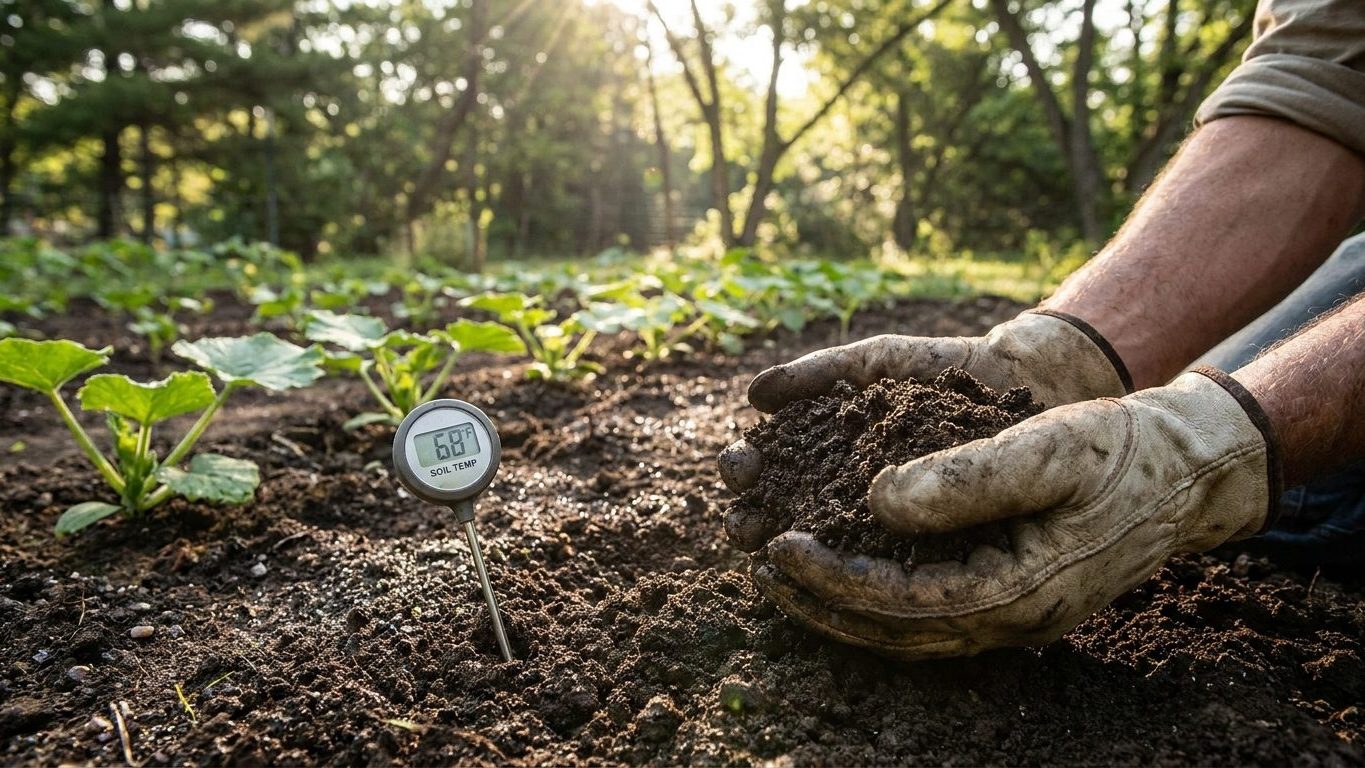
Soil warmth by feel is the first and most direct check. Winter squash seed wants soil that feels genuinely warm to the back of your hand, not just frost-free. If the soil still feels cool or damp-cold at a depth of an inch or two, even on a warm afternoon, it hasn’t caught up to the air temperature yet, and seed sown into it will sit and rot before it germinates rather than sprouting quickly.
The first flush of male flowers is the second signal, and it tells you the plant has shifted from pure vegetative growth into reproductive mode. Male flowers typically show up before the female flowers that actually set fruit, so seeing them is a sign your plant has enough warmth and daylight banked to keep moving forward, not a sign fruit is imminent.
The appearance of true leaves, the second set that looks like an actual squash leaf rather than the rounded seed leaves, confirms the plant has moved past its most fragile stage and established a real root system. A slow or stalled appearance of true leaves after a cold snap is often the clearest on-the-ground evidence that your microclimate ran colder than the county average that week, more reliable than any date on this page.