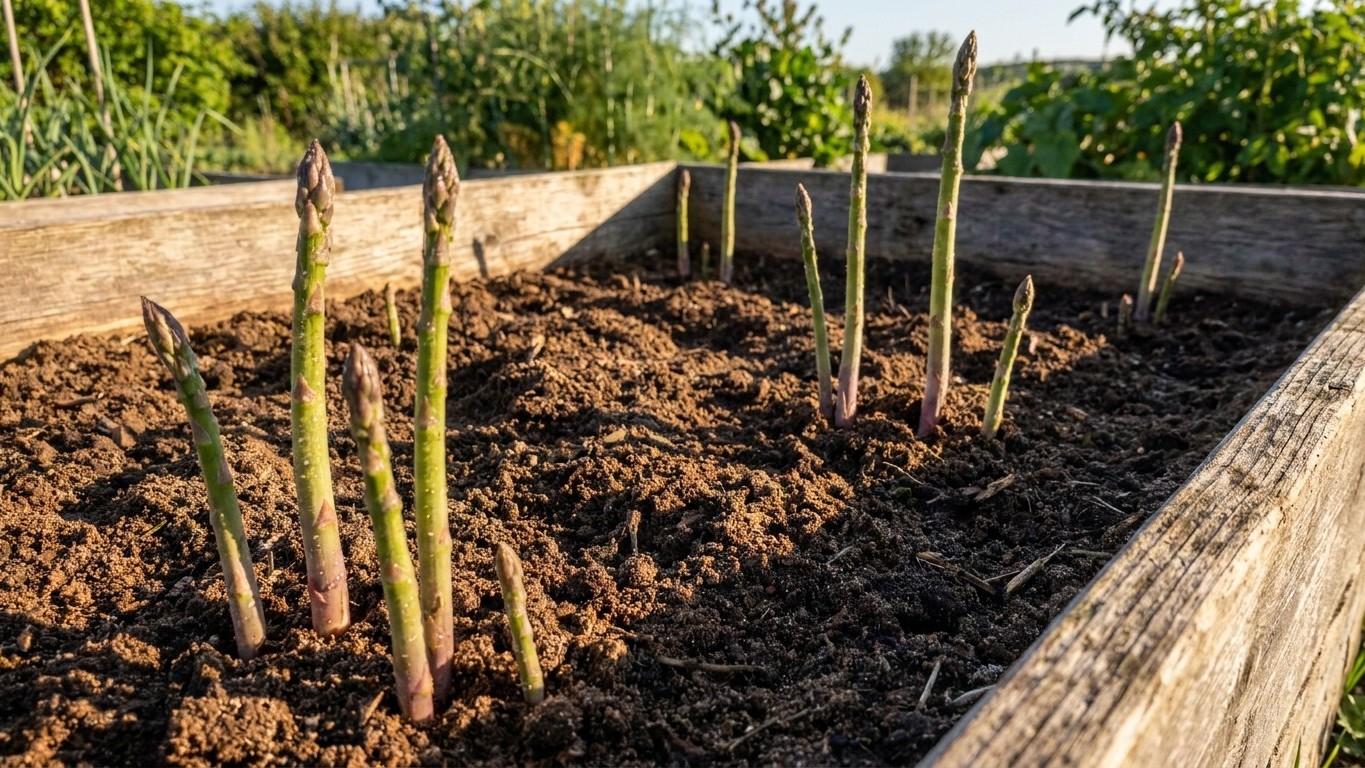

Yes, in most cases. New Brunswick’s dominant agricultural soil, a well-drained Podzol, meets the one condition asparagus insists on for its ten-to-fifteen-year run in the ground: drainage. But that’s a provincial average, not a verdict on any single backyard. A garden sitting on the province’s Gleysolic patches, or in a low corner where water pools every spring, faces a longer answer, one that starts with a shovel and a bucket of water before it starts with a crown.
The short answer
an Asparagus Bed isn’t a summer squash you can relocate next year if the spot disappoints. Utah State University Extension puts the plant’s working life at ten to fifteen years once it starts producing, and it won’t produce at all until the third spring after planting. From there the harvest window itself grows in stages: four weeks the first cutting year, six the next, eight after that, and even then the rule for stopping isn’t a date on the calendar. Cutting stops when most of the new spears are thinner than a pencil. That’s the length of the bet a gardener makes the day the crowns go into the ground, and Utah State’s extension office names exactly one soil condition that has to be met for that bet to pay off: the ground has to drain.
New Brunswick’s dominant mapped soil clears that bar. Across the province’s agricultural land, the Canadian Soil Information Service’s survey of 418 mapped soil components found Podzol to be the most common order, covering 46 percent of the surface, ahead of Gleysolic soils in second place. A Podzol forms under conifer stands, where rainwater leaches the bases out of the topsoil and carries them down the profile, leaving a surface that’s strongly acid, with a median pH of about 4.7, but structurally loose: 47 percent sand, 37 percent silt, and only 16 percent clay, with organic matter running around 3.4 percent. That texture, light on clay, heavy on sand and silt, is what the survey classifies as well drained. Water moves through ground like that instead of sitting on top of it, which is the exact behavior a crown needs for fifteen years running.
The state soil is a starting point, not a diagnosis of one garden. That figure is a median drawn from agricultural regions across the province, not a reading from any one backyard, and the survey’s own runner-up tells the other half of the story. Gleysolic soils, the second most common order mapped, form under conditions wet enough that iron in the soil never gets the oxygen it needs to fully oxidize, leaving grey, mottled layers that hold water rather than shedding it. A garden on river-bottom ground, in a low corner of a yard, or on any lot a builder has graded and filled can behave nothing like the provincial median. The fix, if a test hole fills with water after a rain and stays full for hours, isn’t to fight the native ground for fifteen years. It’s to build up rather than dig down, raising the bed enough that the crowns sit above whatever water table the soil underneath can’t clear on its own.
Will the summer here water it for you?
Asparagus asks for different things at different ages. For the first two years, while roots are still shallow and establishing, the target is 1 to 2 inches of water every other week. After that, once the crown is settled, the schedule eases to 1 to 2 inches every three weeks. Whether a New Brunswick garden needs a hose to hit those numbers comes down to what a normal summer actually delivers.
- What establishment years demand: 1 to 2 inches every other week works out to roughly 2 to 4 inches of water a month while the bed is still young.
- What the region’s summer delivers: at the Moncton A station, the 1981-2010 climate normals put June rainfall at 3.73 inches, July at 3.63 inches, and August, the driest of the three, at 3.18 inches, for about 10.5 inches across the whole summer.
- Where the two line up: June and July sit close to the range the bed wants during its first two years. August’s 3.18 inches lands nearer the low end, and since that figure is a monthly total rather than a weekly one, a garden can go two or three weeks between storms even in a statistically normal August.
- What changes after year two: once the schedule relaxes to 1 to 2 inches every three weeks, New Brunswick’s typical summer rainfall generally covers that pace without supplemental watering in most years.
- What still needs checking on the ground: a Podzol’s sandy loam texture drains fast, which is exactly why it suits a fifteen-year bed, but that same looseness lets moisture escape between rains. A rain gauge in the bed itself, not the seasonal average, is what tells a gardener whether August needs a hose.
When to put the crowns in
Crowns go into the ground in early spring, set in furrows dug about 8 inches deep, according to Utah State University Extension. The furrow isn’t filled in all at once. Soil goes back in gradually over the course of the year, about 2 inches added every other month, so the crown ends up buried at its full depth only by fall.
Timing that to New Brunswick’s calendar means working around the frost, not around a fixed week. Environment and Climate Change Canada’s 1981-2010 climate normals put the mean last spring frost at the Moncton station at around May 23. That’s a mean, not a guarantee. In roughly half of recorded years, frost has arrived after that date, so it’s better treated as the midpoint of a window than as a safe date circled on the calendar. Soil that’s still cold and wet in early May does a crown no favors either, so gardeners planting from crowns typically wait until the ground has warmed and dried enough to work, using that mid-to-late-May mark as a rough guide rather than a starting gun.
Utah State’s extension office also names seed as a route into the bed, an earlier and slower alternative to crowns: seed goes in ahead of transplanting, giving the plant an extra season to build the root system that crowns already arrive with. It’s a slower path to that first real harvest in year three, and the source doesn’t spell out seed-specific planting dates the way it does for crowns, so a gardener choosing that route is working from the same frost window with less detailed guidance to lean on.
Whichever way the plant gets into the ground, the source names four varieties by nothing more than their sex. Jersey Giant and Jersey Knight are all-male hybrids; UC 157 F1 and Purple Passion produce both male and female plants. Utah State University Extension doesn’t rank any of them by flavor or yield, and no nursery is named here either. On the evidence published, the choice comes down to whether an all-male bed’s tidier spacing matters more to a given garden than anything else does.
Common questions
Does New Brunswick’s acidic soil hurt asparagus?
Not according to what’s published here. Utah State University Extension’s guidance on asparagus names drainage as the soil condition that matters and is silent on pH. So while the province’s typical surface reading of about 4.7 is worth knowing about a garden in general, there’s no published figure saying it helps or hurts an Asparagus Bed specifically.
What if a soil test shows my spot doesn’t drain?
A bed meant to stay put for ten to fifteen years isn’t the place to gamble on ground that holds water. If a test hole stays full for hours after rain, building the bed up rather than digging it into the native soil keeps the crowns above whatever is causing the standing water, whether that’s a Gleysolic layer, a low spot, or fill from past construction.
How much winter cold does an Asparagus Bed in New Brunswick need?
That figure isn’t published in the source used for this guide. Utah State University Extension’s asparagus guidance is silent on any winter chilling requirement, so no chilling-hour number is given here, and none should be assumed from the hardiness zone alone.
When will I actually get to eat something?
Not before the third spring after planting. The first harvest year runs about four weeks, the second about six, and the third about eight, with cutting stopped each year once most of the new spears come up thinner than a pencil rather than on a fixed date.