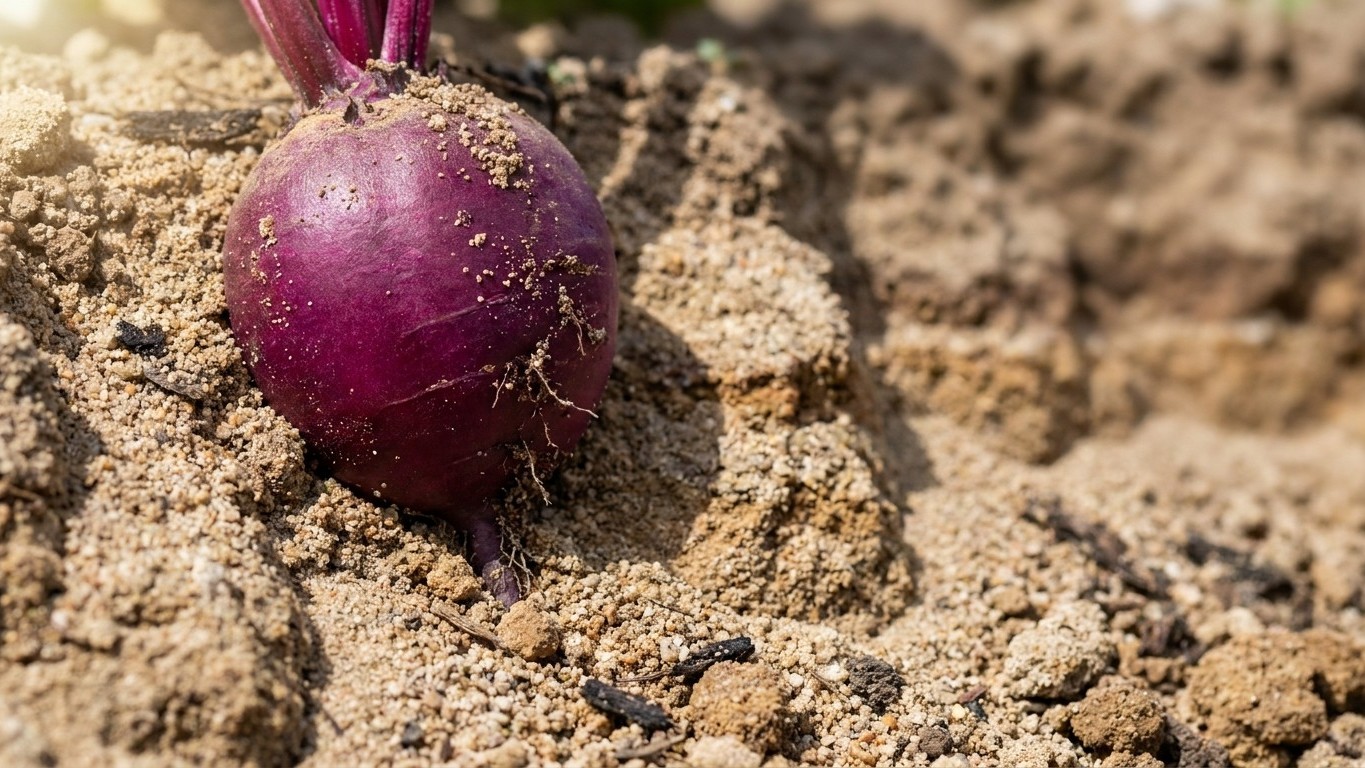

Beet crops in New Brunswick mostly lose out to weather and ground, not to anything with legs. A dry spell in the first six weeks sends plants to flower. Heat above 85 F with thirsty roots turns them woody. Strongly acid soil is the usual background condition. After harvest, a too-cold cellar invites black spot and rot. This page covers those four, and it says plainly where sourced data runs out.
The short answer
What the province’s ground tends to do
Canada has no official provincial soil the way an American state does, so there is no single series to name. The best stand-in is the dominant profile of the agricultural regions. In New Brunswick that is a Podzol, the acid, leached soil that forms under conifers, where rain has washed the bases out of the surface. Podzols cover 46 percent of the mapped surface, with Gleysolic soils next. The figures here come from 418 mapped surface horizons in the Canadian Soil Information Service tables (Agriculture and Agri-Food Canada). The median surface is loam to silt, with 47 percent sand, 16 percent clay and 37 percent silt. Organic matter sits near 3.4 percent, drainage is well drained, and median pH is about 4.7, which is strongly acid.
A province spans hundreds of soil series, so treat this as a starting point, not a diagnosis. River bottoms, wet ground and any lot a builder has scraped or filled can behave nothing like the median. The survey also covers farmland, not every corner of the province.
What that means for a beet
Utah State University Extension describes the target as deep, sandy, well-drained soil rich in organic matter. On texture and drainage the median profile lands close. Clay at 16 percent is modest, and the well-drained class is what a root crop wants. The sand share is also why water leaves the bed quickly, and that matters in the next section. Acidity is the part to check, because a median pH of 4.7 says nothing about your own bed. A soil test gives your number, and the Beet Soil in New Brunswick: What the Root Will Meet page walks through reading it. If you add compost, Extension caps it at 1 inch of composted organic matter per 100 sq ft.
Heat and the woody root
The days above 90 F in a typical year are not published here for Moncton, and I won’t guess at them. The Extension threshold is lower anyway: heat above 85 F combined with water stress makes the root woody. Count the 85 F days on your own thermometer in July, and you’ll know how exposed your bed is. For the wider picture, see Growing Beets in New Brunswick.
The six weeks that decide it here
Beets are sown in place, so the clock starts at seeding, and the crop takes 60 to 80 days from that day. The first six weeks are the sensitive stretch. Water stress in that window causes premature flowering, which is bolting. A plant that bolts has decided to make seed instead of a root.
Sowing two to three weeks before the last frost puts those six weeks in a predictable slice of spring. The Moncton station, in Environment and Climate Change Canada’s climate normals, gives an average last spring frost of May 23. That is a mean, not a safe date. In one year out of two the last frost falls later, so read it as the midpoint of a window. Northern and upland districts run weeks behind Moncton. Canadian normals also use an older averaging period than the US figures elsewhere on this site, so don’t compare the two too tightly.
Counting back from May 23 gives a sowing window of roughly May 2 to May 9 in the Moncton area. The first six weeks then run to about June 13 or June 20. Harvest from those sowings falls between early July and late July. The When to Sow Beets in New Brunswick page covers shifting that window for colder districts.
What does spring usually do inside that window? This page holds no rainfall record, so take this as a pattern, not a measurement. Maritime springs tend to swing between soggy stretches and dry ones. The bolting risk sits in the dry stretch. A well-drained, fairly sandy bed sheds a wet week’s rain fast, and a few dry days can leave seedlings short of water. Weeks one through six are when to check moisture by hand, not by looking at the sky.
Woodiness is a separate failure with a separate timetable. It shows up later, in July, when the roots are sizing up and a hot spell above 85 F meets dry soil. Keeping the seedling bed damp in June does nothing to protect a root in a July heat wave. Both need watering, but they are two different problems, and each calls for watching a different part of the season.
What goes wrong here
Most failures trace back to the soil and the calendar above, with storage adding a few more.
In the garden
- Bolting from early thirst. Water stress in the first six weeks causes premature flowering. A sandy, well-drained bed dries quickly, so check moisture often through mid June and water before the surface crusts and the seedlings flag.
- Woody roots from later heat. Heat above 85 F with water stress is the combination. Keep the bed evenly moist during July hot spells, and don’t leave roots in the ground past the 80-day end of the range.
- Strongly acid ground. The median surface pH is about 4.7, but yours may differ. Test first, then correct according to the result. Guessing at lime is how people overshoot.
- A bed unlike the median. Gleysolic soils are the second most common order, and filled or scraped ground varies widely. If your garden sits on either, rely on your own test and drainage check, not this page’s averages.
- Too much compost. Rich soil helps, but Extension caps amendment at 1 inch of composted organic matter per 100 sq ft. More than that is waste.
After harvest
- Storing them with leaves on. Bunched beets keep only 10 to 14 days at 32 F and above 98 percent humidity. Top them first if you want them to last longer.
- Over-chilling. Colder is not better here. USDA Agricultural Handbook 66 reports more black spot and rot at 32 to 34 F than at slightly warmer temperatures. Topped roots belong at 33 to 36 F and 98 percent humidity, and a pit or cellar should stay between 31 and 41 F. Every other root crop tends to get colder advice, which is why this one trips people up. The handbook is available from USDA’s Agricultural Research Service.
- Storing the small roots. Large roots keep much better because they lose water and shrivel more slowly. Eat the small ones first and store the big ones.
Common questions
Which insects and diseases attack beet leaves in New Brunswick?
No sourced pest or disease list is published here, and I won’t invent one. For leaf damage you can’t identify, take a sample to your provincial agriculture office or a local garden-supply expert for a diagnosis. Meanwhile, rule out water stress and heat first, since they cause most of what the sources document.
Is May 23 a safe planting date?
No. It is the average last spring frost at the Moncton station, so in one year out of two the last frost comes later. The sowing window for beets starts two to three weeks before it. Districts to the north and at higher elevation run weeks behind.
Can I start beets indoors and transplant them?
Beets are sown in place. The 60 to 80 days to harvest run from seeding in the bed, not from a transplant date, so count from the day the seed goes in.
What temperature should I store beets at?
Topped beets keep best at 33 to 36 F and 98 percent humidity, according to USDA Agricultural Handbook 66. Pits and cellars should stay between 31 and 41 F. Storage at 32 to 34 F produced more black spot and rot than slightly warmer storage, so a fridge set as cold as possible is not the answer.