
The short answer: no insect species for carrot is documented specifically for New Brunswick in the sourced records behind this page. What is documented, and verified, is the province’s dominant soil profile and the growing and storage numbers that decide whether a carrot problem is even a pest to begin with. Start there, because most of what gardeners blame on bugs traces back to something in the ground.
Which pests attack carrot in New Brunswick
There is no province-specific insect list attached to the verified sources for this page. That matters, because a lot of general-interest gardening content fills that gap with species pulled from other regions, and a carrot grower in New Brunswick ends up chasing a pest that was never confirmed anywhere near their soil. This page won’t do that. If you want a confirmed, current species list for your county or parish, that has to come from a provincial extension or agriculture office, not from a generalized article.
What the sourced record does confirm is the ground those roots grow in. New Brunswick’s mapped agricultural soils are most commonly Podzol, the acid, leached soil type that forms under conifer cover, where rain washes the mineral bases out of the topsoil. The median surface pH sits around 4.7, which is strongly acid. Texture runs 47 percent sand, 16 percent clay and 37 percent silt, with organic matter around 3.4 percent, and drainage is generally good. That comes from Agriculture and Agri-Food Canada’s Canadian Soil Information Service, sampled across 418 mapped soil components in the province’s agricultural zones. It’s a provincial average, not a reading from any one backyard, and the far north of the province isn’t represented in that dataset at all.
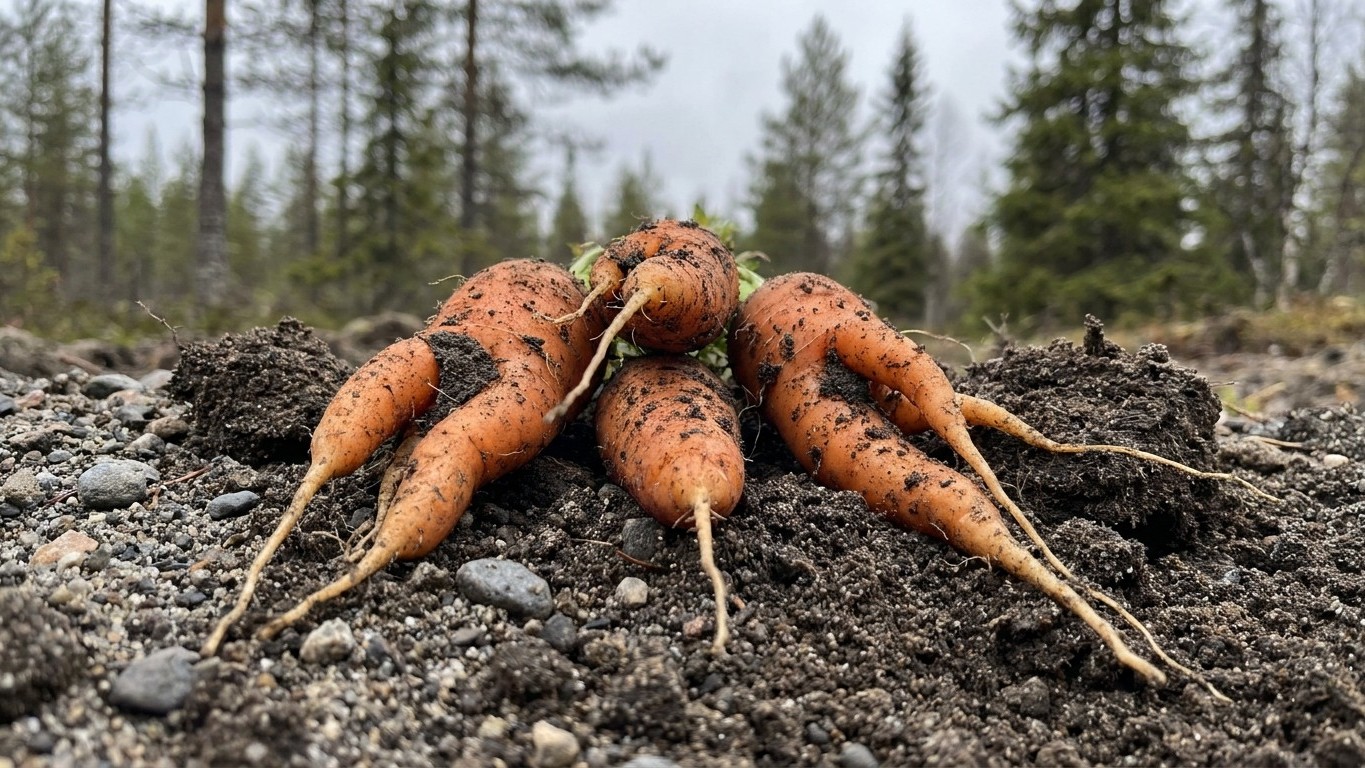
Why does soil chemistry belong in a pest article? Because carrot roots grown in compacted, clay-heavy or rocky ground fork and twist on their own, with zero insect involvement, and that damage gets misread as pest injury constantly. Sixteen percent clay is enough to cause forking if the bed hasn’t been loosened, according to Utah State University Extension’s guidance on carrot growing, which specifically flags heavy or rocky soil as a cause of forked roots and recommends deep, sandy, well-drained ground rich in organic matter. Utah State also notes that heavy soil needs generous compost and double digging to grow a straight carrot at all. None of that requires naming a single insect.
When each one shows up, and what it does first
Without a confirmed species list for this province, this section can’t walk through named pests and their calendar. What the sourced facts do support is a growth-stage timeline, and knowing which stage you’re in narrows down what’s realistic as a cause.
Carrots are sown directly into the bed; there is no transplant date on this crop, so every count below runs from the seeding date, not from setting out plants. Utah State University Extension puts full maturity at 70 to 100 days from seeding, depending on the carrot type and the season. Clemson Cooperative Extension gives a tighter harvest window of 65 to 75 days after planting for a usable root. Those two figures aren’t contradictory; they describe overlapping stages of the same crop, with 65 to 75 days marking when roots are typically pulled and 70 to 100 days marking when the crop fully matures if left longer.
Early on, right after emergence, damage tends to show on the thin, feathery foliage first, simply because that’s all there is to damage. Chewed or notched leaves at this stage point toward foliage feeders, of whatever species is actually present locally, something only a local extension identification can confirm. Mid-season, once the root is bulking underground, damage shifts to what you can’t see without pulling a carrot: tunneling, discoloration, or a root that forks instead of running straight down. That forking, as covered above, is frequently a soil-texture problem rather than an insect one, especially in ground that matches New Brunswick’s documented clay content. Near harvest, in the 65-to-75-day window, any damage that shows up affects storage life directly, since a wounded root breaks down faster in the root cellar regardless of what caused the wound.
Telling the damage apart from everything else
Most carrot complaints aren’t about identifying an insect. They’re about ruling out everything that isn’t one. A forked or stubby root, with no tunneling and no chew marks, is a soil signal, not a pest signal, and it should send you to a shovel and a bag of compost before it sends you to a spray bottle.
| What you see | Likely cause | What settles it |
|---|---|---|
| Root splits into two or more forks | Compacted or rocky soil, or fresh manure worked in too close to sowing | Check soil texture and recent amendments; Utah State Extension ties this directly to heavy or rocky ground |
| Tunnels or channels inside the root | An insect feeding underground | Cut the root open; a smooth void with frass points to feeding, not disease |
| Yellowing, stunted tops with no visible chewing | Nutrient deficiency or waterlogging | A soil test rules out deficiency; drainage class rules out waterlogging |
| Wilting despite damp soil | Root or crown rot, or root damage cutting off water uptake | Pull one plant and inspect the root and crown directly |
| Ragged, torn foliage edges | Mechanical damage from wind, hail, or garden tools | Damage pattern is random and matches recent weather or activity, not a feeding pattern |
None of this replaces a local diagnosis. What it does is stop you from treating a soil-texture problem with an insecticide, which wastes a growing season on a fix that was never going to work. If tunneling or chewing is present and doesn’t match the categories above, that’s the point to contact your extension office with a sample, rather than guess from a photo online.
What actually works here, and what is a waste of time
On a growing season this short, timing beats intervention almost every time. A physical barrier, fine mesh laid over the bed right at seeding, keeps flying insects off the crop during the vulnerable early weeks, and it costs nothing in chemical exposure to figure out later whether it was even needed. Putting the barrier down at seeding, not after damage appears, is what makes it work; once an insect has already laid eggs in the bed, a cover on top doesn’t undo that.
Soil correction is the other lever, and it’s the one this page can actually back with a named source. Utah State University Extension recommends deep, sandy, well-drained soil rich in organic matter for straight carrots, and for heavy ground specifically calls for generous compost and double digging before sowing. Given New Brunswick’s documented clay content, a raised bed filled with a lighter mix is a reasonable answer for a grower dealing with chronic forking, not a change of carrot variety.
What’s a waste of time: guessing at a pesticide without a confirmed pest, spraying on a schedule instead of in response to an actual sighting, and skipping the temperature step at harvest. Clemson Extension is specific that carrots need 33°F and high humidity to hold without wilting, and that leafy tops left on draw moisture out of the root, cutting storage life to 10 to 14 days versus months for tops removed at harvest. A root that looked pest-damaged after three weeks in a 50-degree garage was often just stored wrong, not attacked twice. This page names no product and no active ingredient, because pesticide registration is state- and province-specific, and the only body that can tell you what’s legally labeled for use in New Brunswick is the extension or agriculture office covering your area.
Where to check this for your own county
Everything documented on this page sits at the provincial level: the soil survey behind the state_soil figures covers New Brunswick’s mapped agricultural regions as a whole, sampled across 418 components, and a single garden can sit well outside that median. A provincial average pH of 4.7 tells you what the region tends toward, not what your bed measures; a soil test is the only way to get your own number.
The same logic applies to pests, which is exactly why no species list appears here. Insect presence shifts county to county and even field to field, tied to local crop history, nearby wild hosts, and microclimate, and a list compiled at the provincial level, if one existed, still wouldn’t confirm what’s active in a specific backyard. The right next step is contacting New Brunswick’s provincial agriculture office or your local county service directly, describing the damage using the categories in the table above, and, if possible, bringing in a sample. That’s also the office that can confirm what pest control options are actually registered for home use in the province, since that list changes and isn’t something a general gardening page can responsibly print.
If a soil test comes back confirming the low pH and clay content this page describes as typical, that’s your cue to amend before next season rather than to keep chasing an insect that may not be the actual cause.
Common questions
Does New Brunswick’s soil make carrots more vulnerable to pests?
Not directly. The province’s documented soil, an acid Podzol with 16 percent clay, mainly affects root shape and drainage. Soil condition doesn’t create insect pressure, but it does produce forking and stunting that get mistaken for pest damage.
How long does it take to grow a carrot from seed in New Brunswick?
The sourced figures aren’t province-specific, but the general carrot timeline is 70 to 100 days from seeding to full maturity, per Utah State University Extension, with Clemson Cooperative Extension putting a usable harvest at 65 to 75 days after planting.
Why are my carrots forked instead of straight?
Forking is most often a soil problem, not an insect one. Heavy, rocky or compacted ground causes the root to split as it grows around obstructions; Utah State University Extension recommends deep, well-drained, sandy soil with plenty of organic matter, and double digging where the ground is heavy.
What’s the right way to store harvested carrots?
Cut the leafy tops off first, since they keep drawing moisture out of the root. Clemson Cooperative Extension recommends storing at 33°F with high humidity; carrots stored with their tops still on last only 10 to 14 days, versus far longer once trimmed.