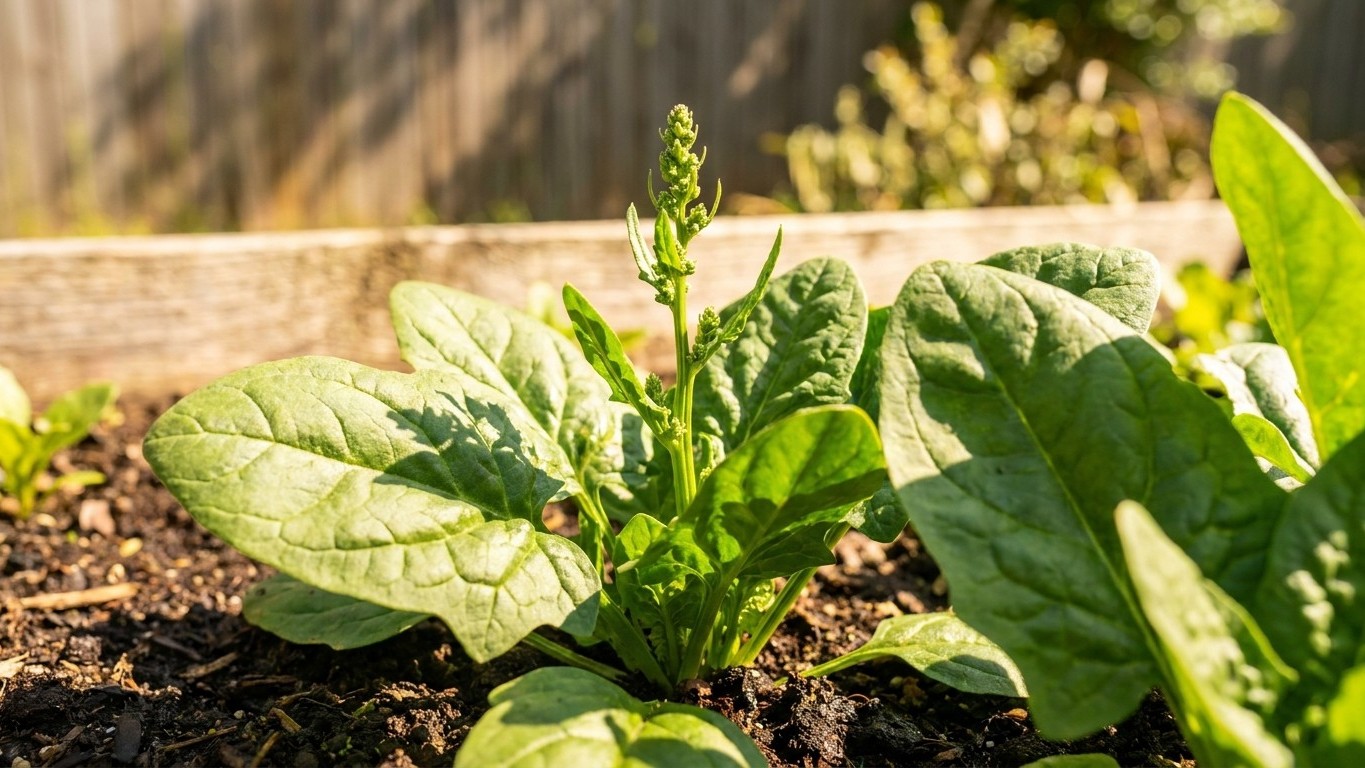

New Brunswick spinach bolts early in most years, and it isn’t a mystery of bad luck. The culprit is day length as much as heat: by the summer solstice, the reference station near Moncton logs 15 hours and 34 minutes of daylight, well past the point where spinach shifts into flowering mode. Add a growing season with essentially zero days above 90 F, and the picture gets clearer: this crop struggles less from scorching heat here than from the calendar itself. Spring and fall each offer a narrow window worth planning around.
The short answer
On the longest day of the year, the Moncton area sees 15 hours and 34 minutes of daylight, calculated from the region’s latitude using the standard sunset hour-angle formula. That number matters more to spinach than any thermometer reading, because spinach flowers, or “bolts,” in response to long days as well as warm weather. It doesn’t wait for a heat wave to give up on producing leaves. Once daylight stretches past a certain length, the plant’s internal clock shifts over to seed production regardless of how mild the air feels.
This is where New Brunswick’s mild summers can be misleading. The reference station averages zero days a year at 90 F or hotter, a genuinely cool climate by North American standards. A gardener might assume that cool weather buys extra weeks of harvest. It doesn’t, not fully. Day length keeps climbing through spring no matter how cool the air stays, and by the time the solstice arrives, the trigger for bolting has already been pulled by daylight alone, independent of temperature.
Heat still plays a supporting role, though. Spinach grows best where temperatures stay below 75 F, and that threshold does double duty: it’s both a growth ceiling and the point past which leaves turn bitter, according to Utah State University Extension. New Brunswick’s cool summers rarely push far above that mark for long stretches, and the near-total absence of 90-degree days means extreme heat isn’t the main enemy here. Day length is.
The honest answer, then, is that this territory’s limit is day length first, with warmth acting as an accelerant rather than the trigger. A cooler year won’t rescue a late-planted spring crop from bolting once daylight climbs into that 15-hour-plus range. The plant’s response to long days, which includes flowering, elongating stems, and bitter leaves, happens even if the thermometer never leaves the 60s. Growers who count on cool weather alone as protection are working from an onion grower’s playbook, not a spinach grower’s. For onions, long days build the crop, triggering bulb formation through a completely different mechanism. Spinach runs the opposite way: long days push it toward seed, not toward more leaf growth. Knowing which side of that switch a garden sits on changes how a spring or fall planting schedule gets built in this province.
How long the spring window really is
Working out a realistic spring window here means lining up three numbers: the frost date, the sowing rule, and the point where day length and warmth start pushing spinach toward bolting.
- Start with the frost date. Environment and Climate Change Canada’s 1981-2010 normals put the average last spring frost at the Moncton station on May 23. That’s a mean date, not a guarantee, meaning frost arrives later than that in roughly half of all years. Treat it as the midpoint of a range rather than a safe cutoff, especially in northern or upland parts of the province where spring runs behind the coast.
- Move the sowing date back. Spinach seed goes into the ground two to three weeks before that last frost, per Utah State University Extension guidance, since the crop tolerates cold soil far better than heat. That places a typical sowing window somewhere around the first half of May, adjusted for how far behind or ahead of Moncton a given garden runs.
- Track the daylight climbing toward the solstice. From early May onward, daylight lengthens every day, closing in on that 15-hour-34-minute peak in late June. There’s no pause button on this clock, and it keeps ticking whether the spring is cool or unusually mild.
- Watch the 75 F ceiling arrive alongside it. Growth stays good below that mark; above it, leaves toughen and turn bitter even before the plant fully bolts. In a climate with essentially no 90-degree days, this ceiling gets crossed gradually rather than through sudden heat spikes, but it still arrives well before midsummer in most years.
- Add up what’s left. Between a sowing date in early-to-mid May and the point in June when day length alone crosses the bolting threshold, the usable spring harvest window in New Brunswick runs roughly six to eight weeks. That’s a short season by vegetable-garden standards, and it closes because of the calendar as much as the thermometer.
The autumn crop, and when the soil lets you sow
A fall planting sidesteps the day-length problem, since daylight is shrinking rather than climbing by late summer. Two other obstacles take its place instead: soil that’s still too warm for the seed to germinate well, and a frost that eventually shuts the growing season down. Both need to be worked around from the harvest date backward.
Soil too warm to germinate
Spinach seed germinates poorly once soil temperature climbs above 80 F, according to Utah State University Extension. That’s a soil reading, not an air temperature, usually taken with a simple soil thermometer a couple of inches down rather than guessed from the forecast. In a climate where the reference station averages zero days a year at 90 F or hotter, soil rarely bakes the way it does farther south or inland in warmer states, so this threshold tends to ease off earlier in late summer here than in hotter regions. Still, late July and early August soil can sit warm enough to slow or block germination, and sowing into that warm ground usually means a spotty, disappointing stand rather than an outright failure.
The frost that ends the season
Environment and Climate Change Canada’s 1981-2010 normals put the average first fall frost at the Moncton station on October 2. As with the spring figure, that’s a mean date. Frost shows up earlier than that in about half of all years, and the number shifts depending on how close a given garden sits to the coast versus inland or upland terrain. Utah State University Extension’s rule for a fall crop is to sow 50 to 75 days before the date you want to harvest, since no maturity figure is published for spinach as a category. Counting back from an October 2 harvest target puts sowing somewhere between mid-July and mid-August, roughly July 19 through August 13. That window gives the crop enough weeks of cooling, shortening days to bulk up leaves before frost, without asking seed to germinate in soil that’s still holding onto midsummer heat.
| Planting window | Main limiting factor | Key threshold | Approximate sowing window |
|---|---|---|---|
| Spring | Day length, with heat as accelerant | 15 h 34 daylight at solstice; 75 F growth ceiling | Early to mid-May |
| Fall | Warm soil, then frost | 80 F soil germination limit; average first frost October 2 | Mid-July to mid-August |
Utah State University Extension lists four spinach varieties for home gardens: Bloomsdale, Melody, Teton, and Olympia. The source doesn’t publish days-to-maturity or bolt-resistance data for any of them, so timing decisions here have to rely on the calendar math above rather than on variety descriptions.
Common questions
Can shade slow spinach bolting in New Brunswick?
Shade can knock down soil and leaf temperature somewhat, which helps keep plants under that 75 F growth ceiling a little longer. It does nothing about day length, though. Since bolting here is driven at least as much by long days as by heat, a shaded bed still sees the same 15-hour-34-minute daylight peak in late June and will still shift toward flowering on roughly the same schedule.
Does New Brunswick’s cool summer mean a longer harvest than warmer states get?
Not automatically. The lack of 90-degree days removes one stress, but the region’s long summer daylight hours push spinach toward bolting on their own. A warmer state at a lower latitude with shorter summer days could, in theory, hold spinach in vegetative growth longer, even with hotter afternoons, because the day-length trigger arrives later or not as strongly.
How do I check if soil is too warm to sow fall spinach?
Use a soil thermometer pushed a couple of inches into the bed, taken at the same time of day for a few days running. Utah State University Extension’s threshold is 80 F: germination drops off above that mark. Once the reading holds consistently below it, usually as late-summer nights cool off, the fall sowing window opens.
Why does the source give no days-to-maturity number for spinach?
Utah State University Extension’s guidance for a fall crop is stated as a sowing rule instead: plant 50 to 75 days before the date you want to harvest. No single maturity figure is published for spinach as a category, and no variety-specific data is given for Bloomsdale, Melody, Teton, or Olympia, so gardeners are left to work backward from their target harvest date rather than forward from a fixed number.