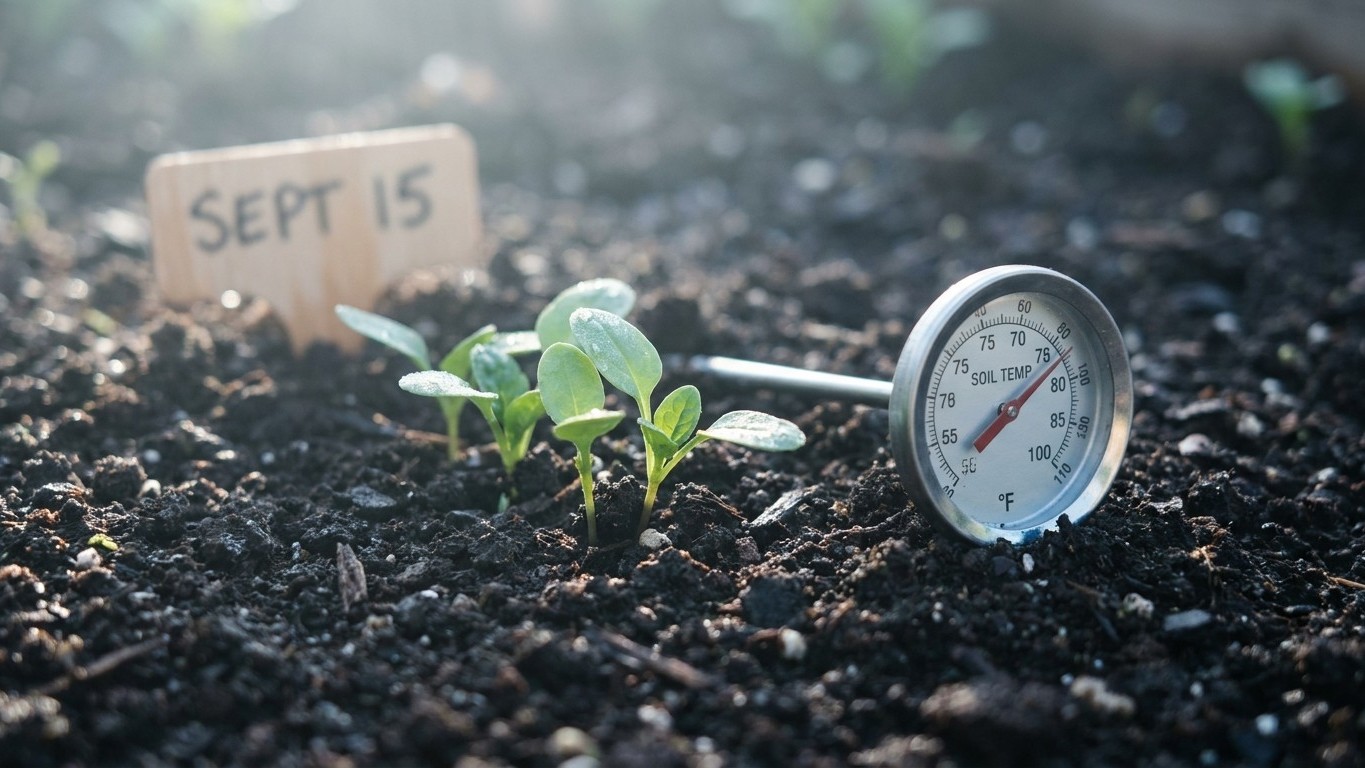

For fall spinach in New Brunswick, the sowing window runs roughly from mid-July through mid-August. That range comes from counting backward 50 to 75 days from the average first fall frost near Moncton, October 2, while also waiting for the soil to cool enough for the seed to sprout. Sow too early and the ground is still too warm to germinate; sow too late and there isn’t enough season left before frost.
The short answer
On the longest day of the year, the Moncton area sees 15 hours and 34 minutes of daylight. That number matters more than most gardeners expect, because spinach flowers, or “bolts,” in response to long days as much as it does to warm temperatures. Once the calendar pushes past mid-spring and days stretch toward that June peak, the plant reads the light and starts putting energy into a seed stalk instead of leaves. A mild, cool summer does not undo that signal. The trigger is the length of daylight itself, and no amount of cloud cover or cool air changes it.
Day length, not heat, does the damage here
This is worth sitting with, because New Brunswick’s summers are not particularly hot. Climate normals for the Moncton station show an average of 0.0 days a year reaching 90 F. There is essentially no heat wave season to dodge. In a place like that, it would be easy to assume spinach could simply be sown all summer, since the classic threat, scorching afternoons, mostly doesn’t happen. But the 75 F ceiling that spinach dislikes doesn’t require 90-degree air to be crossed; ordinary June and July days get there on their own, and the lengthening daylight arrives on schedule regardless of the thermometer.
So the honest way to describe the constraint here is this: day length is the primary limit, and heat is a secondary one that arrives quietly rather than dramatically. The spring crop is racing the calendar toward the solstice, not racing a heat wave. The fall crop faces the opposite problem, waiting for both the daylight and the soil to retreat from their summer peak before the seed will cooperate. Understanding which force is doing the work changes how a gardener plans, because shading a bed or watering more in July won’t buy extra weeks if the days are simply too long for the plant to hold off flowering. The fix is timing the sowing around the light, not fighting the temperature.
How long the spring window really is
Counting the weeks from frost to bolt
The spring window can be worked out step by step from the numbers on record for this area, keeping in mind that the frost date is a mean, not a guarantee: in roughly half of all years, frost arrives later than that average date.
- Start from the mean last spring frost for the Moncton station, May 23. Because this is an average, some years bring frost well into early June, and a gardener sowing right on schedule should still expect occasional setbacks.
- Back up two to three weeks from that date for sowing, which lands the seed in the ground somewhere between roughly May 2 and May 9.
- Track daylight from there. By early June, day length is already well above 15 hours and climbing toward the June 21 peak of 15 hours 34 minutes.
- As that peak approaches, the plant’s tendency to bolt increases regardless of how mild the air feels, so the productive leaf-growing stretch effectively closes well before the solstice itself.
- That leaves a usable spring window of roughly six weeks, from early May sowing to a mid-June finish, before quality drops as plants push toward flowering.
In a year where frost lingers past May 23, that six-week window compresses further from the front end, since sowing has to wait for safer ground. There’s no way to stretch the back end to compensate, since the daylight clock keeps moving forward on its own schedule no matter what the spring weather does.
The autumn crop, and when the soil lets you sow
Fall spinach has to clear two separate hurdles before it can succeed, and they sit at opposite ends of the season.
Soil still too warm to germinate
Spinach seed germinates poorly once soil temperature climbs above 80 F, according to Utah State University Extension. Even in a region with essentially no 90 F air-temperature days, garden soil exposed to full summer sun can still sit warmer than the surrounding air for weeks after the hottest stretch has passed. That means the fall sowing window doesn’t open the moment days start shortening in late July; it opens once the soil itself has actually cooled, which a gardener can check directly with a soil thermometer rather than guessing from the calendar alone.
The frost that ends the season
On the other end sits the average first fall frost, October 2, itself a midpoint rather than a promise; some years push it later, others bring it sooner. The only planting guidance published for a fall crop is to sow 50 to 75 days before the date a gardener wants to harvest. Counting back from October 2 gives a sowing range of about July 19 (75 days out) to August 13 (50 days out). That range is exactly why the practical window described earlier runs from mid-July into mid-August: early enough to get 50 to 75 days of growth before frost, but late enough that soil has had a chance to cool from its midsummer peak.
Four spinach varieties commonly come up in fall planting discussions: Bloomsdale, Melody, Teton, and Olympia. No comparative data on their days to maturity, cold tolerance, or bolt resistance appears in the source used for this guide, so none is offered here rather than guessed at.
Common questions
Can I sow spinach in New Brunswick in the middle of summer?
Not with good results. Long daylight hours through June and July push the plant toward bolting, and soil is often still too warm for reliable germination. The better strategy is to treat midsummer as a waiting period between the spring and fall crops rather than a growing window of its own.
Does a cool New Brunswick summer protect spinach from bolting?
No. Bolting is triggered by day length as well as temperature, and the region’s long summer daylight, up to 15 hours 34 minutes at the solstice, arrives regardless of how mild the air feels. Cool weather alone does not cancel that signal.
How do I know when garden soil has cooled enough for fall sowing?
Check with a soil thermometer rather than relying on the calendar. Germination drops once soil rises above 80 F, so waiting for a clear drop below that threshold, rather than guessing from air temperature, gives a more reliable starting point for a fall sowing.
What happens if I sow fall spinach too close to the average frost date?
Since the recommended range is 50 to 75 days before harvest, and the average first frost falls October 2, sowing after mid-August leaves too little time to reach a usable harvest before frost, even accounting for the fact that frost sometimes arrives later than average.