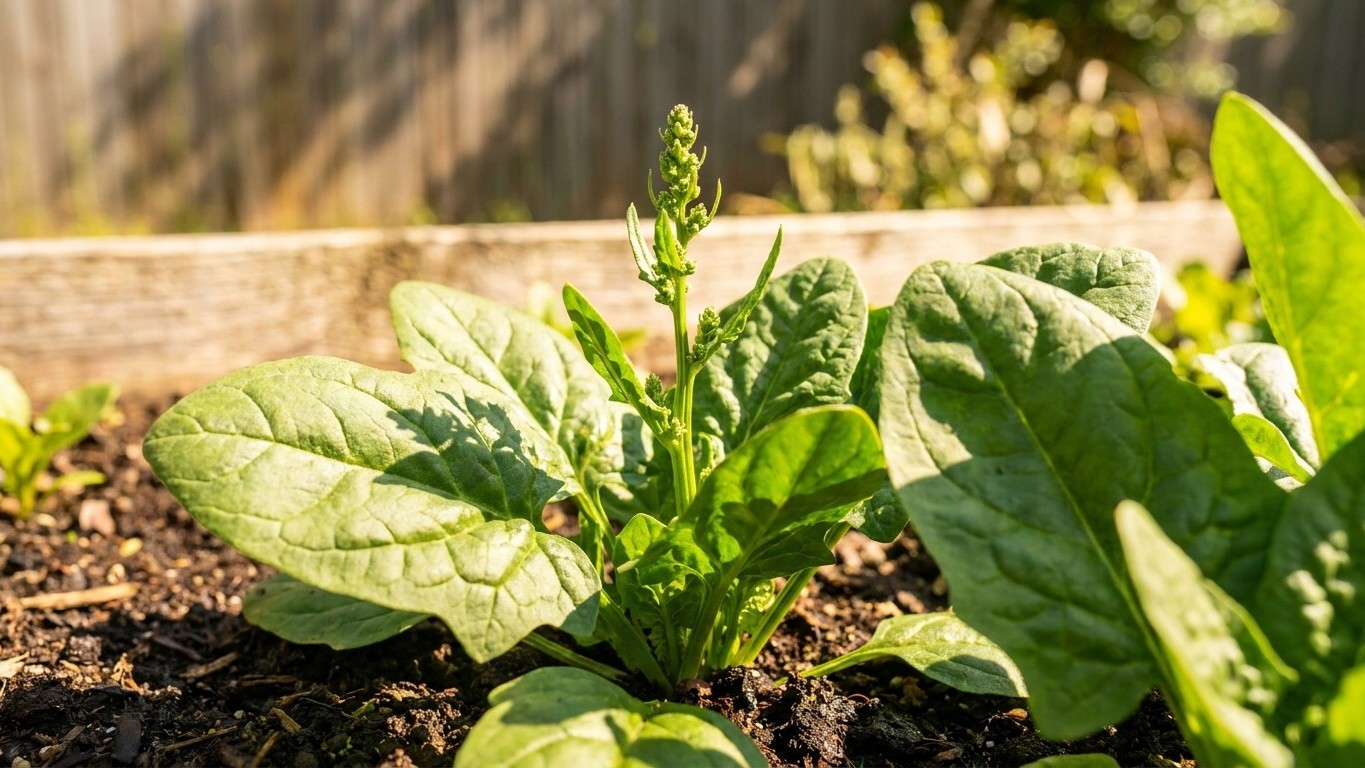

In New Brunswick, cut spinach in late spring, before the days peak and the afternoons settle above 75 F (about 24 °C), and again in early autumn, ahead of the first frost. Summer in between is mostly lost to bolting. Once the leaves are in the fridge, two weeks is the ceiling, and only at 32 F. The reference point throughout is the Moncton area.
The short answer
At Moncton’s latitude, the longest day of the year delivers 15 h 34 of daylight. That figure is calculated from the station’s latitude with a geometric horizon, so real daylight runs a few minutes longer. It matters because Utah State University Extension notes that spinach bolts during long days and warm temperatures. Long days alone are enough to send it into flower, so a cool summer buys no extra weeks here. The plant reads the calendar, not the thermometer.
So the limit in New Brunswick is both day length and heat. Spinach grows best where temperatures stay at or below 75 F, and that same number marks where the leaves turn bitter. The heat counts at Moncton A look mild: an average of 4.6 days a year above 30 °C, and 1.0 day above 32 °C. Those are counts of extreme days, though, and 75 F sits far below them. Spinach starts to struggle on ordinary warm afternoons, long before a scorcher shows up in the statistics.
In practice, cut when the plants have a full rosette of leaves and a warm spell is on the way, rather than waiting for a perfect size. A plant that has started to send up a center stalk is finished, so harvest it all. Leaves cut after the heat arrives taste noticeably harsher. The full picture of early flowering is covered in Will Spinach Bolt Early in New Brunswick?, and the general growing calendar is in Growing Spinach in New Brunswick.
Storage is where gardeners most often overestimate. According to the UC Davis Postharvest Technology Center, the optimum is 32 F with 95 to 98 percent relative humidity. Even then, spinach “will not maintain good quality for more than 2 weeks,” and wilting, yellowing and decay increase beyond 10 to 14 days. At 41 to 50 F, the range a refrigerator door actually holds, deterioration is faster, and leaves can yellow in days. Store it at the back of the bottom shelf, the coldest spot, never in the door. Treat two weeks as a ceiling, not a plan, and eat it well inside that.
How long the spring window really is
The last spring frost at the Moncton station averages May 23. That is a mean date from Environment and Climate Change Canada, so in one year out of two the frost lands later. It is the midpoint of a window, not a safe date. A province is not one climate either, and northern or upland districts run weeks behind Moncton. Spinach is sown 2 to 3 weeks before the last frost, which puts the Moncton sowing between about May 2 and May 9. Here is how the usable weeks work out:
- Start with your own frost date. Use May 23 only if you garden near Moncton. Farther north or at higher elevation, push everything later by the number of weeks your area lags.
- Count back two to three weeks. That gives roughly May 2 to May 9 near Moncton, as soon as the soil is workable.
- Measure the runway to the solstice. From May 2 to the longest day, about June 21, is roughly seven weeks. From May 9 it is about six. Daylight keeps building the whole way toward 15 h 34, and that long day is a trigger for flowering.
- Watch afternoon highs. The date when 75 F arrives for good is not published in the normals used here, so no calendar date can be promised. Once afternoons hold at that level, growth stops being good and the leaves turn bitter.
- Cut everything, not a little at a time. When the window closes, harvest the whole bed rather than leaving plants to sulk through the heat.
The answer for New Brunswick is a short spring: six or seven calendar weeks between the earliest sowing and the solstice, with the actual harvest squeezed inside that. The source publishes no days-to-maturity for spinach, so there is no honest way to say how many of those weeks are spent growing and how many cutting. What the arithmetic does show is that a late start costs real harvest. A sowing that waits until the May 23 midpoint has under four weeks left before the solstice, and a cold, wet May that delays the soil can eat most of the rest.
The autumn crop, and when the soil lets you sow
The second harvest is the more forgiving one, but it has two obstacles, and they pull in opposite directions.
Warm soil, not cold, blocks the sowing
Seed germination is reduced when soil is above 80 F (about 27 °C). Late July and early August are exactly when a sunny vegetable bed stays that warm. The block is warmth, not cold, which surprises people who assume autumn sowing is about racing the chill. The sources used here give no soil-temperature calendar for New Brunswick, so a soil thermometer is a better guide than the date. Push it a couple of inches into the bed in the morning and again mid-afternoon. If the readings are above 80 F, shade the bed and water it before sowing, or wait a week and check again. Days are already shortening from the 15 h 34 peak by then, which helps with flowering, but it does nothing for germination.
The frost that ends the season
The first fall frost at the Moncton station averages October 2. As with the spring date, this is a mean, so half of years frost later and half earlier, and upland or northern districts see it sooner. Utah State’s guidance for a fall crop is to plant 50 to 75 days before the date you want to harvest. Counting back from October 2 gives a sowing window of about July 19 to August 13.
That window runs straight into the first obstacle. The early end is the warm-soil end, and the late end leaves little margin if frost comes early. A sensible compromise is to aim for a harvest in late September, a week ahead of the average frost, which moves the window to roughly July 12 to August 6. Then lean toward the later part of it, and sow once the soil thermometer reads below 80 F. The same source publishes no figure that would narrow the 50 to 75 days, and it names four varieties (Bloomsdale, Melody, Teton and Olympia) without giving any data on how fast or slowly each one grows. Pest pressure also shifts as the season turns, and the timing is laid out in What Eats Spinach in New Brunswick, and When.
Common questions
Can I cut spinach in the middle of summer in New Brunswick?
Rarely with good results. With 15 h 34 of daylight at the solstice, long days push spinach toward flowering even in a cool summer, and warm afternoons above 75 F add bitterness. Sow for spring and autumn instead of trying to hold plants through July.
How long does cut spinach keep in the fridge?
Two weeks is the upper limit, and only at 32 F with high humidity. At the 41 to 50 F typical of a fridge door, quality drops faster. Keep it at the back of the bottom shelf and use it early.
Which variety lasts longest before bolting?
The source names Bloomsdale, Melody, Teton and Olympia but publishes no data about any of them, so ranking them for bolting or storage would be guesswork. Judge them by your own results over a season or two.
Do the May 23 and October 2 dates apply across the whole province?
No. They are average dates from the Moncton station, and in one year out of two the frost falls later in spring or earlier in fall than that. Northern and upland districts run weeks behind in spring and see frost sooner in autumn, so shift your own sowing windows accordingly.