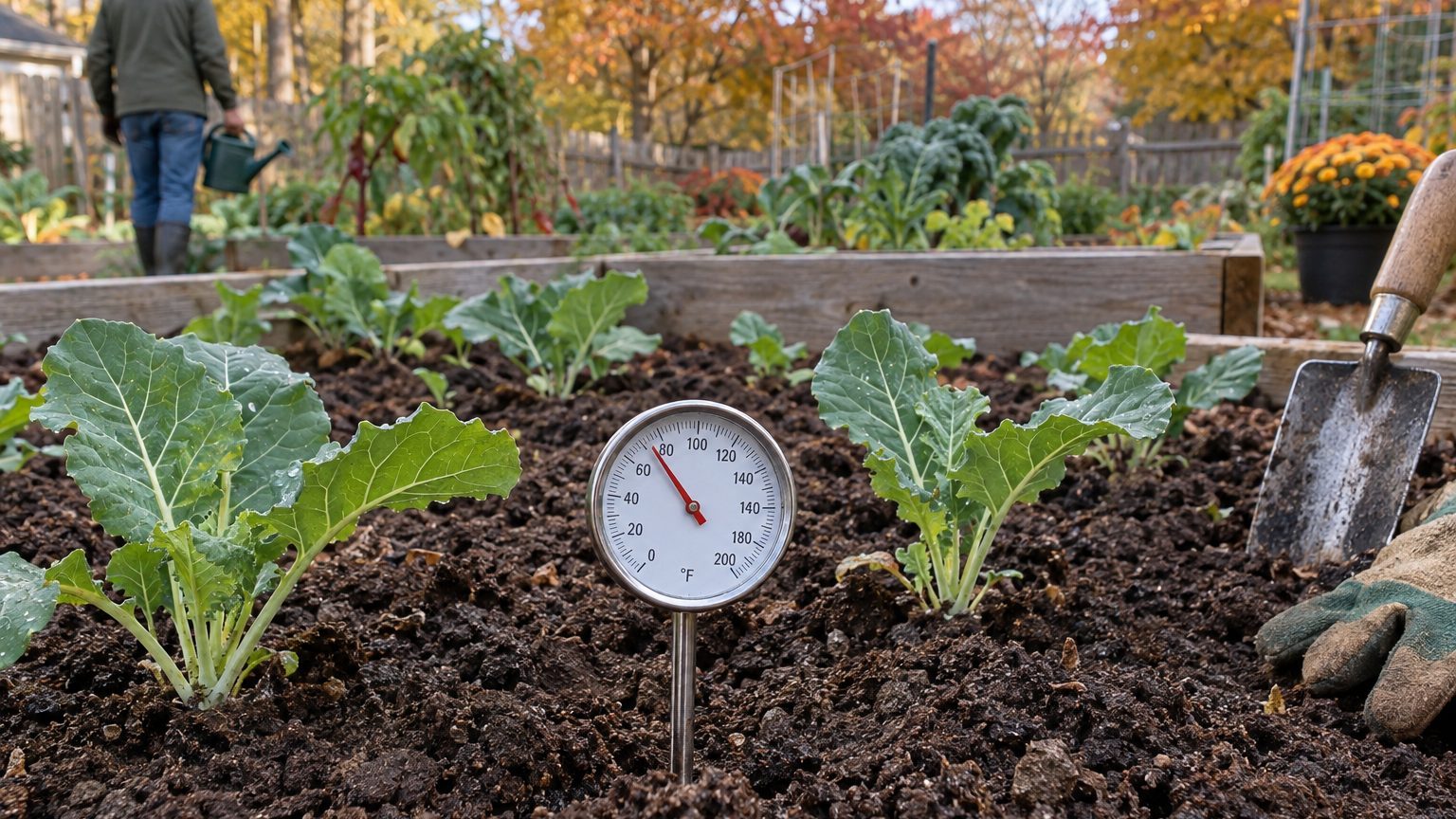

New Hampshire’s last spring frost is only the starting gun for collards, not the finish line. Soil temperature, not the frost date on a calendar, is what actually gets seed and transplants moving. Check the soil with a simple soil thermometer before you sow, rather than counting days from the frost date alone.
When the soil is warm enough in New Hampshire

NOAA’s National Centers for Environmental Information puts the last spring freeze at the Manchester reference station somewhere in the window of April 16 to April 27, based on the 1991-2020 climate normals. That’s a probability band, not a guarantee. Some years the last freeze lands earlier, some years later, and gardens outside Manchester, especially at elevation or away from urban heat, often see frost linger a week or two past that window. Treat it as the outer edge of risk for your county, and check your own records or your local UNH Extension office before you commit seed to the ground.
Reading the soil, not just the calendar
Frost date matters mostly because it marks when hard freezes become unlikely, not because the soil itself has warmed by then. Cold, wet soil in April can sit well below the temperature collard seed needs to germinate reliably, even on a morning with no frost in the forecast. Collards will sit and sulk in soil that’s still cold from winter, and a transplant set into that kind of ground often stalls for weeks rather than growing on.
Instead of watching the calendar alone, dig a handful of soil from planting depth. If it’s still cold to the touch, clumps into a solid ball, or feels wet enough to squeeze water from, hold off. Wait until it crumbles apart and has warmed through with a run of mild days, then direct-sow or set out hardened transplants. Collards belong to the same brassica family as cabbage, kale, mustard, turnip, and rutabaga, so give the bed a rotation away from any of those crops grown there the previous year. If you’re still deciding between direct-seeding and transplanting, the main Growing Collards: One Planting, Months of Harvest guide walks through that choice in more detail.
New Hampshire springs are notorious for a warm stretch followed by a sudden cold snap, so keep some floating row cover on hand even after you’ve decided the soil is ready. A light frost that catches an established collard planting rarely does lasting harm, but a hard freeze on tender young transplants that haven’t hardened off yet can set them back hard, or kill them outright.
How long the season lasts here
NOAA’s 1991-2020 climate normals put Manchester’s first fall freeze at October 13 to October 26, from the same reference station that supplies the spring figure above. Line the two windows up and the frost-free stretch in Manchester runs, at its shortest, from around April 27 to October 13, and at its longest, from April 16 to October 26. That works out to somewhere between about five and a half and six and a half months of frost-free growing, depending on where your particular year and your particular county fall inside those bands.
What extra weeks buys you
A season that long gives collards room to do more than a single planting. Sow a spring crop as soon as the soil has warmed, as described above, and there’s usually still time for a second sowing in mid to late summer aimed at a fall harvest, the crop collards are known for since cool weather sweetens the leaf. Gardeners working closer to the five and a half month end of that range are better off treating the spring sowing as the only one, and putting their effort into extending the fall harvest with row cover instead of squeezing in a second planting.
That’s a very different calculation from a place like Alaska, where the whole growing season can be too short for anything but a single planting; the Growing Collards in Alaska guide covers how growers there compress the whole crop into one window. New Hampshire’s longer season is exactly what makes succession sowing worth the extra bed space here, staggering plantings two to three weeks apart through early to mid summer so the harvest doesn’t all mature at once.
Heat and water in New Hampshire

The number that actually decides how you plan a collard bed in New Hampshire isn’t a summer figure at all. It’s how cold winter gets. NOAA’s 1991-2020 climate normals put the mean daily minimum temperature of the coldest month at the Manchester reference station at 17.1°F. That number isn’t a record low. It isn’t a monthly average either. It marks the average low point each day reaches during the coldest stretch of winter.
Why winter decides everything
In parts of the country where the coldest month stays close to freezing, collards behave as a standing crop, picked leaf by leaf from November into March. Manchester’s normals put this state nowhere near that mild. A mean daily minimum in the high teens means the ground itself locks up hard and repeatedly through winter, and an uncovered collard plant left in the open here won’t make it through most of that stretch. That makes collards fundamentally an autumn crop in New Hampshire, something you push right up to the hard freeze and then finish off, rather than something you keep harvesting all winter without help. A cold frame, a thick mulch, or heavy row cover can buy extra weeks past that first fall freeze, but they extend the fall harvest, they don’t replace the mild winter that true standing culture needs.
New Hampshire summers don’t run especially hot compared with the mid-Atlantic or the Deep South, but they do bring stretches of humid, showery weather that suit fungal problems on brassica leaves more than they suit fast growth. Space plants generously for airflow, water at the base rather than overhead, and watch for the pale, powdery patches of downy mildew or the dark spots of Alternaria leaf spot after a run of wet weeks. Gardeners in other humid summer climates face the same pressure. The Growing Collards in Wisconsin guide covers how growers there manage similar disease pressure through spacing and timing.
Which collards suit New Hampshire
None of this page’s reasoning turns into a single named variety, and that’s deliberate. The types trialled and proven in one part of New Hampshire don’t always perform the same thirty miles away, at a different elevation or on heavier soil, and a name pulled from a seed catalogue without local trial data is a guess dressed up as advice. Check UNH Extension’s current recommendations for varieties trialled in the state before you buy seed, at extension.unh.edu.
Choosing by type, not by name
That said, the criteria you should be shopping by are clear from everything above. Look for:
- A fast-finishing type, so a spring sowing has time to mature before summer heat and pests build, given a growing window that runs only five and a half to six and a half months at Manchester.
- A type that holds quality with some crowding or partial shade at the root zone, useful in a bed where airflow and cooler soil matter more here than raw heat tolerance.
- A type described as tolerant of downy mildew or leaf spot, the two problems humid New Hampshire summers actually bring, rather than tolerance to heat or drought this state rarely tests.
Seed packets list days to maturity counted from transplant, and that figure shifts by a week or two depending on the season, so cross it against Manchester’s frost dates yourself rather than trusting the number printed on the packet alone. A variety listed at a longer maturity is a tighter fit for the shorter end of this state’s window, near five and a half months, than for the longer end near six and a half.