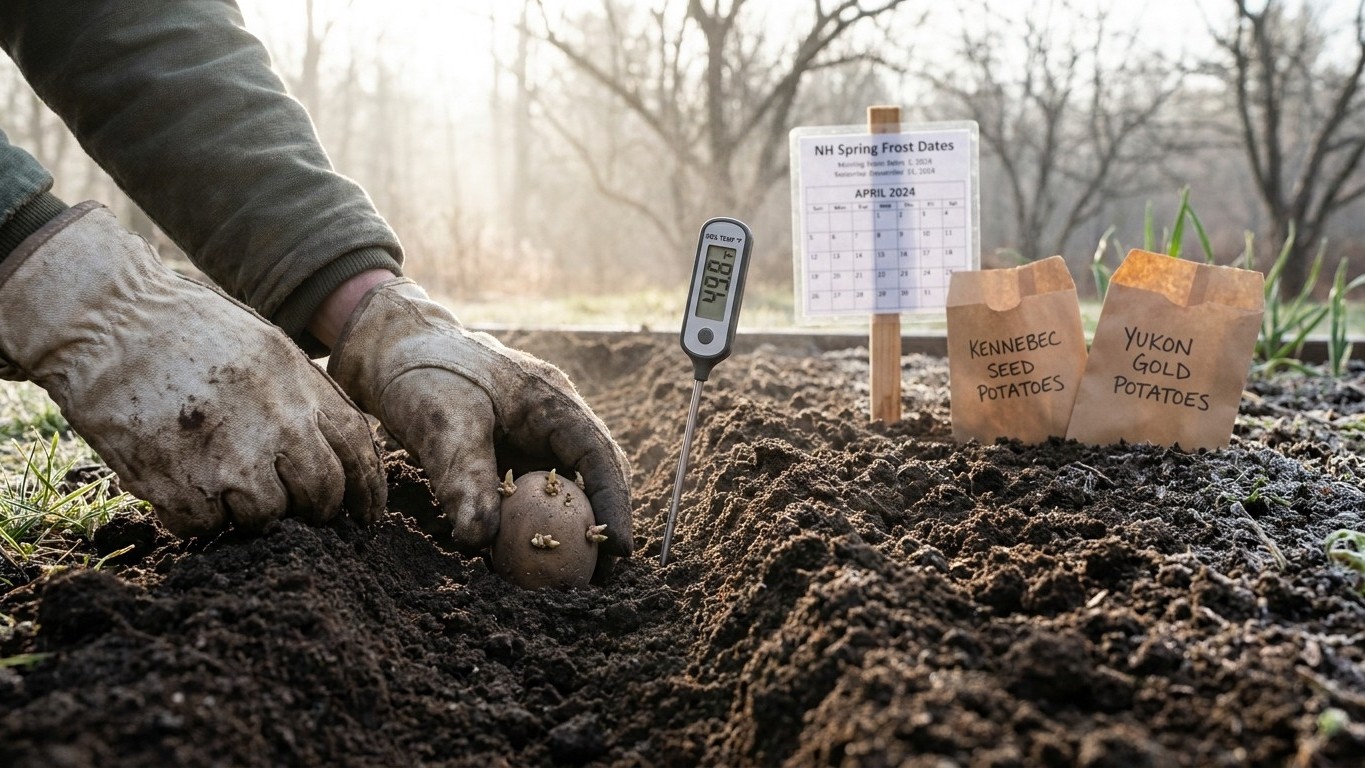

Gardeners in New Hampshire get the best results from early and mid-season potato varieties, planted as soon as soil reaches 50°F, roughly 14 to 21 days before the last spring frost. In the Manchester area, that frost date falls between April 16 and April 27, according to NOAA NCEI’s 1991-2020 Climate Normals. That window, not the calendar month, is what should set your planting date.
The short answer
Potato roots don’t care what the calendar says. They care about soil temperature, and NOAA NCEI’s Climate Normals data for the Manchester weather station puts the last spring freeze somewhere between April 16 and April 27 in a typical year. That’s a 30% to 70% probability band for a 32°F freeze, meaning even inside that window, frost is a coin flip some years. Soil planted for potatoes needs to hit 50°F, which usually happens two to three weeks before that last frost date, not after it. That timing detail matters more for New Hampshire than for warmer states, because the growing season here is short enough that every week counts toward whether tubers finish sizing before summer heat shuts them down.
Given that compressed window, early and mid-season varieties are the practical choice for most of the state. Late-season types aren’t off the table everywhere, but they demand a longer stretch of mild soil temperatures than much of New Hampshire reliably offers, especially at higher elevations or in the North Country, where the frost-free period runs shorter than in the Manchester reference data.
One thing that doesn’t change by variety: seed source. Certified seed potatoes matter regardless of season class, because uncertified seed stock carries viruses that stunt growth and cut yield before you’ve even had a chance to test how a variety performs in your soil. That single choice, certified versus uncertified, does more to determine your harvest than almost any other decision in this whole process.
Neither the University of Maine Cooperative Extension nor Utah State University Extension publishes exact days-to-maturity numbers for individual varieties, and for good reason: maturity in potatoes is driven by soil temperature and day length, not a fixed calendar count. What both sources do publish is season class, early, mid-season, or late, and that classification is the useful planning tool. An early variety bulks up its tubers faster and tolerates a shorter cool window. A late variety needs a longer stretch of moderate soil temperatures to fill out, which is exactly the resource New Hampshire’s compressed spring-to-summer transition doesn’t offer in abundance.
What actually decides it
Two separate mechanisms govern whether a potato variety works in a given New Hampshire garden, and they don’t always point the same direction. Understanding both lets you reason through a location this article never mentions, whether that’s a hillside garden in the Monadnock region or a raised bed in the Seacoast.
The frost window sets your start line
The NOAA NCEI data for the Manchester station gives a last-frost range of April 16 to April 27. That’s a reference figure tied to one weather station, not a statewide guarantee. Gardens in valleys, at higher elevations, or farther north in Coos County typically see their last frost land later, sometimes by a week or two beyond what the Manchester numbers suggest. The reverse also holds in fall: first frost tends to arrive earlier outside the immediate reference-city area. Practically, this means a gardener in Colebrook or Berlin should treat the Manchester dates as an optimistic floor, not a working plan, and check local frost records or a county extension office before committing to a planting date.
The heat ceiling sets your finish line
Potatoes stop sizing when soil temperatures climb above 90°F, according to Utah State University Extension and the University of Maine Cooperative Extension’s Bulletin #2077. Tuber set and fill both shut down at that threshold, and no amount of irrigation reverses it once soil heat has crossed that line. This is the mechanism that decides more of the outcome than any other single factor, because it means a long, hot stretch in July doesn’t just stress the plant, it actively halts the process that produces the harvest. Where a county sees frequent stretches above that threshold, the workable strategy is to plant early enough that the crop matures and is ready to dig before peak summer heat sets in, rather than trying to carry a late variety through the hottest weeks of the year. That’s the logic that favors early and mid-season classes across most of New Hampshire: they finish their bulking phase while soil temperatures are still cooperative, sidestepping the heat ceiling instead of fighting it.
How to do it
- Check your local frost history rather than relying solely on the Manchester reference figures, since gardens outside that immediate area often see later spring frosts and earlier fall ones.
- Buy certified seed potatoes from a reputable supplier. Uncertified seed can carry viruses that reduce yield regardless of how well-suited the variety is to your climate.
- Test soil temperature with a soil thermometer at planting depth. Wait until it reaches 50°F before planting, which typically falls 14 to 21 days ahead of your local last-frost date.
- Choose a season class, early or mid-season, matched to how long your local growing window runs before soil temperatures push past 90°F in midsummer.
- Cut and cure seed pieces if using large seed potatoes, then plant with eyes facing up, spacing rows to allow for hilling as plants grow.
- Hill soil around the base of the plants as they grow to protect developing tubers from sunlight and to help regulate soil temperature.
- Monitor soil temperature through the growing season. If a heat wave pushes soil above 90°F, prioritize even soil moisture, since that’s the only lever left once heat has already begun suppressing tuber fill.
- Dig early and mid-season varieties promptly once foliage begins to die back, rather than leaving them in the ground through the hottest part of summer.
What goes wrong
- Planting by calendar date instead of soil temperature. A gardener who plants on a fixed date regardless of conditions risks either rotting seed in cold, wet soil or missing the early window entirely. Check soil temperature directly and plant once it holds at 50°F.
- Using saved or uncertified seed potatoes. Seed saved from a grocery store potato or an uncertified source often carries viral disease that weakens the plant before it ever faces New Hampshire’s frost or heat pressures. Source certified seed each season instead.
- Choosing a late-season variety in a short-season county. In areas where the frost-free window runs shorter than the Manchester reference figures suggest, a late variety may not finish bulking before fall frost arrives. Switch to an early or mid-season class matched to your actual local window.
- Assuming irrigation fixes heat stress. Once soil temperature crosses 90°F, watering keeps the plant alive but doesn’t restart tuber sizing. The fix is timing, planting early enough that the bulking phase finishes before that heat threshold is reached, not compensating after the fact.
- Ignoring elevation and microclimate. A garden a few hundred feet higher in elevation, or tucked in a low frost pocket, can run a week or two colder than the Manchester data implies. Track your own site’s frost history over a season or two rather than trusting a single regional figure.
Common questions
Can I grow a late-season potato variety anywhere in New Hampshire?
It depends entirely on your local frost-free window. Where the season runs long enough for soil to stay below 90°F through the bulking period, a late variety can work. In shorter-season counties or at higher elevations, an early or mid-season class is the safer match, since it finishes before the heat ceiling or fall frost arrives.
How do I know if my soil has reached 50°F for planting?
Use a soil thermometer inserted at planting depth, generally a few inches down, and check it over several consecutive days rather than relying on a single reading. Air temperature alone doesn’t tell you what the soil is doing.
Why does certified seed matter if a variety is already well-suited to my climate?
Season class only determines whether a variety’s growth pattern fits your frost and heat windows. It says nothing about the seed’s health. Uncertified seed can carry viruses that reduce vigor and yield no matter how well the variety otherwise matches your conditions.
What happens if a heat wave hits after tubers have already set?
Soil above 90°F halts further tuber sizing, and that effect isn’t reversed by watering once it’s underway, per Utah State University Extension and University of Maine Cooperative Extension guidance. The practical response is to keep soil moisture even to protect existing tubers and plan next season’s planting date earlier to finish bulking before that heat threshold typically arrives.