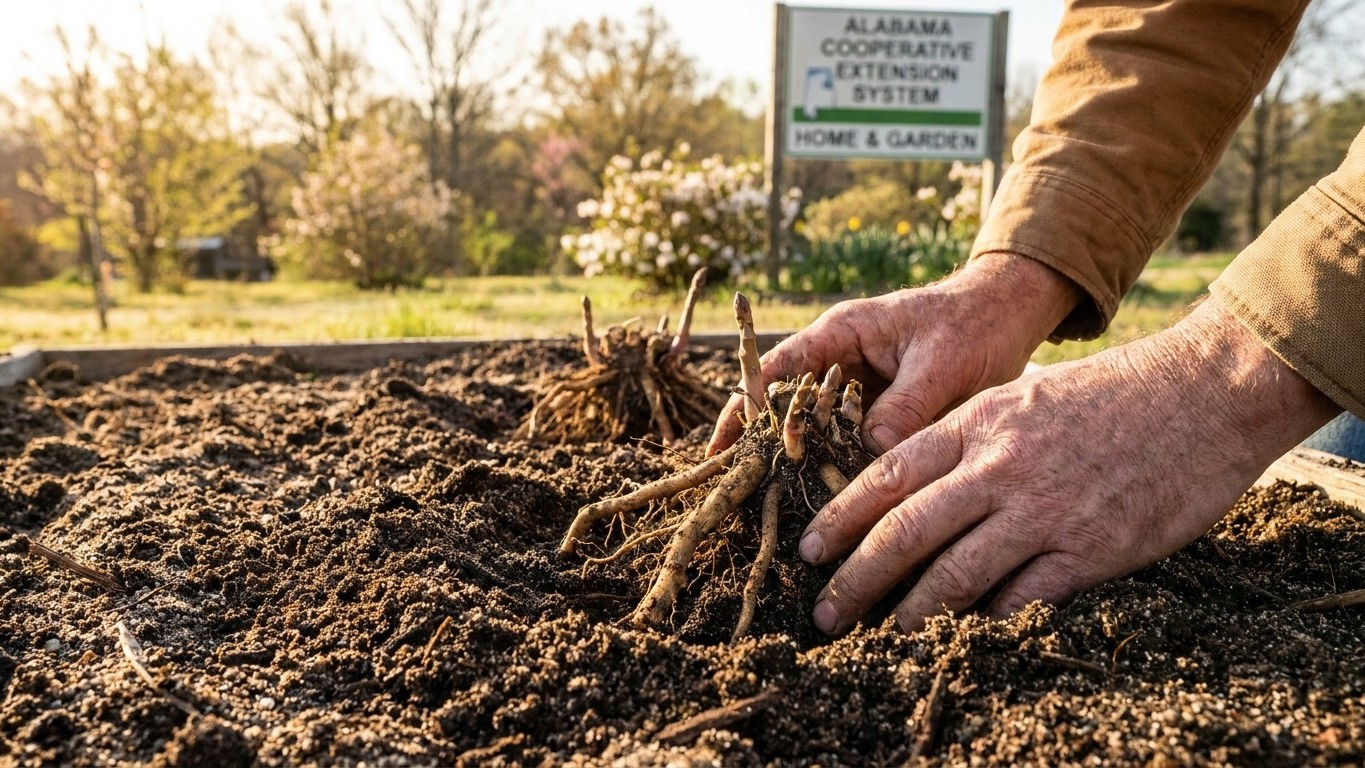

The short version: put Asparagus Crowns in the ground in early spring, timed to New Hampshire’s last frost window, once the soil has thawed and dried enough to work. But that one-line answer skips the part that actually matters here, the ground you’re choosing, the water it will or won’t get on its own, and the three-year wait before you cut a single spear.
The short answer
an Asparagus Bed isn’t a season’s project. Once crowns go in, that patch of ground is spoken for, in Utah State University Extension’s own terms, for 10 to 15 years of production. That’s longer than most people keep a car. Before any furrow gets dug, the only real requirement the source sets is drainage: asparagus wants ground that sheds water, not ground that holds it.
New Hampshire’s representative soil, the Marlow series that USDA NRCS lists for the state, happens to check that box. It’s mapped as well drained: a loam-to-silt mix running roughly 57 percent sand, 5 percent clay, 38 percent silt. Sand and silt in that proportion move water through rather than trapping it against the roots, which is exactly what a fifteen-year asparagus crown needs underneath it. USDA’s data on this series also records a surface pH near 3.5, strongly acid, and organic matter around 85 percent, but neither of those figures says anything about what asparagus prefers. The source on asparagus itself is silent on soil pH, so no acidity target is offered here, and that organic-matter number is a flag rather than a garden fact: a reading that high describes a natural forest litter layer, not a cultivated bed that’s been turned, amended and planted for years.
Here’s the catch, and it’s an important one: the Marlow series is what USDA lists as representative of New Hampshire soils. It is not a diagnosis of the particular yard behind a particular house. The state has river-bottom soils that drain fast, low spots that stay soggy into June, and any lot a builder graded or filled that behaves nothing like the mapped series. If a gardener digs a test hole eight or ten inches down after a rain and finds standing water sitting there an hour later, that ground doesn’t drain well enough for a permanent asparagus bed as it is. The fix isn’t to abandon the spot but to build up: a raised bed, or a mounded row, lifts the crowns above the slow-draining layer and lets gravity do what the native soil won’t.
The other part of that 10-to-15-year commitment is patience before payoff. There’s no harvest at all in the first three years : Utah State is direct on this point, no partial cutting, no “just a few spears.” Once harvest starts in year three, it runs about four weeks. The following year it stretches to six weeks, and after that to eight. The rule for when to stop each season isn’t a date on a calendar; it’s a look at the spears themselves. When most of what’s coming up is thinner than a pencil, cutting stops for the year, so the plant can put its energy into foliage instead of into feeding a gardener.
Will the summer here water it for you?
Asparagus roots want a steady drink, and the target changes as the bed matures: 1 to 2 inches of water every other week for the first two years, then a lighter 1 to 2 inches roughly every three weeks once the crowns are established. New Hampshire’s summer rain, measured at the NOAA reference station for the state, comes to about 10.7 inches total across June, July and August, with July the driest month at 3.3 inches, June at 4.04 and August at 3.35.
- Years one and two, June: the crop’s biweekly target works out to roughly 2 to 4 inches a month. June’s normal of 4.04 inches lands right at the top of that range, so a wet June can carry a new bed on its own.
- Years one and two, July: July’s normal drops to 3.3 inches, inside the range but closer to the low end, and July is also the month most likely to run dry in any given year. A young bed sitting through a dry July stretch will need a hose to close the gap.
- Years one and two, August: at 3.35 inches, August tracks close to July. Same logic applies: adequate on a normal year, short on a dry one.
- Year three onward: the established bed’s lighter need, about 1 to 2 inches every three weeks, works out to roughly 1.3 to 2.6 inches a month. Every summer month’s normal rainfall here clears that comfortably, so mature beds are far less dependent on supplemental watering than new ones.
- The catch with any normal: these are 1991-2020 averages for one reference station, not a promise for any single summer or any single yard. A rain shadow, a slope, or simply a dry year can undercut the average by a wide margin, which is why the only number that actually settles the question is a rain gauge sitting in that specific garden.
The upshot for a new bed is that a gardener should plan to water through most of a New Hampshire summer, not assume the sky will handle it, especially through the July dip. Once the bed matures past year two, the state’s average rainfall generally covers the lighter demand on its own.
When to put the crowns in
Crowns go into the ground in early spring, and in New Hampshire that lines up with the state’s last spring frost window, recorded by NOAA at around April 16 to April 27 for the reference station. That’s a mean figure built from three decades of freeze probabilities, not a guarantee for any one spring or any one county, a rural or elevated garden often sees frost linger a week or two past what an airport station records, so “around” is the operative word, not a fixed date to circle.
The planting method itself is simple but specific: crowns sit in furrows about 8 inches deep. The furrow isn’t filled in all at once. Soil goes back in gradually, about 2 inches every other month across the growing season, rather than burying the crown completely on planting day. That staged backfill gives the emerging shoots room to push upward through loose soil instead of forcing their way through a deep, compacted fill.
For anyone who’d rather skip transplanting altogether, seed is the other route into an Asparagus Bed, though it comes with a longer runway before the plant is established enough to treat like a crown-grown bed of the same age. Utah State’s guidance covers the crown method in detail; for a seed-started bed, the extra season or two of early growth simply pushes that three-year no-harvest clock out further.
Variety choice is worth a mention here, if only because so little about it is actually published. Utah State names four: Jersey Giant and Jersey Knight, both all-male hybrids, and UC 157 F1 and Purple Passion, both male-and-female types. That’s the full extent of what the source states about them, sex type, nothing about flavor, yield, or which performs better in a given climate. No nursery is named, and no case is made for choosing one over another. A gardener picking between them is picking based on availability, not on any documented performance difference.
Common questions
Can asparagus crowns go into wet, heavy soil if the bed is raised?
Yes, and that’s precisely the workaround for ground that doesn’t drain well on its own. Since the only stated soil requirement is drainage, raising the bed above a slow-draining layer meets that requirement without needing to change the native soil underneath.
Does the strongly acid pH of New Hampshire’s representative soil matter for asparagus?
The source on planting asparagus doesn’t state a pH preference, so no target or warning is offered here. The 3.5 figure describes the Marlow series’ surface horizon as mapped by USDA, not a number to plant against, and it isn’t the pH of any individual garden either.
Is there a set date to stop harvesting each season?
No date is given, and none should be assumed. The rule is a visual one: once most of the spears coming up are thinner than a pencil, harvest stops for the year so the fern can grow and feed the crown for next season.
How much watering does a newly planted bed need compared to an older one?
New beds, in their first two years, want 1 to 2 inches every other week. Once established from year three on, that eases to roughly the same amount but every three weeks, a lighter demand that New Hampshire’s summer rainfall normals generally meet on their own.