
In New Hampshire, spring spinach goes into the ground in late March to mid-April, timed 2 to 3 weeks before the last frost. The autumn crop is sown from late July through early September, counted backward from a harvest date that lands before the first fall frost. What decides both windows isn’t cold. It’s day length and soil heat working against a cool-season leaf crop.
The short answer
On the longest day of the year, the reference city for New Hampshire’s climate normals gets 15 hours and 10 minutes of daylight. That number matters more than any temperature reading, because spinach bolts under long days as much as it does under heat. A plant that’s cruising along in cool 60-degree weather will still throw a flower stalk if the days are long enough, no matter how mild the thermometer reads. So the idea that a cool New England summer “buys extra time” for spinach doesn’t hold. It’s backwards. The days get long here just like everywhere else at this latitude, and long days push the plant toward flowering regardless of how comfortable the air feels.
Heat plays a supporting role, not the lead. New Hampshire averages only 10.9 days a year that reach 90 degrees Fahrenheit or higher at the reference station, so brutal, prolonged heat waves aren’t the state’s defining feature. Growth quality for spinach starts to suffer once temperatures climb above 75 degrees Fahrenheit, and that ceiling gets crossed on plenty of ordinary July and August afternoons even without hitting the 90-degree mark. So the honest answer is that both forces are at work, but day length is the one that ends the spring crop even in a mild year, while heat mostly governs the summer months when sowing spinach at all is close to pointless.
This is the opposite of how day length works for a crop like onions, where long summer days are the trigger that builds the bulb. For spinach, the same long day is the trigger that ends the leaf harvest. Gardeners moving between crops in the same plot sometimes carry the wrong assumption from one to the other, and it costs them a planting. Spinach doesn’t need long days. It needs to be harvested before they arrive, and again before they’ve fully retreated in fall.
That framing sets up the two real questions New Hampshire gardeners have to answer each season: how much usable spring is actually available before the days get too long and the heat too persistent, and how late in summer can seed go into the ground so the fall crop matures before frost without germinating into soil that’s still too warm to cooperate.
How long the spring window really is
- Start with the last spring frost. At the reference weather station, that date falls between April 16 and April 27, based on NOAA’s 1991-2020 climate normals. Sowing 2 to 3 weeks ahead of that puts seed in the ground somewhere between March 26 and April 13, depending on how the current season is tracking and how quickly the particular garden’s soil is workable.
- Count the growing weeks that follow. From an early-April sowing, the plant has roughly eight to ten weeks before the lengthening days near the June solstice, when daylight approaches that 15-hour-and-10-minute peak, start tipping the crop toward flowering rather than leaf production.
- Watch the 75-degree ceiling inside that window. Even before bolting sets in from day length alone, any stretch of days pushing past 75 degrees will slow growth and add bitterness to the leaves. In a state where 90-degree days are rare but not absent, a warm spell in late May or June can tip the balance early.
- Treat suburban and rural gardens as running later. The frost dates above come from an airport weather station. Gardens away from that station, especially at elevation or in low-lying rural spots, often see their last spring frost land one to two weeks later, which shortens the safe sowing window on the front end even as it doesn’t change when the days get too long on the back end.
Put together, that’s a spring window best measured in weeks, not months: sow in the back half of March or the first half of April, expect roughly two months of good leaf growth, and plan to have the bulk of the harvest in before the days get long enough and warm enough to force the plant into flower.
The autumn crop, and when the soil lets you sow
Fall spinach in New Hampshire runs on a different clock than the spring crop. There’s no single “sow by” date published for autumn plantings. Instead, Utah State University Extension frames it as counting backward: plant 50 to 75 days before the date you actually want to harvest. That means the sowing date depends entirely on when the gardener expects the first fall frost to arrive and end useful growth.
Soil still too warm to germinate
The first obstacle isn’t cold at all. It’s heat still sitting in the soil from summer. Spinach seed germinates poorly once soil temperature climbs above 80 degrees Fahrenheit, and soil holds onto summer warmth well after air temperatures start to ease. With New Hampshire averaging 10.9 days a year at 90 degrees or hotter, the ground beneath a July or early-August garden bed is very likely to sit above that 80-degree germination threshold, especially in full sun with bare or dark soil. Sowing too early in this window often means seed that simply sits and rots rather than sprouts, not because of frost risk, but because the soil hasn’t cooled enough yet. Waiting for soil to drop below that mark, and giving beds afternoon shade or a layer of mulch to speed the cooling, matters more here than watching the calendar.
The frost that ends the season
The other boundary is the first fall frost, which at the reference weather station falls between October 13 and October 26, again drawn from the 1991-2020 NOAA climate normals. Counting back 50 to 75 days from that range puts a realistic sowing window somewhere between late July and early September, with the exact date depending on how much of that 50-to-75-day range a gardener wants to bank as a buffer. A gardener aiming for an early-to-mid October harvest, ahead of the earliest likely frost, would be sowing toward the end of July or in early August. One planting a bit later in that range, aimed at a harvest closer to the frost date itself, would sow in late August.
As with the spring dates, this frost window comes from an airport station and should be treated as a reference point, not a guarantee for every yard in the state. Rural and suburban gardens, particularly those at higher elevation or in low spots where cold air pools, commonly see their first fall frost arrive one to two weeks earlier than the station date. That shortens the safe autumn sowing window on the far end, so anyone gardening away from the immediate Manchester area should build in extra buffer rather than sowing right at the late edge of the 50-to-75-day range.
| Season | Sowing window | Main limiting factor |
|---|---|---|
| Spring | Late March to mid-April (2-3 weeks before April 16-27 last frost) | Lengthening days pushing toward 15h10 daylight, plus 75 F growth ceiling |
| Autumn | Late July to early September (50-75 days before October 13-26 first frost) | Soil still above 80 F germination threshold in high summer |
Four spinach varieties commonly discussed for home gardens are Bloomsdale, Melody, Teton, and Olympia. Utah State University Extension names these varieties without publishing performance data or days-to-maturity figures for any of them, so there’s no verified basis here for recommending one over another for New Hampshire conditions specifically. Choosing among them is better handled by checking current seed packet information than by relying on any single source.
Common questions
Can spinach be sown in the middle of summer in New Hampshire?
Not reliably. Mid-summer sits inside the stretch when soil temperatures are most likely to sit above the 80-degree germination threshold, and the long daylight hours of that period would push any surviving seedlings toward bolting rather than leaf growth. The better strategy is waiting until soil cools later in summer, within the 50-to-75-day countback from the expected first frost.
Does New Hampshire’s relatively mild summer heat mean spinach can be sown later in spring?
No. The 10.9 average days a year above 90 degrees make heat a secondary concern here, but day length keeps climbing toward that 15-hour-and-10-minute peak regardless of temperature. Long days trigger bolting on their own, so a mild summer doesn’t extend the spring sowing window the way it might for a crop limited by heat alone.
How can a gardener tell if soil is still too warm for fall sowing?
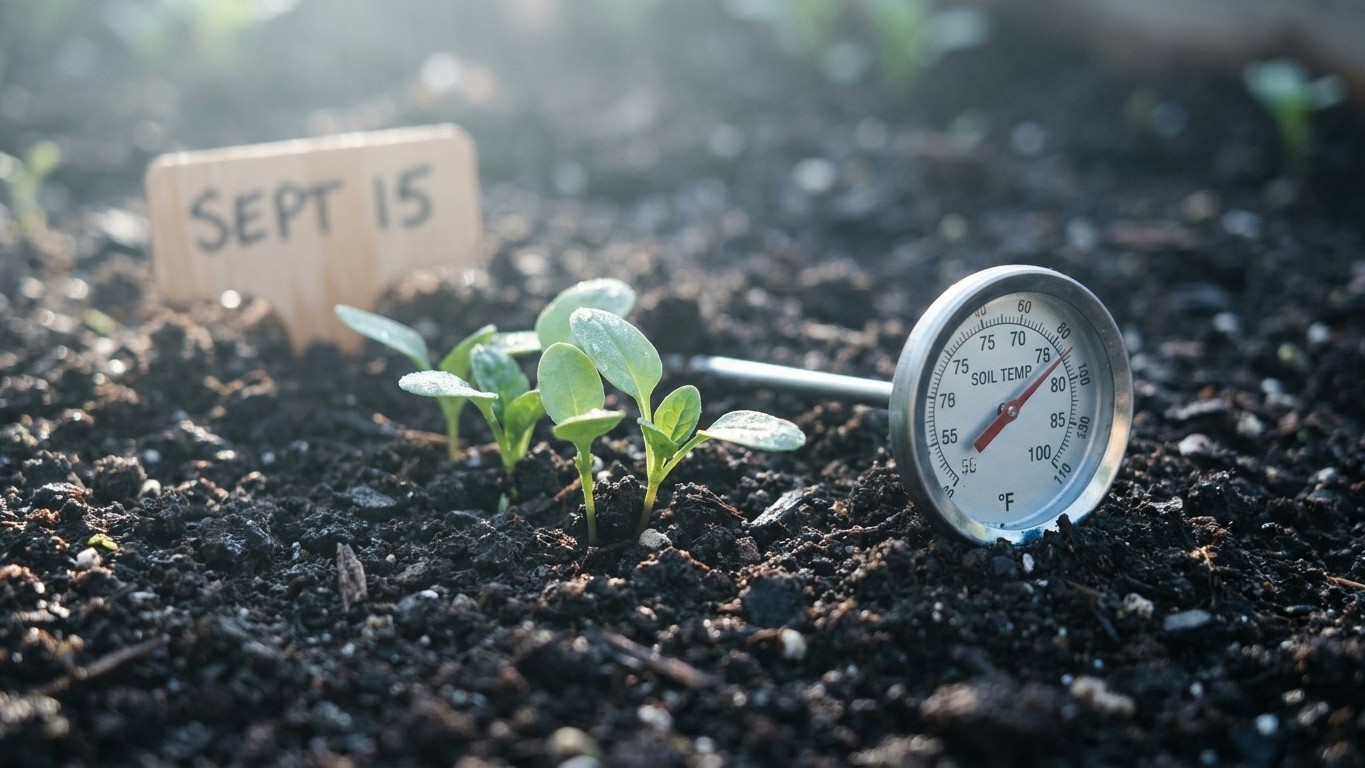
The published threshold from Utah State University Extension is 80 degrees Fahrenheit soil temperature, above which germination drops off. A basic soil thermometer inserted a couple inches deep gives a direct reading; air temperature alone isn’t a reliable stand-in, since soil holds summer heat longer than the air above it.
Should the frost dates from the reference weather station be trusted for every New Hampshire garden?
Only as a starting point. Those April 16-27 and October 13-26 windows come from a single airport station under the NOAA 1991-2020 climate normals. Gardens elsewhere in the state, especially at higher elevation or in rural low-lying areas, typically see later last spring frosts and earlier first fall frosts, often by one to two weeks. Checking local conditions and county-level records adjusts the sowing math accordingly.