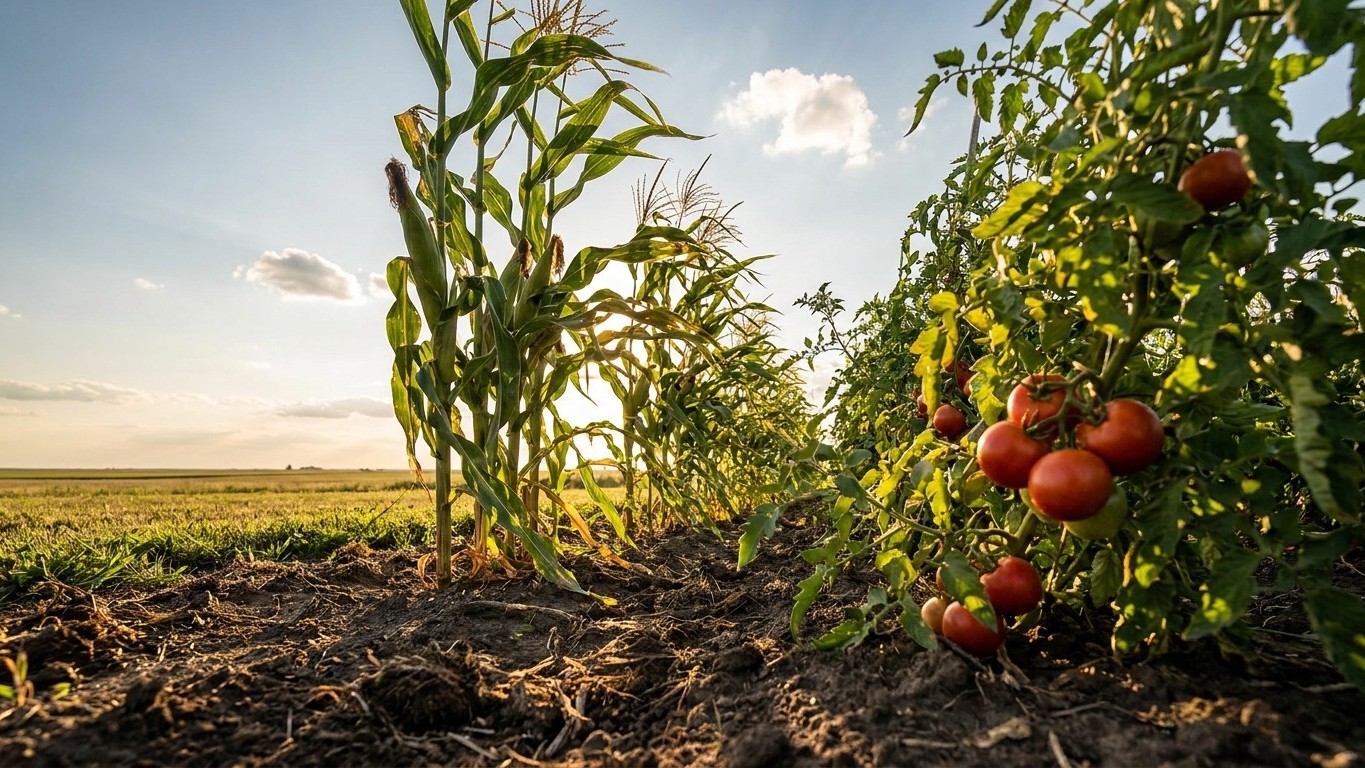

Corn in New Hampshire rarely loses to one big enemy. It loses to three quiet ones: soil that stays cold well after the last frost, a first fall freeze that arrives in mid-to-late October at the reference station, and two sweet corn types tasseling side by side. Insects and wildlife are a separate subject, and this page carries no figures for them. What follows is the calendar, the arithmetic, and the failures that come out of it.
The short answer
Soil reaches 60 F later than the last frost, and that gap catches plenty of gardeners every spring. The reference airport station in the NOAA NCEI U.S. Climate Normals puts the last spring frost between April 16 and April 27. Air warms past freezing in a hurry in April. Ground holds its chill for weeks longer. Utah State University Extension says sweet corn needs soil above 60 F, so the frost date marks the earliest you could start thinking about planting. It is never the day to sow.
Those frost dates describe the airport, not your yard. Suburban and rural gardens typically see the last spring frost later and the first fall frost earlier than the reference city, often by one to two weeks, and more at elevation. Look up the figures for your own county before you trust any date on this page, including the ones here.
The soil reading matters more than the calendar, and the depth matters as much as the number. Clemson Cooperative Extension’s guidance reads: “Do not plant before the soil temperature at the 4-inch depth is at least 50 ºF. Wait to plant extra-sweet varieties until soil temperatures reach 65 °F.” A surface reading runs warmer than the seed zone, so push a thermometer four inches down in the morning, when the ground is at its coldest. The two thresholds are not interchangeable. Ordinary sweet corn can go in at 50 F. A supersweet (sh2) seed sown at that temperature tends to rot rather than sprout, which explains how one gardener can succeed one year and fail the next just by switching varieties.
Does 60 to 90 days fit before autumn? Mostly, yes. The reference station’s first fall frost falls between October 13 and October 26, and the next section does the arithmetic. The short version is that a 60-day corn fits with room to spare, a 90-day corn fits in a normal year at the reference city, and the margin thins fast in a cold, high garden.
Summer heat is not the limiting factor here. The Manchester reference station averages 10.9 days a year at 90 F or higher. That is a light heat load, and it means corn rarely cooks in the field. Heat matters after picking, though. Clemson’s fact sheet says that “Sweet corn loses sugar from the kernel rapidly at high temperatures,” which is the real reason behind the old advice about running from the garden to the pot. If you want the full growing picture, start with Growing Sweet Corn in New Hampshire. For the sowing side, see When to Sow Sweet Corn in New Hampshire.
Does a late variety fit here?
The test is simple subtraction. Take the days between the last spring frost and the first fall frost, subtract the weeks lost waiting for warm soil, and see whether 60 or 90 days remain. At the reference station, the tightest pairing is a last frost on April 27 and a first fall frost on October 13. That is 169 days. The most generous pairing, April 16 to October 26, gives 193.
A 60-day variety
Take the tight 169-day window and assume, as an illustration and not a published figure, that soil needs five more weeks after the last frost to warm up. That leaves 134 days. Now take away another four weeks, the worst case if your garden runs two weeks later in spring and two weeks earlier in fall than the airport. You still have 106 days. A 60-day corn finishes with about 46 days of cushion, which covers a cold June, a slow start, or a seed packet that was optimistic.
That cushion is why an early variety is the safe choice for hill towns, north-facing lots and anywhere frost pockets form. It also lets you sow a second planting a couple of weeks after the first, so the harvest does not all land in a single weekend. Keep the tasseling rule from the next section in mind if the two plantings are different types.
A 90-day variety
Run the same numbers. In the 106-day worst case, a 90-day corn has 16 days to spare. At the reference station in a typical year it fits. The margin is thin, though, and elevation takes more off the top than the example allows. A garden a few hundred feet up a hillside, or sitting in a low spot where cold air pools, can lose the whole cushion and then some.
So the plain answer: a late variety does not reliably fit in cold, high or frost-prone gardens in New Hampshire, and it fits only narrowly everywhere else. If you are sowing right at the soil-temperature threshold and your county’s first fall frost lands on the early side of the range, choose the shorter variety. The packet’s day count runs from planting, not from the last frost, and a cool spring slows the clock. For the ripening side of the question, see Will Sweet Corn Ripen in New Hampshire?
What goes wrong here
Three failures account for most of the disappointing patches. Two come from the climate. The third has nothing to do with it.
- Soil sown too cold. Planting on the strength of a warm spell or a frost date leaves seed sitting in ground that is still cold at four inches. Extra-sweet types suffer most, since they want 65 F and rot below it. Remedy: use a thermometer at the 4-inch depth, hold ordinary sweet corn until 50 F at minimum (Utah State’s guidance is soil above 60 F), and hold extra-sweet until 65 F. Use the soil reading, not a calendar date.
- A variety too late for the season. A 90-day corn sown after a slow spring runs into the first fall frost, which falls between October 13 and October 26 at the reference station and earlier in many rural gardens. Ears stall half-filled. Remedy: count forward from your real planting day, subtract a week or two for your county’s earlier fall frost, and pick a shorter variety if the answer is close.
- Sweetness lost to the neighbors. This one happens in any climate. Utah State University Extension says sweetness is lost if su, se and sh2 types tassel at the same time. The source gives no distance for keeping them apart, so build the plan on timing instead. Grow one type, or stagger plantings so different types are not shedding pollen while the other types’ silks are open. Plant in blocks of three or more rows rather than a single long row, which is a shape for the garden and not a date.
The third failure is the sneaky one because the corn looks perfect. Stalks are tall, ears are full, and the kernels taste starchy and flat. Check which types you have in the ground and when each will tassel before you plant, not after the ears disappoint you.
Common questions
Is the last frost date the day to plant sweet corn? No. The last frost at the reference airport station falls between April 16 and April 27, and the soil reaches 60 F well after that. Plant by soil temperature at the 4-inch depth. Your own county’s frost dates will likely run later than the airport’s. More on timing is in When to Sow Sweet Corn in New Hampshire.
How do I know when the ears are ready? Two separate clocks apply. The 60 to 90 days from planting tells you whether a variety fits the season. Picking is a different clock, 17 to 24 days from silk emergence. In the garden, use three signs together: dry brown silks, husks that are still moist and green, and milky juice from a punctured kernel. One sign alone can mislead you.
How far apart should different sweet corn types be? The source gives no distance, and any number you hear for it did not come from here. What is published is the condition: su, se and sh2 types lose sweetness if they tassel at the same time. Separate the plantings by timing, keep one type if you can, and grow in blocks of three or more rows.
How long does picked corn stay sweet? Clemson Extension says: “Sweet corn can be stored under optimal conditions for about five days, but will lose sweetness with each day of storage.” Five days is a ceiling under ideal conditions, not a promise. Genotype changes the pace. The su type loses sugar fastest, se holds it longer, and sh2 holds it longest, which is the practical reason to pick sh2 if you cannot eat the corn the day you harvest it.