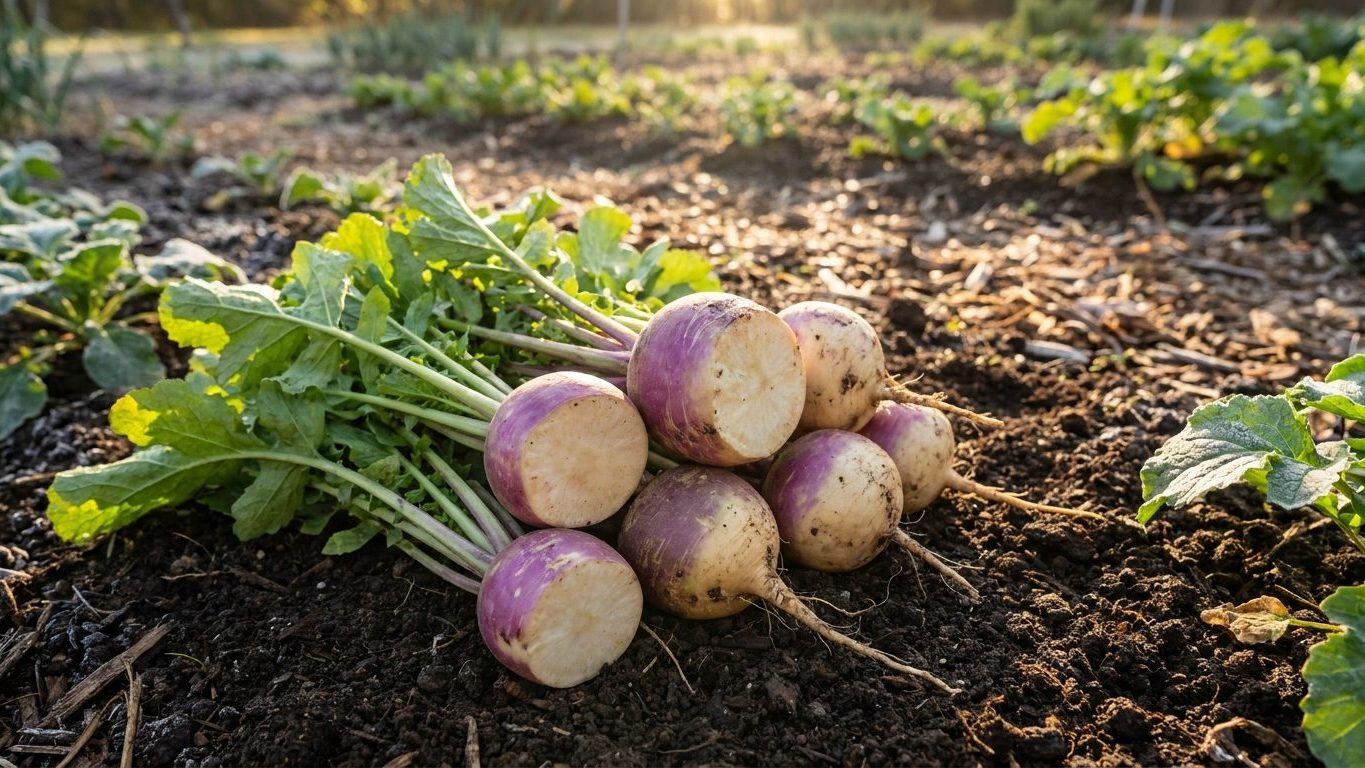

Turnips and rutabaga do best in New Hampshire as an autumn crop, sown so the roots size up in cool weather and finish under the first frosts. A spring sowing is possible once the soil is workable after the last frost, April 16 to April 27 at the reference airport station, though most gardens run later. The limits here are cold ones, not heat. For the crop in general, start with Growing Turnips and Rutabaga: An Autumn Crop, Sweetened by Frost.
When the soil is warm enough in New Hampshire
The last spring frost in the reference data falls between April 16 and April 27. That comes from the NOAA NCEI U.S. Climate Normals 1991-2020, using the 32F freeze probabilities (30-70% band) at the airport station in that file (station USW00014710). It is a reference-city figure, not a statewide guarantee. Suburban and rural gardens typically see the last frost later, often by one to two weeks, and more at elevation, so check your own county before you mark a calendar. A frost date is a probability, not a promise. Some years the last freeze comes before the window, some years after.
Why the frost date is only a proxy
Seeds do not read air temperature. They sit in soil, and soil lags behind the air. After the last freeze, the ground still has to shed its winter chill, drain after snowmelt and spring rain, and crumble instead of smearing in your hand. In practice the soil is ready some days after the frost risk ends, not on the day it ends. A cheap soil thermometer and a handful of soil squeezed in your fist (it should break apart, not hold as a wet ball) will tell you more than the date does.
Turnips and rutabaga also split into two jobs on the calendar. Quick, small-rooted turnip types suit a spring sowing, and they want to be harvested before summer heat turns them pithy or sharp. Rutabaga is a long-season root that suits summer sowing. Its roots size up through late summer and fall, and it finishes as the nights chill. For that crop, the date that matters is the first fall frost. Take the days to maturity from the seed packet and count backward from your local fall frost, with a few days of cushion.
Which varieties have been trialled in your part of the state is a question for University of New Hampshire Extension, not for a general page. Local trials account for the soil, the elevation and the pests that a county actually sees. A gardener in the Seacoast and one near the White Mountains are working with different calendars.
How long the season lasts here
Both ends of the season come from the same NOAA source, so the subtraction is honest. Here are the reference airport windows:
| Milestone | Reference window (NOAA 1991-2020) |
|---|---|
| Last spring frost | April 16 to April 27 |
| First fall frost | October 13 to October 26 |
Pair the latest spring date with the earliest fall date and you get 169 days, from April 27 to October 13. Pair the earliest spring date with the latest fall date and you get 193 days, from April 16 to October 26. So the frost-free window at the reference station runs from about 24 to about 27 weeks. Those two extremes are the edges of the band, not the typical year, and a garden that loses one to two weeks at each end could be working with a month less than the longest figure.
What does that length allow? Enough for two plantings of a quick turnip type: one in spring, and one in late summer timed to mature in the cool tail of the season. It does not allow much improvisation with rutabaga. A long-season root sown late has nothing to make up the shortfall with, and a cold snap near the early end of the fall window arrives before the roots have bulked up. For the timing of repeat sowings, the succession sowing guide on this site lays out the method.
The window also bears on transplanting. A taproot crop does not like being moved, because a damaged tip can leave a forked or stunted root. In a long window you can sow in place and recover from a failed row. In a shorter one, such as a hilltop garden near the early end of the fall range, direct sowing is still the better bet, because transplant shock costs more than the weeks it saves. If you do transplant, check the roots at planting and set the seedlings no deeper than they grew.
Heat and water in New Hampshire
This page does not carry a verified count of days above 90 F or a summer rainfall total for the state, and a guessed number would be worse than none. What the verified figures do show is a cold place. The USDA Plant Hardiness Zone Map 2023 (built on 1991-2020 normals) puts New Hampshire at 3b to 6a, a wide range, because that zone system rests on one variable, the average annual extreme minimum temperature. Other parts of the state differ from the reference city, sometimes by several zones. For a crop that finishes in fall, extreme heat is rarely the governing worry. A cool, damp summer is the risk instead: slow ripening, powdery and downy mildews, foliage that stays wet, and roots that sit in saturated soil.
Turnip and rutabaga are brassicas. They share their diseases and insect pests with cabbage, kale and mustard. A gardener who rotates turnips into a bed that held cabbage last year has rotated nothing, so the rotation page on this site is worth reading before you choose a bed. Even moisture helps, since swings between dry spells and downpours push roots toward cracking and toughness, but standing water in a wet summer invites rot.
Lifting versus leaving roots in the ground
The coldest month decides how you finish the crop. At the Manchester reference station, the mean daily minimum of the coldest month is 17.1 F. That is an average night low, not the record low, which is lower. With nights like that, and colder ones in the northern zones, the ground freezes hard. Mulch can hold roots in the soil through the fall and perhaps into early winter, but it will not carry them through the dead of winter in the colder parts of the state. Where the ground freezes hard, lift them.
The same cold sets the sweetening. Roots turn sweeter in the stretch after the first fall frost (October 13 to October 26 at the reference station) and before the ground locks up. How long that stretch lasts varies by site and by year. It is longer in a mild autumn and short where freezes come early. For other cold-state timing, compare Growing Turnips and Rutabaga in Wisconsin and Growing Turnips and Rutabaga in Alaska.
Storage is a food safety question. Do not trust a root because it looks sound. Inspect each one: check the shoulder, the crown and the cut end. A soft patch, a weeping spot or a moldy crown ends the question, and that root should not be eaten or stored with the rest. Check stored roots regularly and remove any that fail the inspection before they spread trouble.
Which turnips and rutabaga suit New Hampshire
The choice here is by type, and no named variety belongs on this page. This page has no local trial data behind it. A variety that performs in Georgia or Oregon says little about a garden near Keene or Littleton, and a made-up recommendation would be worse than none. The state extension service holds what counts, the varieties trialled in New Hampshire, and University of New Hampshire Extension is the place to ask.
The facts for this state still narrow the type. Here is how each condition shapes the choice:
| Condition | What it favors |
|---|---|
| Short window at the cold end (169 days or fewer in a rural or high garden) | The earliest-maturing types, sown on time |
| Cool, damp summers | Disease resistance as the first criterion, plus wide spacing for airflow |
| Hard ground freeze in the colder zones | Types that store well after lifting, with a clean inspection |
| Heat spells in spring | Quick turnip types harvested before summer, with shade at the root from mulch |
Of these, disease resistance matters most in a damp year. Seed catalogs and extension bulletins state a variety’s resistances, and that label is worth more than a photograph of a perfect root. Also, a variety that sized up fast in a long season at the reference airport may stall in a garden with a window two weeks shorter.
One rule overrides every type decision. Whatever you pick, it is a brassica, so give it a bed that has not held cabbage, kale or mustard recently. The rotation page covers how long to wait.
Common questions
When can I sow turnips in spring in New Hampshire?
Once the soil is workable and has warmed after the last frost, which at the reference airport station falls between April 16 and April 27. Rural and higher gardens are often one to two weeks later, so check your county’s dates and test the soil, not just the calendar.
Can turnips and rutabaga stay in the ground over winter?
Under mulch they can stay into the cold months, but not through the worst of winter in the colder parts of the state. The coldest month averages a minimum of 17.1 F at Manchester, and the north runs colder. Lift the roots before the ground freezes hard.
Is a second sowing worth it?
The window at the reference station runs 169 to 193 days, long enough for a spring sowing of a quick turnip type and a late-summer sowing for fall. A short rural window may leave room for only one, so work out your own dates first.
How do I know whether a stored root is still good?
Inspect it. A soft patch, a weeping spot or a moldy crown ends the question, and looks alone prove nothing. Discard any root that fails, and check the rest often.