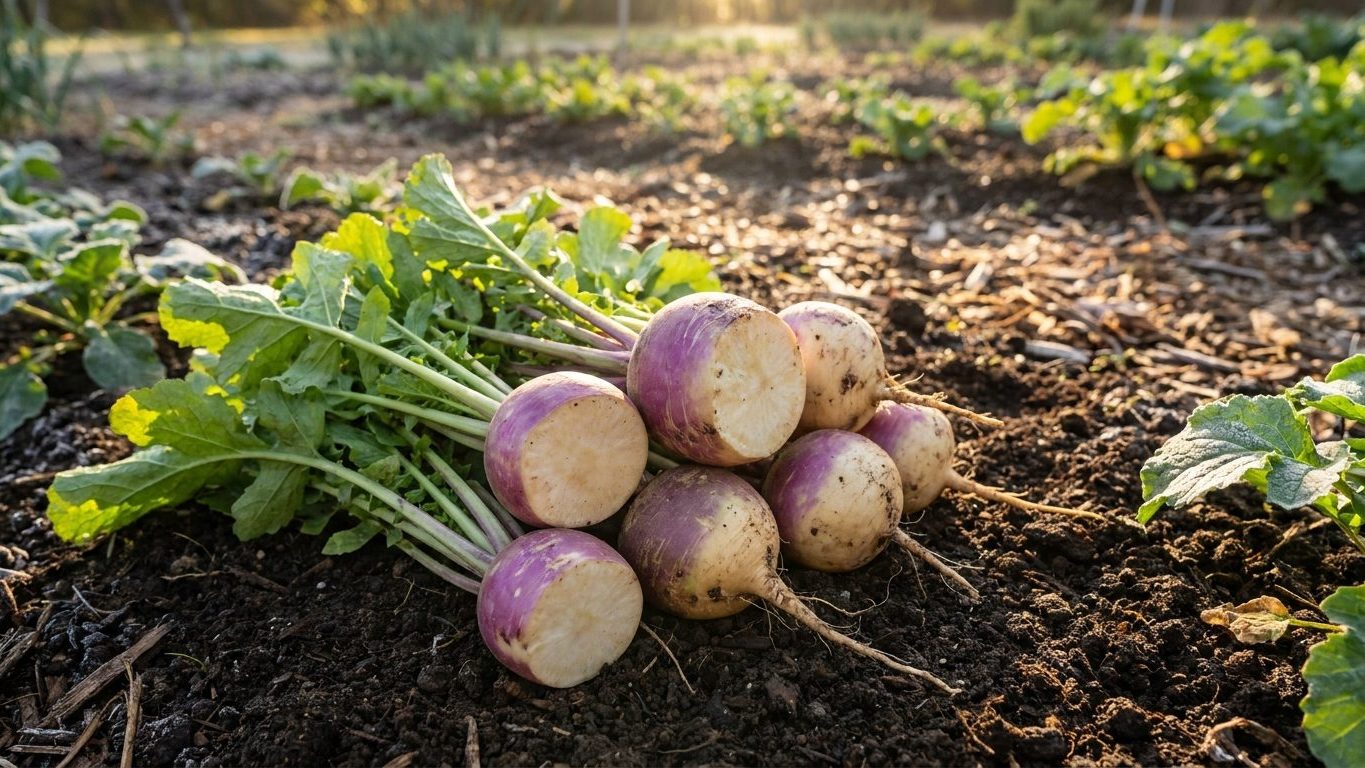

In New Jersey, turnips and rutabaga do best as a fall crop. Sow them in late summer so the roots size up in cool weather and catch the first frosts of November. A spring sowing can work too, but it has to beat the heat. The reference dates come from the Newark airport station, and your own garden will almost certainly run later in spring and earlier in fall.
When the soil is warm enough in New Jersey
The date most gardeners ask about is the last spring frost. According to the NOAA NCEI U.S. Climate Normals 1991-2020, the 30 to 70 percent probability band for a 32°F freeze at the Newark airport station runs from March 29 to April 6. That is a probability band, not a promise. Some years the last freeze comes earlier, some years later, and no calendar date will tell you which kind of spring you are in.
Treat that band as a stand-in for the thing you actually care about. Frost is air temperature. Turnips and rutabaga respond to soil, and soil warms after the frost risk ends, not on the same day. A bed can be frost-free by mid-April and still be cold, soggy and slow in the top few inches. Seed sown into that bed sits, rots or sprouts unevenly.
Why the airport figure runs early for most gardens
The dates above describe one airport in a built-up corridor, which holds heat. Suburban and rural gardens typically see the last spring frost one to two weeks later, and more than that at elevation, so the hills of the northwest are a different calendar from the shore. Check your county’s own normals before you pencil a date into a planner.
The practical test is cheap. Push a soil thermometer a couple of inches down in the morning, and look at the bed itself. If it crumbles in your hand instead of smearing, and water does not pool after rain, the soil is ready. These are cool-season roots, so they tolerate chilly ground better than beans or squash do. But cold, waterlogged ground in early spring is where seed fails, and a spring crop also has a deadline. Roots that mature as summer heat arrives turn woody and strong-flavored, or the plants bolt.
Talk in types here, not brand names. Small, quick, tender turnips suit spring sowing. Rutabaga needs a long stretch of cool weather to fill out, which makes it a fall crop in this state. The varieties that have actually been trialled in New Jersey are listed by the Rutgers New Jersey Agricultural Experiment Station, and that list beats any recommendation from a page that has never seen your soil. For the general crop picture, start with Growing Turnips and Rutabaga: An Autumn Crop, Sweetened by Frost.
How long the season lasts here
Both frost dates come from the same Newark station and the same NOAA normals, so the subtraction is honest. Count from the end of the spring band to the start of the fall band, and the frost-free window at the reference station runs between 212 and 232 days.
| Pairing | Last spring frost | First fall frost | Window |
|---|---|---|---|
| Tightest | April 6 | November 4 | 212 days |
| Most generous | March 29 | November 16 | 232 days |
That is a little over seven months at the airport. A garden that sees its last frost a week or two later and its first a week or two earlier loses somewhere between two and four weeks from that figure. Still a long window, just not as long as the table suggests.
What a long window allows
A window this long is the reason New Jersey gardeners are not forced to choose between spring and fall. A quick spring sowing of small turnips can come out before summer heat, and the bed can then be cleared and resown in late summer for the main crop. Rutabaga skips the spring round and goes in once, timed to finish in cool weather.
It also changes the transplanting question. Turnips and rutabaga form a taproot, and a disturbed root forks, stunts or splits. With a window this long, direct sowing nearly always wins, because you have the time to wait for the seed. Transplanting is worth the root-check gamble mostly where the season is too short to waste weeks, and New Jersey is not that place. Compare Alberta, where the first sowing is the only sowing, in Growing Turnips and Rutabaga in Alberta.
For fall roots, work backward from the first fall frost. Find the days to maturity printed on your seed packet, count back from the November band, and add a cushion, because growth slows as days shorten and nights cool. If you want a continuous harvest instead of one big pull, the succession sowing guide on this site lays out how to stagger sowings across the late-summer weeks.
Heat and water in New Jersey
This page does not carry a verified count of days above 90°F or a verified summer rainfall total for the state, and it will not guess at either. Any such count would apply to one reference station anyway, not to a shore town and a northwestern hillside at once. Look up your nearest station in NOAA’s normals if you want the numbers. The useful point is how they bear on this crop, and for a fall crop the heat matters less than you would expect.
Late-summer sowing means the seedlings meet the tail end of the hot, humid season. That is the stretch to manage. Keep the seedbed evenly moist, and where afternoon sun is punishing, shade the row with a cloth or a taller crop until the seedlings have their true leaves. Uneven watering later is what splits roots and makes them woody. Water at the base of the plants rather than overhead, so foliage dries quickly in humid weather.
Humidity is the real adversary. Warm, damp conditions favor leaf spots and mildew, and crowded plants hold moisture around their crowns. Thin to the spacing on the seed packet, even when it feels wasteful. Airflow is a disease-control measure you can take on the day you sow.
One warning on rotation. Turnips and rutabaga are brassicas, so they share their troubles with cabbage, kale and mustard. A gardener who moves them into a bed that held cabbage last year has rotated nothing, because the pests and soil diseases are the same. Clubroot, which favors acidic, wet soil, is the one to take seriously. Check the rotation page on this site before you pick a bed.
The cold figures that govern the crop
The two facts that matter most are cold ones. The mean daily minimum of the coldest month at Newark is 25.5°F (NOAA NCEI Climate Normals 1991-2020). That is an average of the nightly lows, not the record low, so individual nights drop well below it. The USDA Plant Hardiness Zone Map 2023 puts the state across zones 6a to 7b, which is a wide range. The southern and coastal parts of the state sit at the mild end, the northwest at the cold end.
For roots, that spread decides the overwintering question. In milder spots, a thick mulch over the bed may keep the ground workable so you can pull roots as you need them, but the average night in the coldest month is already below freezing, so this is a gamble, not a plan. In the colder parts, lift the roots before the ground freezes hard and store them.
The same cold gives the sweetness. The first fall frost at Newark arrives between November 4 and November 16, and the weeks after it, before the ground locks up, are when roots sweeten. That stretch is generous in most of the state, which is a point in favor of a late-summer sowing.
Storage is a food-safety question, so inspect before you trust. Check each root for soft patches, weeping spots and moldy crowns. Any one of those ends the question for that root, and a sound-looking skin elsewhere does not rescue it. Do not assume a root is safe because it looks fine from one side.
Which turnips and rutabaga suit New Jersey
Choose by type, using what the state’s climate tells you. A window of 212 to 232 days at the reference station, shrinking in the suburbs and the hills, is long enough for either crop but not long enough to be careless. For a spring sowing, favor the earliest, fastest types, because they must size up before summer heat. Slower, larger types belong in the fall plan.
Heat and humidity point to two further criteria. Types that tolerate heat in the seedling stage, and that hold their foliage open rather than in a dense, damp clump, give you airflow at the root. And because the state’s summers run humid, disease resistance should be the first thing you look for on the seed packet or in the catalog description, ahead of color, size or flavor claims.
For rutabaga, the type to look for is simply one suited to a long, cool fall, since it is the slowest of the two to mature. A bed sown too late will not size up before the cold arrives, so count back from the first fall frost.
This page names no cultivars, and that is deliberate. A variety name only means something if it has been grown and judged in conditions like yours, and this page has no trial data for New Jersey. Naming one would be guessing, and gardeners notice a wrong guess at once. The Rutgers New Jersey Agricultural Experiment Station is the place to ask, since its recommendations come from what has actually grown in the state. A county extension office can tell you which of the state’s three or four distinct climates yours resembles.
Gardeners in the north of the state who want to compare notes with a neighbor across the line can read Growing Turnips and Rutabaga in New York.
Common questions
When can I sow turnips in New Jersey in spring?
Once the bed has dried and crumbles rather than smears, which usually comes after the frost band at Newark (March 29 to April 6) has passed. Your garden’s frost date is likely one to two weeks later. Go by soil condition, and finish the spring crop before summer heat.
When do I sow for a fall harvest?
Late summer. Find the days to maturity on your seed packet, count back from the first fall frost (November 4 to November 16 at Newark, earlier in most gardens), and add a cushion for the slower growth of shortening days.
Can I leave turnips and rutabaga in the ground over winter?
In the milder parts of the state, a thick mulch may let you leave them in the ground. But the average coldest-month night at Newark is 25.5°F, and the state spans USDA zones 6a to 7b. In the colder parts, lift the roots before the ground freezes hard.
How do I know whether a stored root is still good?
Inspect each one. A soft patch, a weeping spot or a moldy crown ends the question, and a firm look elsewhere on the root does not make it safe. Discard it rather than cutting around the problem.