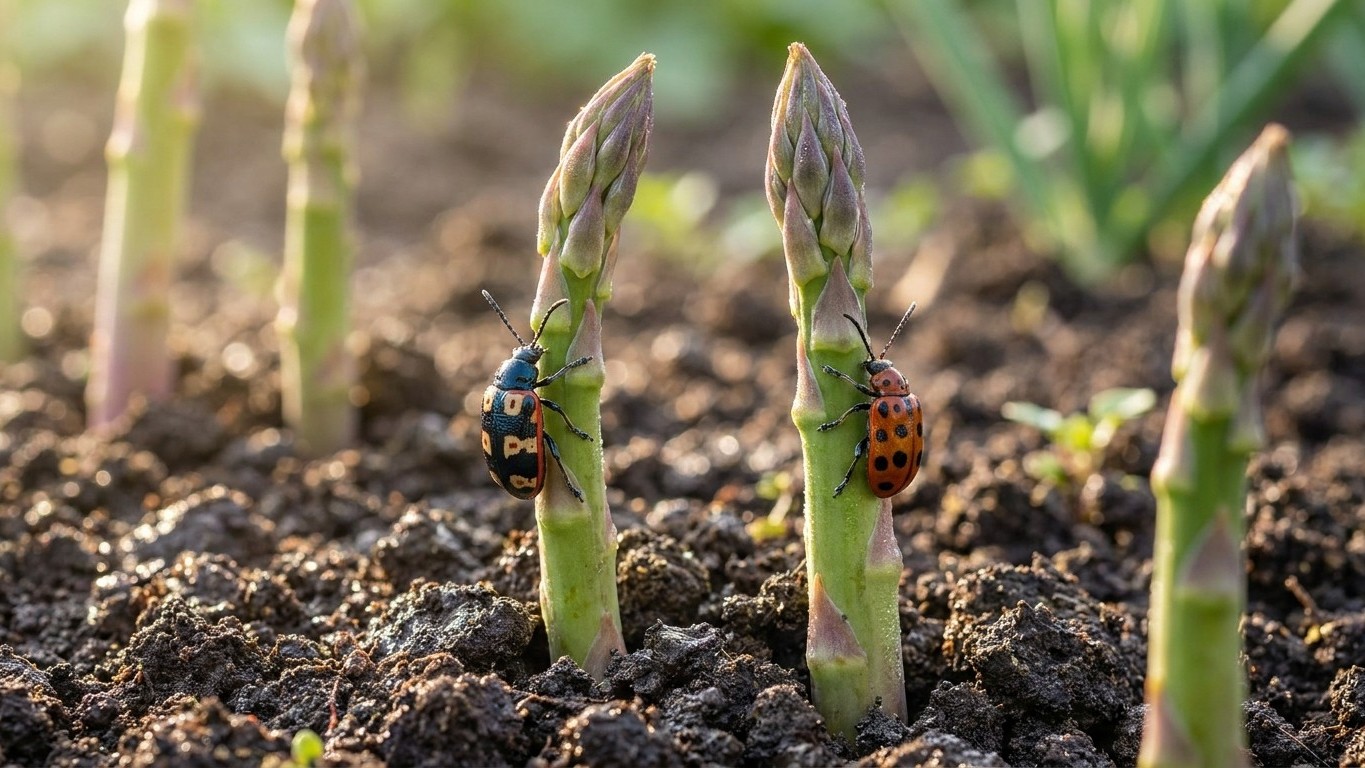

Nothing in the verified material behind this page names a specific asparagus pest or gives a New Jersey pest calendar, and an invented one would be worse than a gap. What the sources do settle is the ground, the water and the planting window for a bed meant to produce for 10 to 15 years. For naming a pest and timing a response, take a specimen or clear photo to your county extension office.
The short answer
An asparagus bed is the one crop where you pick a spot and live with it. Crowns go into 8-inch furrows, nothing is harvested until year 3, and then the bed produces for 10 to 15 years. The only soil requirement in the Utah State University Extension guidance is that it drains. Most soils will do, provided the water leaves.
On that single test, New Jersey’s state soil passes easily. The Downer series, an Ultisol, is classed as well drained, and the USDA’s representative figures for its surface layer explain why: 79 percent sand, 6 percent clay, 15 percent silt. Water moves through that kind of ground quickly. Ultisols are also old, heavily weathered and leached, which is why this one is naturally acid and low in nutrients. The surface pH of the Downer series averages about 6.3, slightly acid, and organic matter sits around 1.2 percent. That is very little. The extension source says nothing about soil pH, so this page does not name a pH target. A soil test will give you your own number.
Read those figures as a tendency, not a diagnosis. The Downer series represents the state. It is not the ground under your back garden. New Jersey spans hundreds of soil series, and river bottoms, clay-heavy pockets and any lot a builder has scraped or filled can behave nothing like it. Those USDA values describe the mapped surface layer, not a worked garden bed.
So the first job is to find out how your own spot drains. Dig a hole about a foot deep, fill it with water, and see whether it empties in a reasonable time or sits there the next morning. Standing water after a hard rain is a worse sign than a dry-looking surface in August. If it stays wet, move the bed to higher ground, or build a raised bed so the crowns sit above the wet layer. Don’t plant and hope. Amending a heavy soil each season is a chore for annual vegetables. For a bed that stays 15 years, a spot that holds water is a mistake you can’t undo without digging everything up.
If your ground is sandy like the Downer series, the worry flips. Drainage is not the problem, but hunger and thirst may be. Low organic matter and a leached, nutrient-poor profile mean a sandy bed will lean on you for watering, which the next section takes up. For the wider picture, see Will New Jersey Soil Hold an Asparagus Bed for Fifteen Years? and the main guide, Growing Asparagus in New Jersey.
Will the summer here water it for you?
The bed wants 1 to 2 inches of water every other week for the first two years, then every three weeks after that. New Jersey summers come close to covering that on paper, but only on paper. Here is how to work out what you actually owe the bed.
- Start with what the sky delivers. At the reference weather station (NOAA NCEI Monthly Climate Normals, 1991-2020), June brings 4.34 inches, July 4.66 and August 4.15, about 13.2 inches across the three months. The year totals 46.6 inches. August is the driest of the three.
- Convert it to a weekly rate. About 13.2 inches over a summer works out to roughly an inch a week on average, which is more than a bed on the every-other-week schedule asks for. In an average stretch, rain alone could meet the target.
- Remember it is an average, not a schedule. Normals describe what the region can usually expect, not a forecast. A summer thunderstorm that drops an inch in twenty minutes mostly runs off instead of soaking in, so the gauge total overstates what reaches the roots.
- Factor in your soil. The same inch behaves differently on sand and clay. On a sandy surface like the Downer series, rain passes through within the day, so a wet summer can still leave a sandy bed dry. A clay surface holds water for a week, which is why drainage mattered so much above.
- Factor in the heat. Hot days drive evaporation, so the bed loses water faster in the stretches when you most want it kept moist.
- Put a rain gauge on your own plot. The station figures are not your garden’s. A slope, a city location or a rain shadow changes them. Each fortnight, compare the gauge reading with the 1 to 2 inches the bed wants, and add the shortfall by hand. If the gauge shows 2 inches or more, add nothing.
- Stretch the interval after two years. From the third year the same 1 to 2 inches goes down every three weeks, and the gauge still decides how much of it you have to supply.
The honest summary: in a normal New Jersey summer, a bed on well-behaved ground may need little extra water, and a bed on fast-draining sand will need more than the rainfall totals suggest. This page does not publish a specific number of gallons, because the sources do not carry one.
When to put the crowns in
Crowns go in during early spring, and New Jersey’s calendar gives you a fairly clear target. At the reference weather station, the last spring frost falls around March 29 to April 6, based on the 30-70 percent probability band for a 32°F freeze in the NOAA NCEI 1991-2020 normals. A mean frost date is an average, so some years will beat it and some will miss.
That station is an airport, not your yard. Suburban and rural gardens usually see the last spring frost later than the reference city, often by one to two weeks, and more at elevation. Your own date may sit well into April. Check your county’s frost dates before you mark the calendar, and treat the numbers above as a starting point, not a state-wide guarantee. The sources also give no frost tolerance for crowns, so this page won’t say how much cold they can take once planted.
The furrow is 8 inches deep, and it is not filled in all at once. Backfill gradually across the year, about 2 inches every other month, until the trench is level. After that, patience. There is no harvest until year 3, and then the window runs 4 weeks, then 6, then 8 in the seasons that follow. The end-of-harvest rule is an object, not a date: stop when most spears are thinner than a pencil. For more on timing, see When to Plant Asparagus Crowns in New Jersey.
Four varieties are named in the Utah State University Extension source, and all four are described only by sex. Jersey Giant and Jersey Knight are all-male. UC 157 F1 and Purple Passion are male and female. The source gives no flavor, no yield and no reason to prefer one over another, so nothing here can rank them. It also names no nursery, and neither does this page.
Seed is the alternative to crowns, but the extension source describes the crown route, and it gives no sowing date or timeline for starting from seed. Anything stated here about seed timing would be a guess. If you are leaning toward seed, ask your county extension office for a local schedule before you commit a bed that will stay put for 15 years.
Common questions
Is there a verified pest calendar for New Jersey asparagus here?
No. The sources behind this page cover soil, water, planting time and harvest, and none of them names a pest or a date for one. If something is chewing on spears or ferns, a specimen or a clear photo taken to your county extension office will get you a real answer.
Does sandy Downer soil mean I can skip worrying about drainage?
Only if your garden actually has it. The Downer series is the state soil, listed as well drained, but your lot may be clay, fill or a river bottom. Do the water test in the hole before you dig a furrow, and get a soil test for your own numbers.
When can I harvest, and how do I keep the spears?
Not until year 3, and the harvest windows then run 4 weeks, 6 weeks and 8 weeks in successive seasons. Stop when most spears are thinner than a pencil. After picking, the target is 32 to 35°F with near-saturated air. Above 50°F spears toughen within hours, and at about 31°F or below they freeze and go mushy on thawing. Standing the cut ends in water, or wrapping them damp, is the home-kitchen version of high humidity.
Which variety should I plant?
The Utah State University Extension source names Jersey Giant and Jersey Knight (all-male) and UC 157 F1 and Purple Passion (male and female), and publishes nothing else about them. No flavor, yield or preference is given, so any ranking would be opinion.