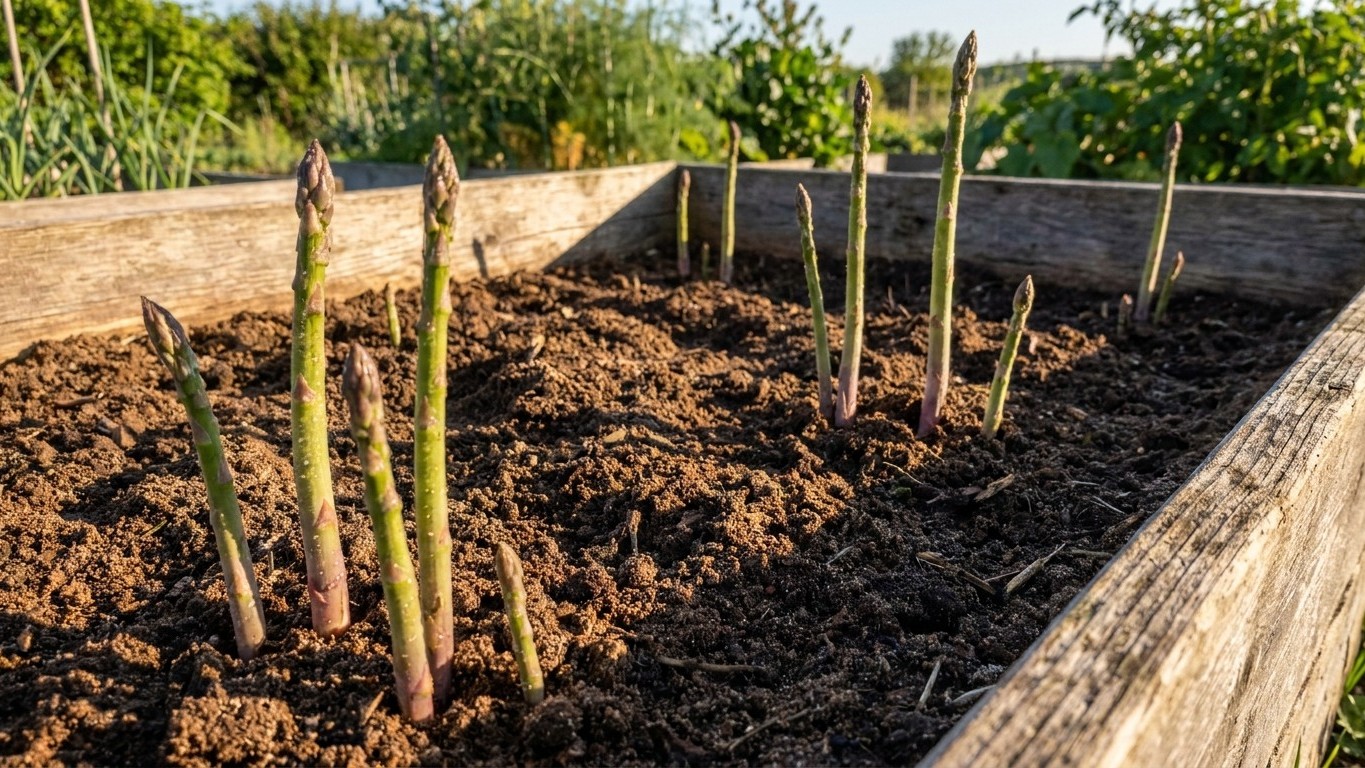

Yes, most likely, but not automatically. The province’s dominant soil, a Podzol, runs imperfectly drained by classification, and an Asparagus Bed is planted once and left for 10 to 15 years. That combination means drainage has to be checked before the first crown goes in the ground, not after the bed has failed. A raised bed or berm solves the problem in most yards; a test spade solves the uncertainty.
The short answer
Utah State University Extension, the only source behind this crop’s growing guide, sets exactly one soil condition for asparagus: the ground must drain. Nothing is said about pH, nothing about a chilling requirement for winter dormancy, and nothing about which named variety performs best here. That silence matters, because it means a gardener in this province can stop hunting for a magic number and focus on one physical question: does water sit on this ground, or does it move through it?
What the province’s typical ground actually does
The most common mapped surface soil across Newfoundland and Labrador’s agricultural districts is a Podzol, the acid, leached soil type that forms under conifer cover, where decades of rain wash the mineral bases out of the topsoil. It covers 59 percent of the mapped surface, with Organic soils as the next most common group. The median surface reading is strongly acid, around pH 4.3, and the texture leans loam to silt: 56 percent sand, 9 percent clay, 35 percent silt, with organic matter around 3.3 percent. Agriculture and Agri-Food Canada’s own classification lists the drainage class for this profile as imperfectly drained. That single word is the one to weigh against a 10-to-15-year planting decision. A sandy-leaning texture usually helps water pass through, but imperfect drainage on the provincial record suggests a layer somewhere below the surface, compaction, a perched water table, or simple topography, is slowing that passage down in a lot of the mapped ground.
What changes the answer for one garden
None of this is a diagnosis of a single backyard. The provincial figures are a median drawn from 459 mapped soil components across the farmed regions of the province; river-bottom ground, muskeg, and any lot a builder has cut, filled, or graded will read completely differently, and the far north of the province isn’t represented in this survey at all. A gardener who digs a hole, fills it with water, and watches it sit for hours has answered the drainage question for their own plot better than any provincial average can. Where standing water is the result, the fix is not a different soil test, it’s a raised bed or a mounded row that lifts the crowns above the slow layer. Once drainage is sorted, the planting mechanics are straightforward: crowns go into 8-inch furrows, harvest doesn’t start until year three, and even then it’s gradual, roughly four weeks of cutting, then six, then eight in later seasons, with the rule being to stop once most spears have gone thinner than a pencil rather than counting to a fixed date. The bed then keeps producing for a decade or more, provided that first drainage call was the right one.
Will the summer here water it for you?
Asparagus wants 1 to 2 inches of water every other week through its first two growing seasons, then eases to about the same amount every three weeks once established. Environment and Climate Change Canada’s 1981-2010 normals for the St John’s A station put summer rainfall at roughly 11.4 inches across June, July and August, broken down as 3.84 inches in June, 3.61 in July, and 3.94 in August. Here’s how that stacks up against what a new bed actually needs.
- June, the wettest of the three months at 3.84 inches: spread over the month that’s close to the 1-to-2-inch-per-two-weeks target on paper, but rain rarely falls in tidy, even installments, so a dry stretch of a week or more can still leave a new bed short.
- July, the driest at 3.61 inches: this is the month most likely to need a supplemental soak, particularly for first- and second-year crowns that haven’t built a deep root system yet.
- August, back up to 3.94 inches: generally enough on its own, though the imperfectly drained texture common in the province’s mapped soils means the same rain event can behave two ways, running off quickly on a slope, or sitting and then drying slowly on flatter, denser ground.
- Year three onward, once the every-three-weeks schedule applies: the province’s summer total comfortably covers the requirement in most years, leaving supplemental watering as an occasional July fix rather than a routine chore.
- The one instrument that settles it for a specific yard: a rain gauge on the actual bed. These are long-term normals from a single reference station, not a forecast, and a slope, a coastal exposure, or a site farther from St John’s can shift real totals in either direction.
this is not a climate where a gardener needs to build an irrigation system from scratch. It’s a climate where July deserves attention and the rest of the summer mostly takes care of itself, provided the drainage question from the first section has already been answered honestly.
When to put the crowns in
Crowns go into the ground in early spring, and in this province that timing anchors to a mean last spring frost date of around May 30 at the St John’s A station. That date is an average, not a guarantee, meaning that in one year out of two, frost actually arrives later than it. Treat late May as the middle of a window rather than a green light, and a gardener who waits until early June for the ground to firm up and dry out after snowmelt is not being overly cautious, they’re reading the same average correctly.
The planting method itself is simple on paper: crowns are set into furrows about 8 inches deep, then the furrow is filled in gradually across the season, roughly 2 inches of soil added back every other month rather than all at once. That gradual backfill lets the emerging shoots keep pushing up through loosening soil instead of being buried under a full furrow’s worth of dirt on day one. Seed is the alternative starting method, though the source behind this guide doesn’t set out a specific seed-starting calendar for this territory, so the safest approach is to apply the same frost logic used for crowns: seedlings destined for the garden go out only once the risk of a late frost has clearly passed, using that same around-May-30 window as the reference point rather than a fixed date.
Variety choice at planting time is limited by what’s actually published. Utah State University Extension names four: Jersey Giant and Jersey Knight, both all-male hybrids, and UC 157 F1 and Purple Passion, both male-and-female types. No flavor comparison, no yield ranking, and no regional preference is given for any of them in that source, so the honest answer for a Newfoundland and Labrador gardener is that variety selection here comes down to availability rather than a documented performance edge.
| Variety | Sex type | Performance notes published |
|---|---|---|
| Jersey Giant | All-male | None published |
| Jersey Knight | All-male | None published |
| UC 157 F1 | Male and female | None published |
| Purple Passion | Male and female | None published |
Common questions
Does the provincial soil figure describe my own yard? No. It’s the median of 459 mapped soil components across the province’s farmed districts, useful for spotting a tendency like acidity or slow drainage, not a substitute for digging a hole on your own lot and watching what the water does.
What if a drainage test shows standing water? A raised bed or a mounded row lifts the crowns above the slow layer. Given that this bed is meant to produce for 10 to 15 years, that upfront fix is far cheaper than replanting a failed bed halfway through its expected life.
Can I take a few spears in year three to see how the bed is doing? No. The guide behind this crop is explicit that harvest doesn’t begin until year three, and even then it starts modest, around four weeks of cutting, building up in later seasons, with the stopping point being when most spears run thinner than a pencil rather than a set number of weeks.
Does this province’s climate provide enough winter chilling for asparagus dormancy? That figure isn’t published in the source behind this guide, and it shouldn’t be guessed from a hardiness zone. What is documented is the growing-season side, planting timing, watering needs, and the 10-to-15-year production window, which is enough to plan a bed responsibly even without a chilling number.