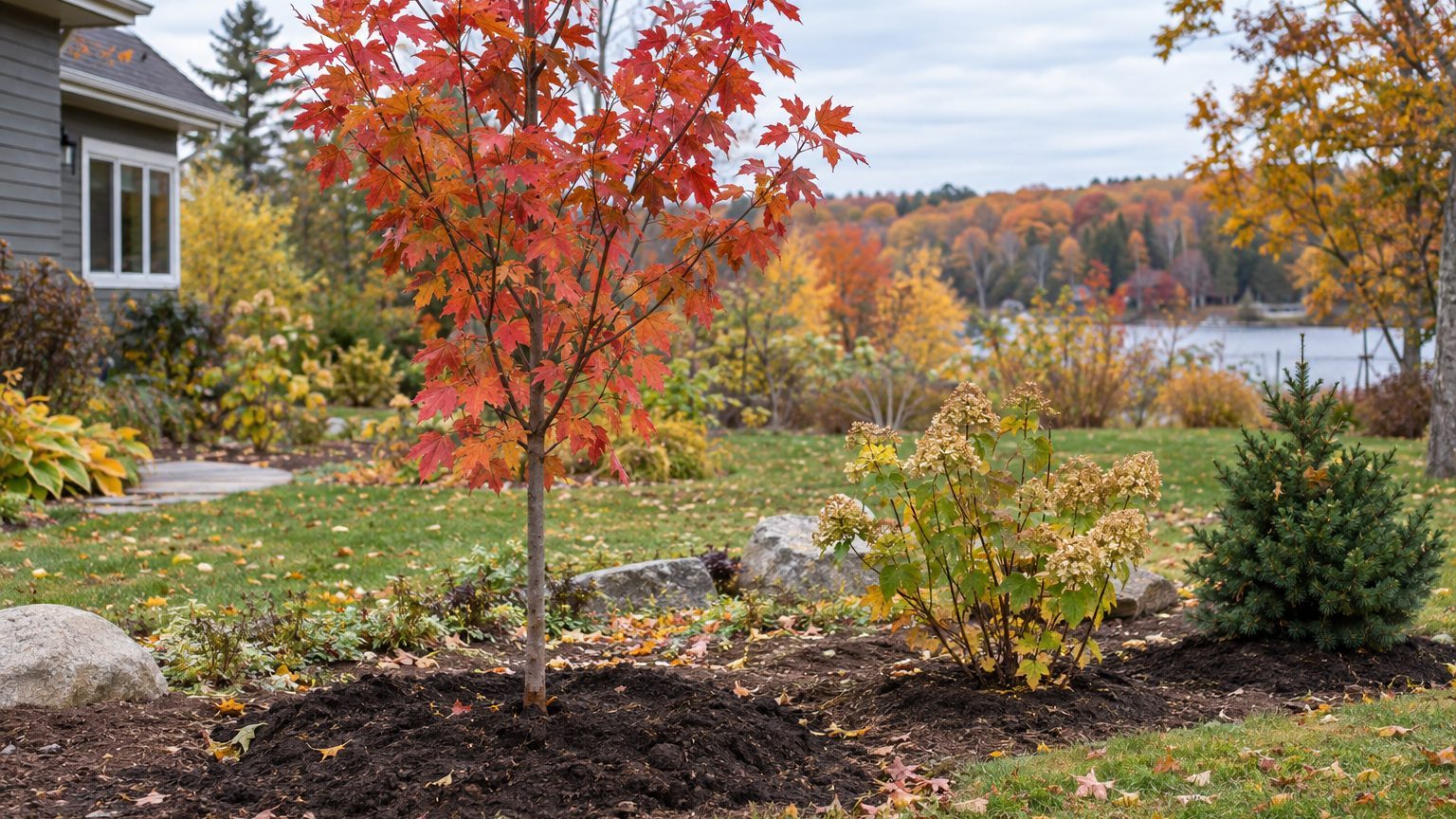

In New Jersey, the safe fall planting deadline for trees and shrubs runs from September 23 to October 5, which is six weeks before the first fall frost at Newark (November 4 to November 16). That is the conservative cutoff, not a hard stop. Roots keep working until the soil itself freezes, and that happens later. A tree planted a few days after the window can still make it. Past that point, the plant you choose and the care it gets matter more than the calendar.
The deadline in New Jersey
Roots don’t follow the air thermometer. They keep growing as long as the soil is workable and above freezing, which can mean weeks after the first frost has blackened the tomato vines and the maples have dropped their leaves. Aboveground, a newly planted tree looks asleep. Underground, it is still pushing into the surrounding soil. That is the whole reason fall planting works, and the reason the deadline is about leaving enough weeks of root growth before the ground locks up.
Cornell Cooperative Extension states the rule this way: “Fall is an excellent time for transplanting, provided you get them to their new home at least 6 weeks before the ground freezes, allowing them time to establish roots before winter dormancy.” The count starts from the day the ground freezes. That is a later event than the first frost, which is only an air temperature.
Working the date backward
NOAA’s 1991-2020 U.S. Climate Normals put the first fall freeze at Newark between November 4 and November 16, a range because any given year can land outside it. Count six weeks back from that range and you get September 23 to October 5. That is the date range to write on the calendar. It is deliberately cautious. Because the ground freezes after the first frost, the true biological limit falls later than this window, and a tree that goes in a little after it is a calculated risk rather than a lost cause.
Does the rule even apply here? Yes. The coldest-month mean daily minimum at Newark is 25.5°F (NOAA NCEI Climate Normals 1991-2020), well under freezing, so the ground does freeze in winter. This is not a place where planting runs year-round. Anyone reading this at the start of October 2026 is standing right at the edge of the window.
Adjusting for your own yard
Those figures come from the weather station at Newark’s airport, and gardens in the suburbs and the countryside typically get their first fall frost earlier, often by one to two weeks, and more at elevation. Farther north and higher up, the cold arrives sooner, so the planting deadline moves earlier too. Pull your county’s own dates from First and Last Frost Dates in New Jersey, then subtract the six weeks yourself. Other New Jersey guides cover the regional differences in more detail.
One more caution on zones. The USDA Plant Hardiness Zone Map 2023 spans 6a-7b across the state. That system rests on a single variable, the average annual extreme minimum temperature, so it tells you what survives the cold, not when to plant.
What to plant late, and what to wait on
Container-grown and balled-and-burlapped plants carry a late fall best, because their roots arrive mostly intact with soil of their own. If the species is fully hardy for your USDA zone, it has little to prove. The 25.5°F figure at Newark is the average overnight low in the coldest month, not the record low, so a bad night will dip below it. A plant rated for your zone shrugs that off. The real test is whether its roots settle in before the ground stiffens.
Fully hardy deciduous trees and shrubs are the safest late bets. Maples, oaks, serviceberries and viburnums all fit that description. Once the leaves drop there is no foliage left to lose water, so the plant puts everything below ground. Evergreens are a different story: they keep their leaves or needles all winter and keep losing moisture to wind and sun, long after the soil has stopped supplying much.
| Type of plant | Late fall verdict | Reason |
|---|---|---|
| Fully hardy deciduous trees and shrubs, container or balled | Plant within the window; a short overrun is a reasonable gamble while soil is workable | Dormant tops lose no water, roots keep growing |
| Evergreens, needled and broadleaf | Plant early in the window, or wait for spring | Foliage loses water all winter while roots are still settling |
| Plants rated near the cold limit of your zone | Wait for spring | Marginal hardiness plus an unestablished root system |
Borderline plants deserve the most skepticism, because garden centers sell them well into fall. A shrub whose tag matches your zone only barely has no margin for error, and a first winter with a half-grown root system removes whatever margin remains. For those, plant evergreens and borderline-hardy shrubs in spring, when they get a full growing season to build roots before the first cold snap.
If the window has already closed, don’t panic. A hardy deciduous tree in a container can still go in while the soil is workable, provided you commit to the watering and mulching that follow. The general planting steps are in Planting and Caring for Trees, Shrubs and Perennials. Evergreens and anything borderline should simply wait.
Watering and mulch until the ground freezes
A tree planted in fall has no reserves in the surrounding soil to draw on, only the roots it brought with it. Water it deeply, enough to soak the root ball and the soil around it, rather than sprinkling the surface every day. Then keep going. Dry stretches in October and November are common, and leaf drop is not a signal to stop. If the soil beneath the surface crust is dry, the tree needs a drink. Keep watering until the ground freezes, because roots can only grow in moist soil.
Mulch does half the job of holding that moisture. The NC State Extension Gardener Handbook, in its chapter on woody ornamentals, says: “A 2-inch to 3-inch layer of mulch suppresses most annual weed seeds and makes it easy to hand-pull any that do germinate.” On trees, it adds: “Provide a 3-inch layer of mulch to reduce water loss and maintain uniform soil moisture and temperature around roots.” The two sentences have different purposes, weeds in one case and moisture in the other, but they land at the same depth. More is not better.
The shape matters as much as the depth. Spread mulch in a flat, wide ring over the root zone, and pull it back from the trunk so the base of the tree stays visible. A mound piled against the bark holds moisture on the trunk, invites rot, and gives mice and voles a sheltered place to chew. Gardeners call that a mulch volcano, and it is one of the most common ways to hurt a young tree while trying to help it. The full method is in Mulching Without Killing the Plant.
The first winter is about roots, not growth. Above ground, the plant is dormant and nothing visible is happening. Below ground, roots keep extending until the soil gets too cold, and the next spring’s leaves depend on how far they got. This is also why late fertilizer and fall pruning work against you: both nudge the plant toward tender new shoots that winter will simply kill. Leave the plant alone, keep the soil moist, and let the roots do the work.
What goes wrong
The most common mistake is planting by what the nursery has in stock rather than by what the climate allows. Garden centers keep selling trees and shrubs deep into November, and the plant in the pot has no idea what the date is. Anything that goes in after the first fall frost range at Newark, November 4 to November 16, and earlier in the colder north, has not had six weeks of root growth. Once the soil is frozen too hard to dig, hold the plant until spring instead of forcing it in.
Winter burn is the second problem, and it hits evergreens hardest. Rhododendrons, hollies and boxwoods, along with needled evergreens, keep losing moisture through their foliage to sun and wind while frozen soil can’t replace it. The result is brown, bronzed or scorched leaves by late winter. A new transplant is more vulnerable because its roots haven’t spread. Planting early in the window, watering until freeze-up and choosing a spot sheltered from winter wind all lower the risk.
Heaving catches shallow root balls. New Jersey winters swing back and forth across freezing (a coldest-month average low of 25.5°F at Newark means plenty of nights below it, with thaws in between). Each freeze-thaw cycle can lift a loosely planted ball a little further out of the ground and expose the roots to air. After a thaw, check young plants, press any lifted ones back down, and top up the mulch ring. Mulch evens out soil temperature, which is part of why it is worth the effort.
Last comes a dry fall. When the soil is parched, roots stop growing, and a plant can go into winter stressed before the cold even starts. A new planting that gets neglected in October is the same as one planted too late.
Common questions
Is it too late to plant a tree in New Jersey in October?
Not automatically. The safe window ends between September 23 and October 5, calculated as six weeks before the first fall frost. Past it, risk rises but the ground is not frozen yet. A fully hardy deciduous tree in a container can still go in while the soil is workable, if you water deeply and mulch right away. Evergreens and borderline-hardy plants should wait for spring.
Does the six-week rule count from the first frost or from frozen ground?
Cornell Cooperative Extension counts from when the ground freezes. Because the ground freezes later than the first frost, using the first frost as the starting point gives a more cautious date. That is why September 23 to October 5 is a safe target and not the true limit. The colder parts of the state reach both events earlier.
Do the Newark dates apply to my yard?
Only roughly. The figures come from the airport weather station. Suburban and rural yards typically get their first fall frost earlier, often by one to two weeks, and higher ground sooner still. Look up your county’s first fall frost and count back six weeks from there. Gardeners near the New York line may also want How Late Can You Plant Trees and Shrubs in Fall in New York? to compare how the cutoff shifts in colder country.
What does my USDA zone tell me about fall planting?
It tells you which plants can survive your winters, not when to plant them. The USDA Plant Hardiness Zone Map 2023 covers New Jersey with a range of 6a-7b and is built on the average annual extreme minimum temperature alone. Use it to pick plants rated for your zone, and use your county’s frost dates to set the planting deadline.