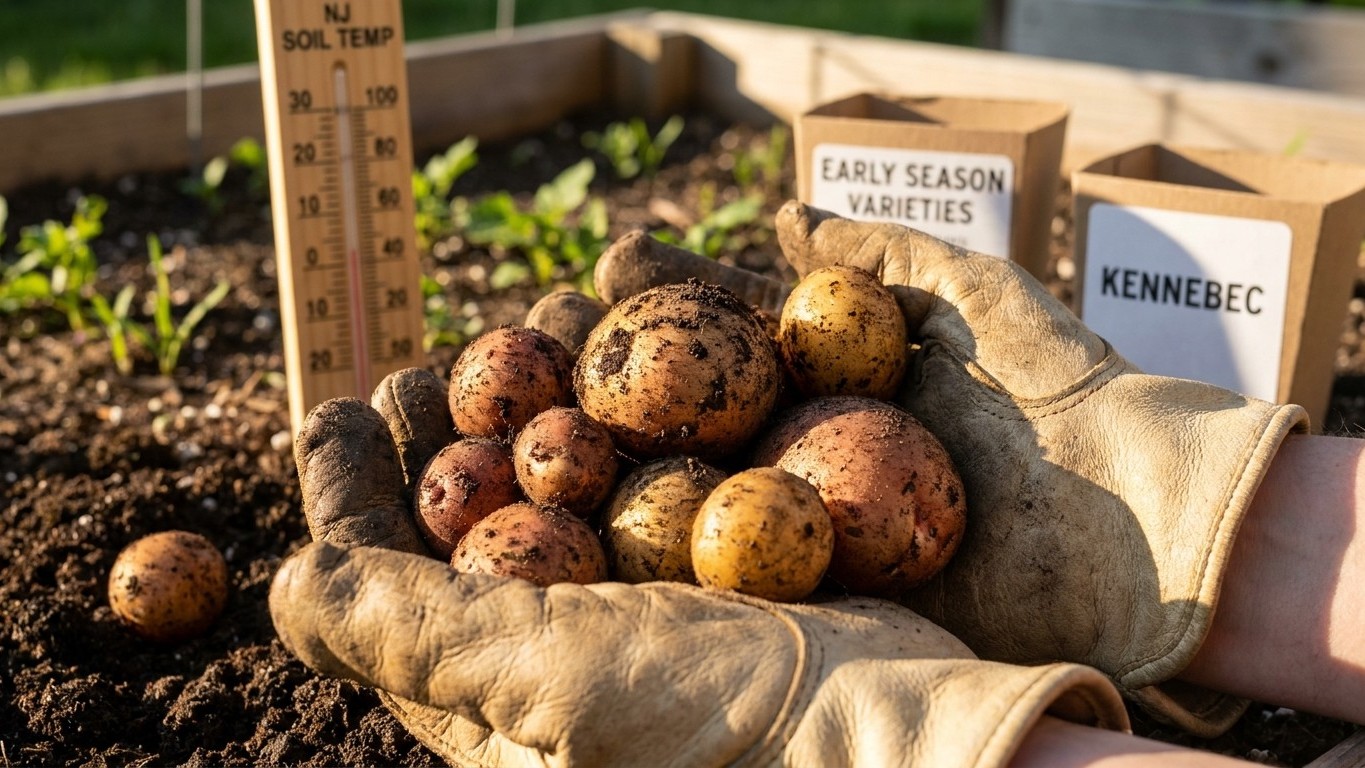

Early and mid-season varieties are the safer bet almost everywhere in New Jersey, because the state’s last spring frost window (March 29 to April 6, per NOAA NCEI’s 1991-2020 Climate Normals for the Newark reference station) leaves a planting slot that late-season potatoes often can’t beat before soil heat shuts tuber growth down. Certified seed of an early or mid-season type is the starting point Utah State University Extension and the University of Maine Cooperative Extension both point to.
The short answer
Newark’s airport weather station puts the last spring freeze between March 29 and April 6, according to NOAA NCEI’s 1991-2020 U.S. Climate Normals. That’s the anchor date for the whole state, though your own yard is likely to run later, sometimes by a week or two, especially inland or at higher elevation. Potatoes don’t wait for that date anyway. Utah State University Extension and the University of Maine Cooperative Extension both note that potatoes go in the ground as soon as soil reaches 50 F, which lands 14 to 21 days before the last frost. That’s the practical calendar a New Jersey gardener works from, not the frost date itself.
What that early planting buys is time before the other threshold that actually decides which varieties belong in a New Jersey garden: soil temperatures above 90 F, which the same two extension sources identify as the point where tuber set and fill simply stop. Watering more doesn’t reverse it. New Jersey summers push soil past that mark regularly, especially in the sandier, faster-warming soils common in the southern half of the state. That single fact is why early and mid-season types dominate advice for this state: they size their tubers and finish before the hottest weeks arrive, while late-season types are still trying to bulk up when the soil crosses into the danger zone.
In practice that means leaning on varieties extension programs classify as early or mid-season, chosen for a purpose rather than a texture label. Types bred for baking, and types suited to boiling, roasting, or salads, both exist in the early and mid-season classes, so there’s no need to reach for a late-season variety just to get a baking potato. Late-season types aren’t banned from New Jersey gardens, but they’re a narrower bet, workable mainly in the cooler northern counties or for gardeners willing to irrigate through a hot stretch and accept some risk to yield.
None of this works without clean seed. Both Utah State and the University of Maine are specific that seed potatoes should be certified, because uncertified stock carries viruses that no variety choice can compensate for. A certified early or mid-season variety, planted at the right soil temperature, is the combination both extension services point to for a state with New Jersey’s frost timing and summer heat.
What actually decides it
Soil temperature and the heat ceiling
The 90 F soil threshold noted by Utah State University Extension and the University of Maine Cooperative Extension is the mechanism that overrides everything else on this page. Tubers form and fill in a window of moderate soil temperature; once soil runs hotter than that, the plant keeps growing leaves but the tubers underground stop sizing. This isn’t a drought problem you can water your way out of. It’s a heat problem, and it explains why season class matters more than which named variety you pick: an early or mid-season plant reaches and finishes its tuber-fill window before the soil gets that hot, while a late-season plant is often still filling tubers when the ceiling arrives.
Frost timing versus the planting window
The Newark reference station’s March 29 to April 6 last-frost window matters less for potatoes than it does for tender crops like tomatoes, because potatoes go in the ground before that date, not after it. The 14- to 21-day gap ahead of last frost, tied to the soil hitting 50 F, is the real planting trigger. A gardener working from the calendar alone, waiting for the frost date to pass, is planting later than the crop needs and shortening the cool window before the heat ceiling arrives. That gap compounds for anyone outside the immediate Newark area, since surrounding yards typically see their own last frost later than the airport station records, which pushes the safe frost date back but doesn’t move the soil-temperature trigger at all.
Certified seed and disease pressure
Variety selection assumes clean starting material. Uncertified seed potatoes carry viruses that reduce vigor and yield regardless of how well-matched the season class is to New Jersey’s climate. This is a single, plain fact worth more than pages of general caution: certified seed is the baseline, and skipping it undercuts every other decision made about variety or timing.
How to do it
- Check soil temperature directly in the planting bed with a soil thermometer rather than guessing from air temperature, since soil lags behind.
- Plant once soil reaches 50 F, which typically falls 14 to 21 days before the last frost date for the area, per Utah State University Extension and the University of Maine Cooperative Extension.
- Select certified seed potatoes in an early or mid-season class, choosing a type suited to baking or one suited to boiling and salads depending on how the crop will be used.
- Cut and cure seed pieces if needed, then set them in the prepared bed at the recommended spacing for the variety’s growth habit.
- Hill soil around the emerging stems as they grow, covering developing tubers and keeping them shaded from surface heat.
- Track soil temperature through the season, especially in sandier or south-facing beds that warm fastest, watching for the point it approaches 90 F.
- Harvest an early or mid-season crop as tops die back, before extended stretches of soil heat compromise the tubers already set.
What goes wrong
- Planting by the calendar instead of the soil. Waiting for a frost date on a chart, rather than checking soil temperature, delays planting past the ideal window; the fix is a soil thermometer, not a fixed date.
- Choosing a late-season variety in a hot section of the state. Late types are still filling tubers when soil crosses the 90 F ceiling described by Utah State University Extension and the University of Maine Cooperative Extension; switching to an early or mid-season variety avoids the collision entirely.
- Using saved or uncertified seed. Home-saved tubers or bargain seed stock often carry viruses that stunt yield no matter how well the variety and timing were chosen; buying certified seed each season resets that risk.
- Assuming one frost date covers the whole yard. The Newark reference station’s window doesn’t account for local variation; gardens away from that station commonly see later spring frosts, so relying on soil temperature rather than a single regional date avoids planting into a lingering cold snap.
- Trying to push tuber size with extra water during a heat spell. Once soil passes the 90 F mark, irrigation doesn’t restart tuber fill; the only real remedy is timing the crop, through variety choice and early planting, so it finishes before that heat arrives.
Common questions
Do late-season potato varieties ever work in New Jersey?
They can, mainly in the cooler northern parts of the state or with attentive irrigation, but they carry more risk than early or mid-season types because they’re still filling tubers as soil approaches the 90 F ceiling described by Utah State University Extension and the University of Maine Cooperative Extension.
Is the March 29 to April 6 frost date accurate for my whole county?
It’s specific to the Newark reference station used by NOAA NCEI’s Climate Normals. Surrounding areas, and especially inland or higher-elevation spots, often see later last frosts, so treat that window as a starting reference and confirm timing locally.
Why does seed certification matter more than the variety itself?
A well-matched variety planted from uncertified, virus-carrying seed will still underperform. Certified seed removes that variable, which is why both extension sources treat it as a baseline requirement rather than an optional upgrade.
Can I tell if my soil has crossed the 90 F ceiling without a thermometer?
Not reliably. Air temperature and soil temperature diverge, particularly in sandy or exposed beds that heat faster than shaded or heavier soils, so a soil thermometer pushed a few inches into the bed is the only direct way to know.