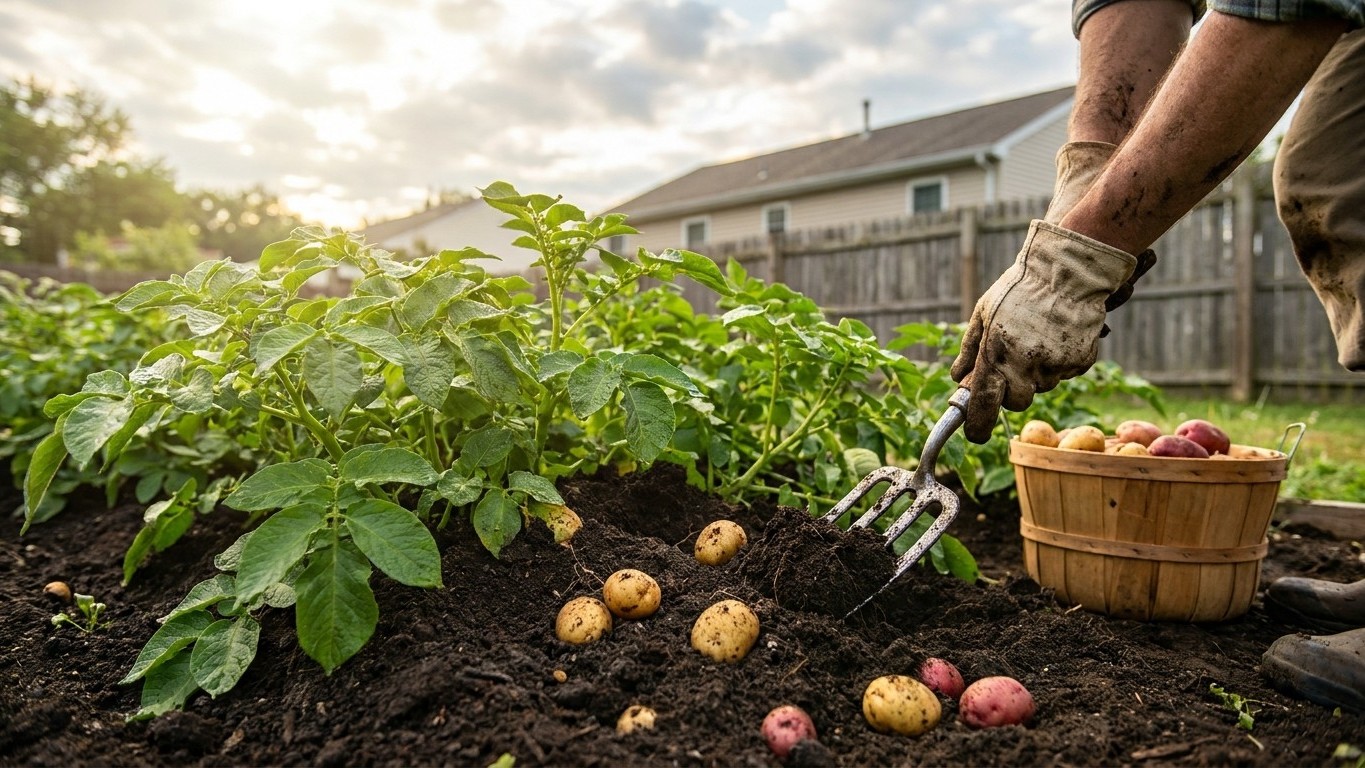

New Jersey gardeners get one real shot at potatoes here: plant early using the Newark-area frost window, then dig before the year’s heat load peaks. The math is set by two numbers, not by guesswork or a seed packet’s suggestion, and both come from the same weather station that tracks this state’s growing conditions most closely.
The short answer

Newark averages 20.8 days a year at 90 F or above, according to NOAA NCEI Climate Normals covering 1991-2020. That’s not a brutal desert number, but it’s enough heat, concentrated in July and August, to matter for a crop that stops growing tubers once soil temperatures cross that same 90 F line. The last spring frost at the Newark reference station falls between March 29 and April 6, per the same NOAA NCEI dataset’s 32 F freeze-probability tables. Those two figures together answer the planting question before you’ve bought a single seed potato.
Utah State University Extension’s potato fact sheet is blunt about the mechanism: tuber set and fill shut down once soil temperatures climb past 90 F. New Jersey’s summer heat arrives late enough, and the frost-free window opens early enough, that a gardener here can plant a crop, let it bulk up tubers through the cooler weeks of May and early June, and get most of the harvest in before the hottest stretch of July hits. This is a spring-planted, early-to-midsummer-dug crop in this state, not a plant-it-and-forget-it summer-long project the way it might be in a cooler climate with a longer cool season. For guidance on timing that dig and curing the crop afterward, see Harvesting and Storing Potatoes in New Jersey.
Potato varieties fall into three season classes, a classification both Utah State University Extension and the University of Maine Cooperative Extension use instead of publishing exact days-to-maturity numbers, since actual timing shifts with soil temperature, moisture and daylight. Early varieties are bred for fast bulking and are typically grown for boiling and general table use. Mid-season varieties bridge storage life with kitchen versatility. Late varieties are the ones extension bulletins point to for baking, since they build the drier, denser flesh that baking rewards. For help matching specific cultivars to these season classes, see this guide to Potato Varieties That Suit New Jersey.
| Season class | What it’s suited for | Why it fits NJ’s window |
|---|---|---|
| Early | Boiling, general use | Bulks tubers before peak heat arrives |
| Mid-season | Storage, all-purpose kitchen use | Needs the full cool stretch from planting to early summer |
| Late | Baking | Riskier here, pushes tuber fill closer to the hot weeks |
When to plant here
Work backward from the frost date instead of forward from a calendar guess. Here’s the sequence for When to Plant Potatoes in New Jersey, using the Newark reference window of March 29 to April 6:
- Start from the last spring frost date for your reference station: March 29 to April 6 at Newark.
- Potatoes go in the ground once soil temperature reaches 50 F, and that point normally arrives 14 to 21 days before the last frost date, per University of Maine Cooperative Extension guidance.
- Subtract 21 days from March 29: that lands on roughly March 8.
- Subtract 14 days from April 6: that lands on roughly March 23.
- That gives a planting window of about March 8 to March 23 for gardens matching the Newark reference conditions, provided a soil thermometer confirms 50 F at planting depth.
That window is a starting point, not a fixed date. Soil warms unevenly across a state this size, and a thermometer pushed 3 to 4 inches into the bed tells you more than any calendar does. If the soil is still cold and wet in early March, wait. Cold, waterlogged ground rots seed potatoes faster than a slightly late planting ever costs you.
What the heat does to the crop
The mechanism is the whole point of this page. Once soil temperature crosses 90 F, tuber set and fill shut down, according to Utah State University Extension’s fact sheet on potato culture. The plant doesn’t die, and the foliage can stay green, but the below-ground work that produces the actual harvest stalls out. Watering more doesn’t reverse it, because the problem isn’t drought stress, it’s the soil temperature itself blocking the physiological process that builds tubers.
New Jersey’s 20.8 days a year at 90 F air temperature (Newark, NOAA NCEI 1991-2020) translates into soil temperatures that regularly exceed that 90 F threshold for stretches of July and August, since bare or lightly mulched garden soil tracks air temperature closely and often runs warmer at midday. That’s exactly why this state’s potato season is framed around planting early and digging before that heat load builds, rather than trying to carry a crop through the hottest weeks of summer.
Practically, that means a gardener who plants in the March 8-23 window, per the arithmetic above, is aiming to have tubers largely sized before the year’s heaviest heat days land. A gardener who delays planting into May, or who tries a second planting for a fall crop timed to mature in August, is fighting the same 90 F soil ceiling with no real fix available. Mulching helps moderate soil temperature by a few degrees and is worth doing, but it doesn’t substitute for planting on time.
What goes wrong here
- Uncertified seed potatoes. Seed saved from a grocery store potato or an uncertified source often carries viral disease that reduces yield and can spread to soil for future seasons. Certified seed potatoes, sold specifically as disease-tested planting stock, are worth the extra cost every time.
- Planting into cold, wet soil. Pushing seed potatoes into ground that hasn’t reached 50 F, especially if it’s still saturated from spring rain, invites rot before the plant ever sprouts. Wait for the soil thermometer, not the calendar date.
- Skipping the hilling. Tubers that develop near the surface and get exposed to sunlight turn green and produce solanine, a compound that makes them unsafe to eat. Hilling soil up around the stems as plants grow keeps developing tubers covered and in the dark.
- Digging too early. Pulling plants the moment foliage looks full-sized, before the vines have started dying back, cuts the harvest short and leaves tubers smaller and thinner-skinned than they’d otherwise be. Given how narrow the pre-heat window is in this state, it’s tempting to dig early out of nerves about the coming hot weeks, but a few extra days of bulking before the heat truly sets in usually pays off.
Checking this against your own county
Newark’s numbers are a reference point, not a guarantee for every yard in the state. Elevation, and the general difference between the state’s northern and southern counties, can shift both the last frost date and the arrival of consistent 90 F days by a couple of weeks in either direction. A garden in a higher, cooler pocket of the northwest may see frost linger later into April, while a low-lying southern county garden may warm and heat up earlier than Newark does.
Before locking in a planting date, check current conditions and local guidance through Rutgers New Jersey Agricultural Experiment Station Extension, which tracks county-level soil and weather data across the state. A soil thermometer in your own bed still beats any regional average.
Common questions
Can I plant a second, fall potato crop in New Jersey?
The same 90 F soil ceiling that limits summer growth also complicates a fall planting timed to bulk tubers during the hottest weeks. Neither Utah State University Extension nor University of Maine Cooperative Extension frames New Jersey’s climate around a fall crop; the spring window described above is the one both sources’ guidance supports here.
Does mulch replace the need to plant early?
No. Mulch can moderate soil temperature by a few degrees and conserve moisture, but it doesn’t override the 90 F tuber-set threshold once ambient heat pushes soil past that line for sustained stretches.
Why does uncertified seed matter so much?
Uncertified seed potatoes frequently carry viral disease invisible to the eye, which reduces yield and can linger in garden soil to affect future plantings. Certified seed is disease-tested specifically to avoid that risk.
What does it mean if my potato plants stay green but tubers stay small?
That’s the classic sign of soil temperature exceeding 90 F during the tuber-fill stage, per Utah State University Extension. The foliage keeps photosynthesizing, but the below-ground bulking process has stalled, and no amount of additional watering restarts it.