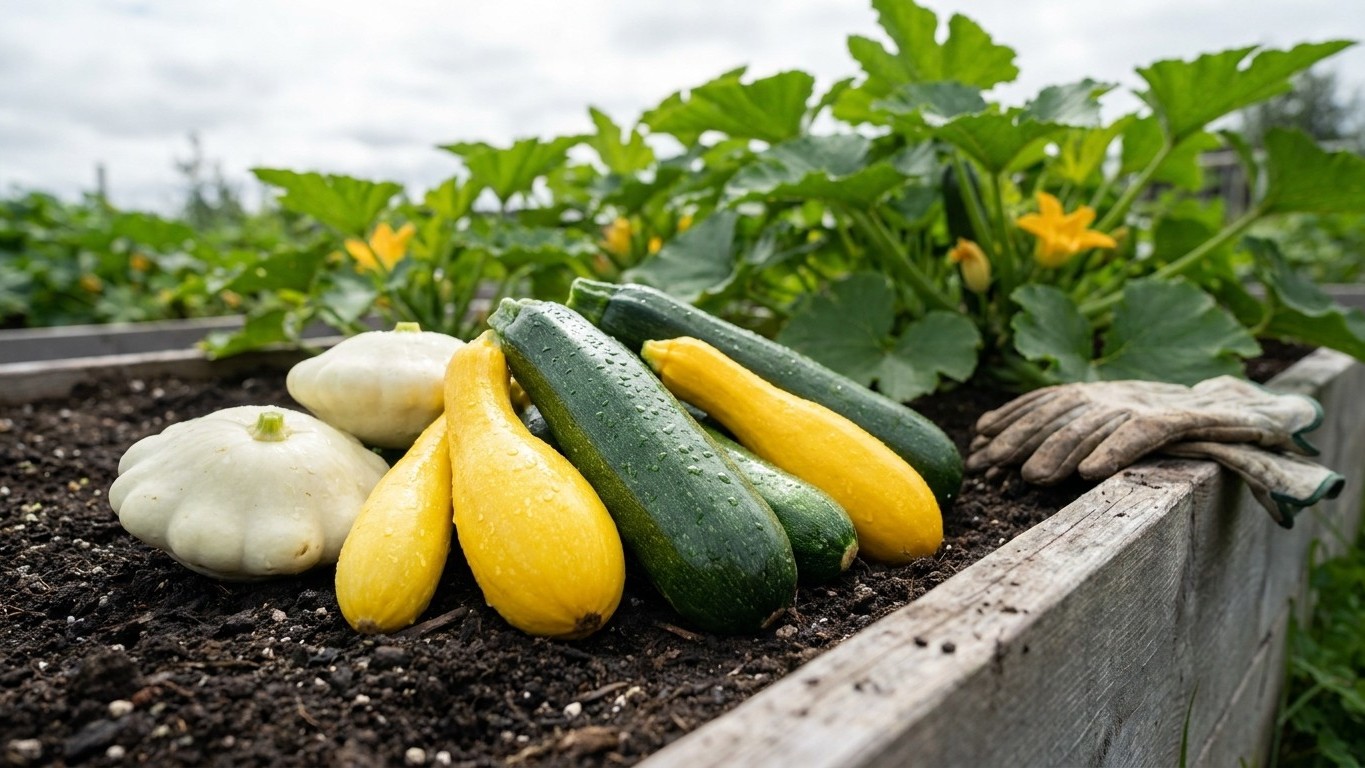

Yellow straightneck and crookneck squash, along with disease-resistant zucchini hybrids, top the list for New Jersey gardens. The state’s growing season runs long enough that maturity days barely matter here, what actually decides success is humidity, rainfall timing, and the fungal pressure that builds through a wet Mid-Atlantic summer.
The short answer for New Jersey
Start with the numbers that actually govern this crop. The reference station at Newark shows a last spring frost landing between March 29 and April 6, and a first fall frost arriving November 4 to November 16. That’s a frost-free window stretching roughly seven months. Summer squash needs 40 to 55 days from seed to first harvest, so New Jersey’s season length is almost never the limiting factor. A gardener could sow in late May and still pull a full harvest before the first cold snap.
Heat load is moderate, not extreme. The reference station averages 20.8 days a year at or above 90F. That’s enough to stress a thirsty plant during a dry stretch, but nowhere near the heat pressure of a Gulf Coast or desert Southwest garden. Varieties bred to shrug off 100-plus-degree stretches aren’t necessary here, and some of them sacrifice disease resistance to get that heat tolerance.
What does matter is the summer rainfall pattern: about 13.2 inches across June, July, and August, arriving as 4.34 inches in June, 4.66 in July, and 4.15 in August. That’s real humidity sitting on leaves for hours after a thunderstorm rolls through. Combined with the heat, it’s a near-perfect setup for powdery mildew and bacterial wilt. The decision by type looks like this:
| Type | Why it fits New Jersey |
|---|---|
| Yellow straightneck/crookneck | Fast to bear, wide selection of powdery-mildew-tolerant hybrids |
| Zucchini (disease-resistant hybrids) | Needs airflow-friendly, resistant genetics to survive humid Julys |
| Pattypan/scallop | Short enough cycle to support a second sowing after an early-July pull |
Open-pollinated heirlooms aren’t ruled out, but they generally lack the mildew resistance bred into modern hybrids, so they need more attention to spacing and airflow to hold up through August.
What will not work here
Season length isn’t the trap in New Jersey. The trap is treating this state like a dry-climate garden. Varieties and spacing advice written for the arid West, where tight rows and minimal airflow are fine because humidity never builds, run into trouble fast once they meet a New Jersey July. With 4.66 inches of rain typically falling that month and 20.8 days a year pushing past 90F, leaves stay damp longer after a storm, and that’s exactly the window powdery mildew and bacterial wilt need to take hold.
Weekly watering schedules copied from a drought-region guide also misfire. The summer rainfall total looks generous on paper, about 13.2 inches over three months, but it rarely arrives evenly. A single thunderstorm can dump most of a week’s allotment in twenty minutes, and most of that runs off rather than soaking into the root zone, especially on compacted or clay-heavy soil common across parts of central New Jersey. A plant watered “on schedule” during a dry stretch between storms can still wilt by midweek.
The slowest-maturing summer squash varieties, the ones bred for extended harvest windows over 60 days, aren’t disqualified by frost dates here. They’re disqualified by disease timing. A long-season plant sits exposed to humid August conditions for weeks longer than a fast 40-day type, and that extra exposure is where mildew usually wins. Growers who insist on heirloom types with long harvest windows need wider row spacing than the seed packet suggests, simply to keep air moving between plants.
Finally, tight succession planting without a disease-resistance check is a common failure point. Squash bugs and cucumber beetles thrive in the same humid conditions that favor mildew, and a second planting crowded too close to a declining first one gives pests an easy bridge. None of this is a New Jersey-specific pest problem exactly, but the state’s rainfall and heat numbers make the window for it wider than in a drier region.
What changes across New Jersey
New Jersey isn’t one growing zone, and treating it that way is the second most common mistake after ignoring humidity. The USDA Plant Hardiness Zone Map places the state across a 6a to 7b range, built on average annual extreme minimum temperature. That’s a two-zone spread inside one state’s borders, and it matters for squash growers because it shifts the safe planting window by roughly two weeks between the warmest and coolest pockets.
A garden sitting in the milder 7b range, generally toward the southern and coastal parts of the state, tends to see its last spring frost earlier and its first fall frost later than the Newark reference figures used above. A garden in the cooler 6a range, more common inland and at higher elevation in the northwest, should expect the opposite: a later last frost and an earlier first one, compressing the safe window on both ends.
This isn’t a call to guess which zone applies to a specific yard. The USDA hardiness map is built for exactly that lookup, and it accounts for local elevation and terrain in a way a single state-wide average can’t. What’s worth remembering is that the Newark frost dates cited earlier come from one airport weather station. Suburban and rural gardens, especially those away from the heat-holding effect of pavement and buildings, typically see the last spring frost later and the first fall frost earlier than that station records, sometimes by one to two weeks, and more at elevation.
The practical takeaway: a gardener in the cooler end of the state’s range should treat the Newark dates as optimistic and build in a buffer before setting out transplants, while a reader in the milder coastal or southern stretch might reasonably push both ends of the season a little further than the reference figures suggest.
Where to check this for your own county
Everything above is a state-level picture, built from one reference station and one statewide hardiness range. That’s useful for understanding the forces at play, but it’s not a substitute for a county-level recommendation, and it was never meant to be.
Rutgers Cooperative Extension, part of the Rutgers New Jersey Agricultural Experiment Station, is the source to check next. Its site is njaes.rutgers.edu. Two things are worth looking for there specifically. First, a county-level planting calendar, since Rutgers extension offices operate at the county level and often publish sowing windows adjusted for local frost data rather than the single airport station used for statewide normals. Second, look for variety trial results. Land-grant universities like Rutgers regularly run summer squash cultivar trials at research farms across the state, testing disease resistance and yield under actual New Jersey growing conditions rather than a seed catalog’s general claims.
A county recommendation will always beat a state-level one, because it accounts for local soil type, microclimate, and the specific disease pressure that shows up in that part of New Jersey in a given year. This page can tell a reader what forces are at play statewide, the frost window, the heat load, the rainfall pattern, and how they interact. It can’t tell a reader what a particular county’s extension office has already tested and confirmed works locally. That’s the next stop, not this one.
Checking this against your own garden
Every date and average in this article is a starting point, not a guarantee. The garden itself has the final word, and it communicates through a few simple signals that don’t require any equipment.
Soil warmth by feel is the first check. Summer squash seed germinates poorly in cold ground no matter what the calendar says, and a hand pressed into the soil a few inches down can tell a grower whether it feels closer to cool basement air or comfortable room temperature. Ground that still feels cold to the touch in late April, even after the reference frost date has passed, is a sign that a particular yard runs cooler than the regional average, whether from shade, low-lying drainage, or elevation.
The first flush of male flowers is the second signal worth watching. Summer squash typically produces male blossoms before female ones, and a sudden burst of them is a sign the plant has shifted into active growth mode, usually tied to sustained warm soil and longer daylight. Female flowers, with the small swollen base behind the petals, follow shortly after and mark the real start of the harvest countdown.
Third, watch the first true leaves, the ones that emerge after the initial rounded seed leaves and actually resemble squash foliage. Their appearance timing and vigor say a lot about whether the local combination of soil temperature and moisture is matching or lagging the regional pattern described above. A garden where true leaves lag noticeably behind a neighbor’s, planted the same week, is telling its owner something specific about its own microclimate that no regional average could have predicted.