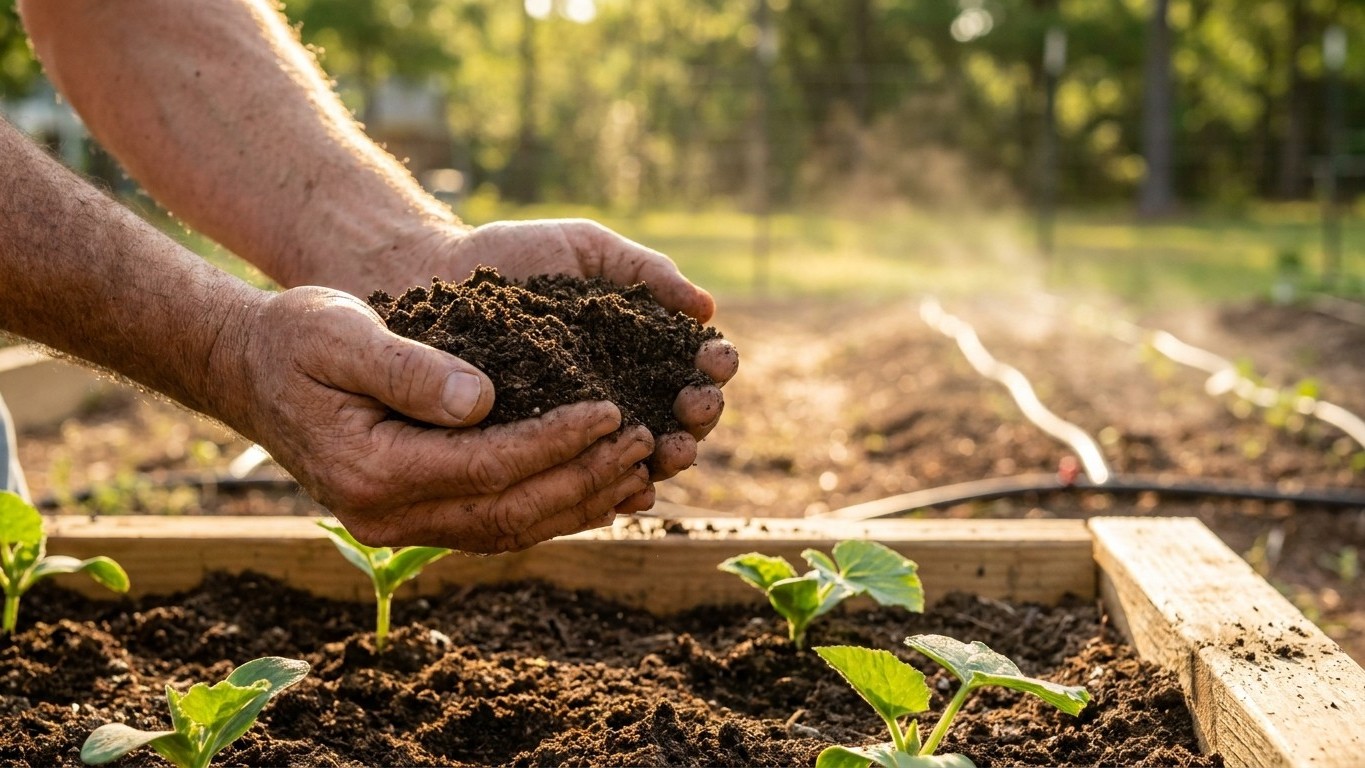

In most of New Jersey, summer squash goes into the ground once the soil hits the mid-60s, which usually lands sometime between the first and third week of May. Frost dates give you a starting point, but the real signal is soil temperature, and that lags behind the calendar more than most gardeners expect.
When the soil is warm enough in New Jersey
The last spring frost at the reference weather station (USW00014734, near Newark) falls between March 29 and April 6, according to NOAA’s 1991-2020 Climate Normals. That’s a 30-70% probability band, not a hard line, so treat it as the point where frost risk drops off rather than a guarantee that cold air won’t return. Suburban and rural gardens away from the airport tarmac often see frost linger later, sometimes by a week or two, more if you’re at elevation in the northwest part of the state.
Here’s the part that trips people up: frost date and planting date for summer squash are not the same thing. Squash seed rots in cold, wet soil, and the seedlings sulk if soil temperature sits below the mid-60s Fahrenheit. Since soil warms slower than air, especially in clay-heavy ground that holds winter moisture, the real planting window typically opens two to three weeks after that last frost date passes, not the day after.
That pushes direct-sown squash in most of New Jersey into early-to-mid May for reliable germination. Gardeners who want an earlier start often raise transplants indoors for three to four weeks and move them out once nighttime lows stay comfortably above 50°F. Summer squash resents root disturbance, so if you start indoors, use containers you can slide the whole root ball out of intact rather than bare-root transplants.
A black plastic mulch or a raised bed helps in the shoulder season, since both warm faster than bare open ground. If you garden on a low-lying site or near water where cold air pools, expect your workable window to open later than the reference station suggests. Check your own soil with a simple probe thermometer before trusting the calendar; it costs little and tells you more than any frost map. Your county office of the Rutgers Cooperative Extension keeps localized guidance if you want a second opinion tuned to your specific area.
How long the season lasts here
Run the numbers from the same reference station and New Jersey’s frost-free window stretches from late March/early April (March 29-April 6) to early-to-mid November (November 4-16), which works out to roughly seven months of frost-free potential in a typical year. That’s a generous window by East Coast standards, and it changes what’s realistic to plant, not just when to plant it.
A window this long means summer squash growers here aren’t limited to one sowing. Squash plants tend to slow down and get chewed up by pests and disease after eight to ten weeks of production, so a second sowing timed for mid-to-late summer often outproduces babying a single spring planting through the whole season. With five-plus months between the safe spring planting date and the first fall frost, there’s real room to stagger crops rather than betting everything on one round.
This is where the length of the season actually matters more than the exact dates. In a state with a short frost-free window, you’d plant once, watch it closely, and hope for the best. New Jersey’s longer season means the first sowing doesn’t have to be perfect. If it struggles, or gets hit by squash vine borer or powdery mildew midseason, there’s still time to start over. It also makes the transplant-versus-direct-seed decision less high-stakes: transplants that get root-checked and set back a week rarely blow the whole season here, because there’s slack built into the calendar.
For the specific mechanics of timing a second round, spacing sowings so you’re not swamped with squash all at once, and reading your own local frost data against these dates, see this site’s guide to succession sowing summer squash.
Heat and water in New Jersey
New Jersey’s reference station (Newark) averages 20.8 days a year at or above 90°F. That’s a moderate heat load, enough to matter but nowhere near the brutal stretches seen in the Deep South or interior Southwest. Squash pollen loses viability fast once temperatures push into the high 90s, which is why fruit set can stall during a heat spike even on a healthy, blooming plant. At Newark’s level of heat exposure, that kind of pollen failure is an occasional problem during a hot week in July, not a defining feature of the whole summer.
Rainfall tells the other half of the story. Summer rainfall across June, July and August totals about 13.2 inches at the reference station, broken down as 4.34 inches in June, 4.66 in July, and 4.15 in the driest month, August. That’s a reasonably wet summer by national standards, not a drought-prone one. The risk in a summer like this isn’t usually running dry, it’s the opposite: squash’s huge leaves and shallow roots don’t need constant soaking, and rain that arrives as a heavy thunderstorm can sit on foliage and soil surface long enough to invite powdery mildew and other fungal issues, especially once August humidity builds and rainfall dips slightly.
The honest read for New Jersey is a middle-ground climate: enough heat load to justify watching soil moisture during any stretch of 90-degree days, but not so little summer rain that irrigation is a daily requirement. Spacing plants for airflow and watering at the base rather than overhead does more good here than obsessing over quantity of water. On sandy soils common along the coastal plain, that 13.2 inches drains through fast and needs supplementing during dry spells; on the heavier clay loams found further inland, the same rainfall lingers longer and overwatering becomes the bigger risk. A rain gauge on your own plot, checked against your soil type, tells you more than the regional average ever will.
Which summer squash suit New Jersey
Given a long frost-free window, moderate heat, and reasonably wet summers, New Jersey suits a broad range of summer squash types rather than forcing a narrow choice. An early-maturing type makes sense for gardeners who want to catch a harvest before squash vine borer populations build up in early summer, since that pest tends to hit later plantings harder. For a second, mid-summer sowing, a type with some tolerance to powdery mildew is worth prioritizing, given how the drop in August rainfall combines with lingering humidity to favor fungal disease late in the season.
Bush-type squash, which take up less space and offer better airflow around the base of the plant, tend to perform well in New Jersey’s humidity, since air movement around the leaves is one of the simplest ways to slow mildew development without reaching for a fungicide. Vining types can still work, especially where a gardener wants to train plants up a trellis to improve airflow further and keep fruit off damp soil.
What this page won’t do is hand you a cultivar name. Variety trial results shift year to year, and what performs well in a sandy coastal garden near the shore often behaves differently in the heavier clay soils of the Piedmont or the cooler valleys of the northwest highlands. Naming a specific variety here would mean guessing at a level of detail this page has no way to verify for your exact plot, soil, and microclimate. The recommendation that actually holds up is to check Rutgers Cooperative Extension’s current vegetable variety trials, which test squash types under real New Jersey growing conditions across the state’s hardiness zones (6a to 7b, per the USDA Plant Hardiness Zone Map) and publish results specific to what performs here, not in a national seed catalog’s average conditions.
That’s not a dodge, it’s the difference between generic advice and one that actually accounts for your particular corner of the state. A gardener in Cape May and one in Sussex County are both technically Growing Summer Squash “in New Jersey,” but their soil, frost timing, and disease pressure diverge enough that the extension service’s localized trial data will serve either of them better than any single variety name repeated across every gardening site on the internet.