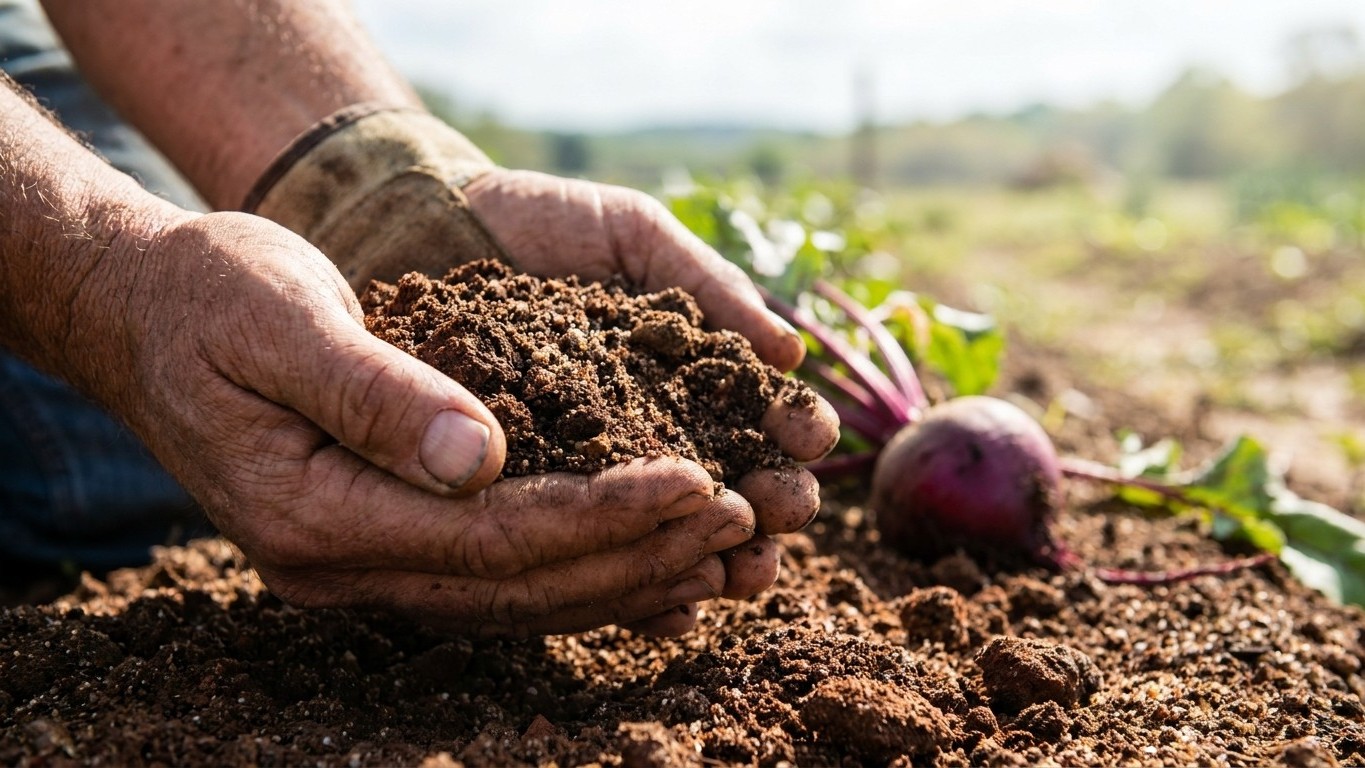

New Mexico’s representative soil is sandy, alkaline and low in organic matter, which cuts two ways for beets: it drains fast enough to prevent rot, but it dries fast enough to trigger bolting if you’re not watching the first six weeks after sowing. The root itself needs deep, loose ground and steady moisture, not a fight against clay or a scramble to catch up on water.
The short answer
The soil that USDA lists as representative for New Mexico is the Penistaja series, an Aridisol, the kind of dry-climate soil that tends toward alkaline and often carries salts near the surface. The surface horizon runs about 69 percent sand, 15 percent clay and 16 percent silt, with a pH near 7.5 and organic matter around 1.4 percent. It’s classified well drained.
For a beet root, that texture is mostly good news. Sandy ground lets a root push down without meeting the kind of dense clay that forks or stunts it, and the drainage class means standing water after a monsoon storm shouldn’t be a chronic problem. The catch is that same sand can’t hold moisture the way beets need it held. Utah State University Extension is direct about this: beets want deep, sandy, well-drained soil rich in organic matter, amended with no more than 1 inch of composted organic matter per 100 square feet. That last part matters here specifically, because 1.4 percent organic matter is thin, and thin organic matter means the soil has little buffer against the swings between a monsoon downpour and the next two dry weeks.
On heat, the exact number of days New Mexico’s reference weather station spends above 90 F isn’t published in the data behind this page, so it won’t be guessed at here. What is on record is the threshold that actually governs the root: USU Extension puts the danger point at 85 F combined with water stress, the combination that turns a beet woody and fibrous instead of tender. New Mexico summers routinely push well past that 85 F mark for extended stretches, which is exactly why the water side of the equation, not just the heat side, decides whether a root stays sweet.
None of this describes any one garden. New Mexico spans hundreds of mapped soil series, from sandy Aridisols like Penistaja to heavier alluvial soils along the river valleys and rocky, thin ground at elevation. The Penistaja numbers are a statewide starting point, not a stand-in for a soil test on the actual bed a beet will grow in.
The six weeks that decide it here
Beets go in the ground as seed, not as a transplant, and the standard timing is 2 to 3 weeks before the last expected spring frost. At the reference weather station behind New Mexico’s climate normals, that last frost date falls between March 31 and April 12, which puts a beet sowing date somewhere in mid to late March for most of the state’s lower elevations. That means the first six weeks of a beet’s life, the window where water stress does the most damage, land squarely in New Mexico’s early spring.
That’s a specific kind of spring. New Mexico’s spring is known for wide temperature swings between day and night, low humidity, and wind that pulls moisture out of exposed topsoil faster than most gardeners expect. Combine that with a soil that’s already 69 percent sand and holding barely 1.4 percent organic matter, and the risk isn’t a soggy bed. It’s a bed that looks fine on the surface and is bone dry three inches down by the time a seedling’s taproot needs that moisture most.
This is where the two failure modes split apart, and it’s worth keeping them separate. Water stress in these first six weeks is what pushes a beet to bolt, sending energy into a flower stalk instead of a root, and once that switch flips there’s no reversing it. The heat and woodiness problem comes later, closer to harvest, when a root that’s already sized up gets stressed by 85 F-plus days without enough water behind it. Early dryness ruins the crop before it starts. Late dryness under heat ruins the texture of a crop that otherwise made it. Same soil, same climate, two different failures with two different timings, and treating them as one problem, just water more, misses which stage actually needs the attention.
Every county gathers its frost dates independently, and elevation shifts them meaningfully in a state with as much vertical range as New Mexico has. The airport-based normals cited here are a reference point, not a promise for a particular backyard, especially one sitting higher or lower than the valley floor the station measures.
What goes wrong here
- Bolting from dry sand in the first six weeks. A bed that’s 69 percent sand loses surface moisture within a day or two of watering, and a beet stressed for water in that early window bolts to seed instead of building a root. The fix is consistent, shallow, frequent watering right after sowing and through emergence, not occasional deep soaking that leaves gaps of dryness in between.
- Woody roots from heat layered on late water stress. Once temperatures push past 85 F and the soil dries out at the same time, the root turns fibrous and tough. Mulching to hold surface moisture and watering on a schedule that doesn’t lapse during the hottest stretch of summer keeps the root from toughening up before harvest.
- Thin organic matter starving root development. At roughly 1.4 percent organic matter, Penistaja-type soil has little reserve to feed a root crop through a full season. USU Extension’s guidance caps the fix at 1 inch of composted organic matter per 100 square feet worked into the bed before sowing, which is a ceiling, not a suggestion to pile on more.
- Salt accumulation near the surface. Aridisols like this one often carry salts close to the surface, a common trait of dry-climate soils that haven’t been leached by heavy rainfall. That can slow or patch germination. A thorough pre-planting watering that pushes moisture past the seed zone helps move salts down and away from where seedlings are trying to establish.
- Surface crusting that blocks emergence. Low organic matter combined with sandy surface soil can crust over after a hard watering or a monsoon burst, sealing the surface before a beet seedling can push through. Keeping the top inch loose with light, frequent watering rather than one heavy soak avoids the crust forming in the first place.
Common questions
Does New Mexico’s alkaline soil hurt beets?
The representative soil runs about pH 7.5, which is alkaline, but the sourced guidance on beets here doesn’t specify a pH tolerance range, so no claim about alkalinity helping or hurting beets specifically is made on this page. A soil test on the actual bed is the only way to know where a given garden’s pH sits.
How many days after sowing does a beet take to mature in New Mexico?
The maturity window runs from seeding, not from any transplant, since beets are direct-sown. The specific day count isn’t part of the sourced data on this page, so check the seed packet for the variety in hand and count forward from the sowing date rather than from germination.
Should I amend New Mexico’s sandy soil before sowing beets?
Given organic matter around 1.4 percent in the representative series, amendment helps, but USU Extension caps it at 1 inch of composted organic matter per 100 square feet. More than that isn’t better and can throw off the loose, deep structure beets need to form a straight root.
Is New Mexico’s last frost date reliable for planning a sowing date statewide?
The March 31 to April 12 window comes from one reference weather station’s climate normals, and elevation changes across New Mexico shift that date meaningfully from one county to the next. Higher ground typically sees a later last frost, so that window is a starting point for a sowing calendar, not a fixed statewide rule.