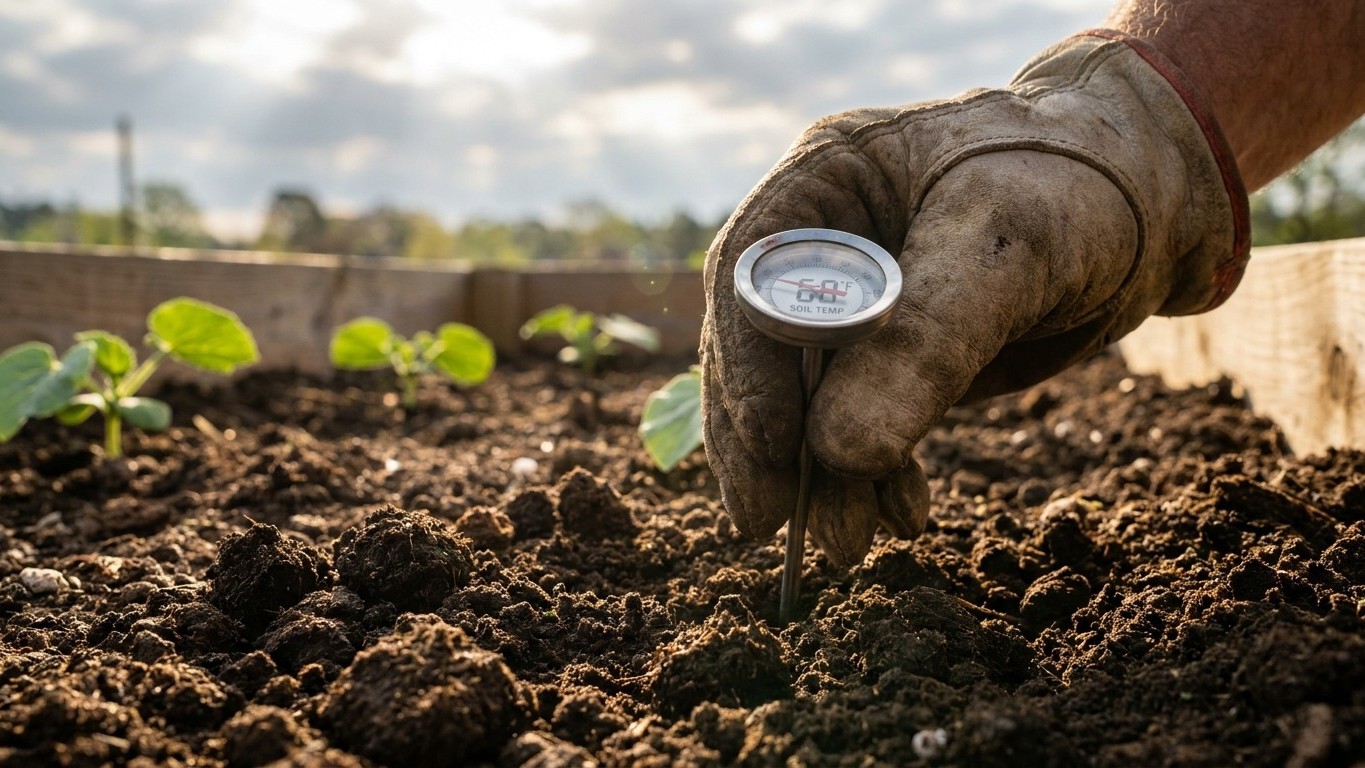

Melons grow well across most of North Carolina, but the state’s three landscapes, mountains, Piedmont, and coastal plain, don’t share a single calendar. The short version: wait until soil is reliably warm (not just frost-free), expect a growing window of roughly seven months in the Piedmont, and match your melon type to how much summer heat and rain your particular corner of the state actually gets.
When the soil is warm enough in North Carolina

Gardeners ask “when can I plant melons” but the honest answer starts with a different question: how warm is the ground, not the air. Frost dates are useful because they’re measured and public, but they’re a stand-in for something else entirely, soil temperature, and melon seed simply refuses to germinate well in cold dirt regardless of what the calendar says.
For the Piedmont, using Charlotte as the reference station, NOAA’s 1991-2020 climate normals put the last spring frost (the 32°F freeze probability window) between March 23 and April 5. That’s a 30-70% probability band, not a guarantee, so treat it as the odds of frost, not a promise it won’t happen. A frost date tells you when the danger of a freeze drops off. It says nothing about whether the soil six inches down has actually shaken off winter.
That distinction matters more for melons than for almost any other garden crop. Melon roots stall in cold soil even when the air feels pleasant, and a seed sitting in ground below the mid-60s Fahrenheit will often rot before it sprouts rather than simply wait. Most growers in the Piedmont end up planting two to three weeks after that last-frost window closes, once the soil itself has caught up, not the moment the frost risk technically clears.
Here’s where the state’s geography changes the answer. Charlotte’s numbers describe the Piedmont. The coastal plain, with its lower elevation and moderating ocean influence, tends to warm earlier in spring, sometimes by a couple of weeks. The Blue Ridge counties to the west run the opposite direction: elevation delays both the last frost and the underlying soil warm-up, often by several weeks compared to Charlotte. A grower in Asheville and a grower in Wilmington are not working from the same clock, even though both are technically “North Carolina.”
Because of that spread, and because USDA places the state across hardiness zones 5b to 8b (a classification built purely on average extreme winter minimums, not spring timing), the smartest move is regional, not statewide. Black plastic mulch or row cover can nudge soil temperature up faster in any of these zones, which is a technique worth knowing regardless of where you garden, but it’s a practice, not a product recommendation, and it doesn’t erase a three-week elevation gap. For the specific soil-warming windows and melon types trialed in your county, the NC State Extension office is the resource built for that, county by county.
How long the season lasts here
Take the two frost dates from the same NOAA normals and the growing window comes into focus. Using the more conservative pairing, the latest likely last spring frost (April 5) to the earliest likely first fall frost (October 30), the frost-free stretch runs about 208 days. Using the more generous pairing, earliest spring frost (March 23) to latest fall frost (November 8), that window opens up to roughly 230 days. Either way, that’s close to seven months of workable garden time in the Piedmont, which is a long season by most of the country’s standards.
A window that size changes what’s worth attempting, not just what’s possible. Melons typically need somewhere in the range of two to three months from transplant to harvest depending on type, which means a 208-to-230-day window has real room left over after the first planting finishes. That’s the practical payoff of a long season: it turns melon growing from a one-shot bet into something you can stagger.
What a long window makes possible
With this much runway, a second sowing in early-to-mid summer is genuinely worth considering, timed so the fruit matures before the fall frost risk climbs back up in October. This isn’t universal advice, a shorter-season territory further north or at higher elevation inside North Carolina’s own mountain counties wouldn’t have the same luxury, and there the first planting is often the only one that makes sense.
The length of the season also affects whether transplanting pays off versus direct-seeding. In a long Piedmont or coastal-plain season, starting seed indoors and transplanting out (with care taken not to disturb the root system, since melons resent root disturbance more than most vegetables) buys a few extra weeks of harvest at the tail end, without much downside if the first frost is still months away. In a compressed mountain season, that same root check becomes riskier, because there’s less slack to recover from transplant shock. If you’re weighing a second planting or want the specific timing math for your area, the site’s succession sowing guide walks through how to count backward from your local fall frost date.
Heat and water in North Carolina

Melons are heat-accumulators. They care less about how many individual days cross a threshold and more about the total warmth banked over the season, but the days-above-90°F count is still the clearest single signal of how much heat load a garden is working with. At the Charlotte reference station, that figure averages 35.0 days a year at or above 90°F.
Thirty-five days is a moderate number, not the scorching, near-daily 90-degree stretch you’d see in parts of the Deep South or the desert Southwest. That matters for melon growing in a specific way: with heat load that’s real but not extreme, the sowing date and soil-warming technique carry more weight than they would in a hotter climate, because the crop needs every available warm week to accumulate enough heat units to ripen well. This is not a hot-climate growing situation where irrigation alone decides fruit size, it’s a moderate one where getting an early, warm start matters at least as much as watering later on.
Rainfall tells a second part of the story. Summer rain across June, July, and August averages about 12.1 inches at the same reference station, broken down as 3.99 inches in June, 3.74 in July (the driest month), and 4.35 in August, against 43.6 inches for the full year. That’s a reasonably wet summer by national standards, and it comes with a real trade-off: melons in warm, humid conditions are prone to powdery mildew and other fungal disease, especially as vines thicken and airflow drops in July and August.
Neither number, the 35 days of heat nor the 12.1 inches of rain, tells the whole story on its own. Soil type decides how that rain behaves: sandy coastal-plain soils drain it away within a day, while Piedmont clay holds it for a week or more, so two gardens receiving identical rainfall can need completely different watering schedules. A single summer thunderstorm also tends to run off rather than soak deep, particularly once those 90°F days are pulling moisture back out through evaporation. The practical takeaway for a moderate-heat, moderately wet state like North Carolina is that mildew and slow ripening are bigger risks than drought stress for most of the growing season, and a rain gauge on your own plot will tell you more than any regional average.
Which melons suit North Carolina
Given a moderate heat load (35 days above 90°F) and a summer that’s wet enough to invite fungal trouble, three qualities matter more than any brand or catalog name: how early a type matures, how well it tolerates humidity without collapsing to disease, and how much airflow it needs at the root zone.
An earlier-maturing type gives a cushion against the two variables that vary most inside the state, the true soil-warming date in your specific county and the disease pressure that builds as summer humidity peaks in July and August. A type bred or selected for disease resistance, particularly against the mildews that thrive in the state’s summer moisture, is a more useful first filter here than one chosen purely for size or sweetness. Airflow matters too: spacing vines and pruning for circulation reduces the humid, still conditions that let fungal problems take hold, a practice that costs nothing and doesn’t require any product.
What this page won’t do is hand you a cultivar name. That’s not an evasion, it’s the correct answer for a state this varied. A melon variety trialed and recommended for the coastal plain’s sandy, earlier-warming soil may perform differently in Piedmont clay or in a mountain county with a season weeks shorter on both ends. Naming one variety here would mean guessing at conditions this page has no way to verify for your specific address.
The resource built to close that gap is NC State Extension, which runs county-level offices and publishes the specific melon varieties trialed for North Carolina’s growing conditions, updated as new disease-resistant types come through testing. That’s the list worth checking before buying seed, because it reflects actual trial results in this state’s soil and climate, not a general national recommendation. Pair that local variety list with what you now know about your own window, roughly 208 to 230 frost-free days, moderate but real summer heat, and rain that needs watching more for disease than drought, and the type-level decision becomes straightforward even before you know the exact name on the seed packet.