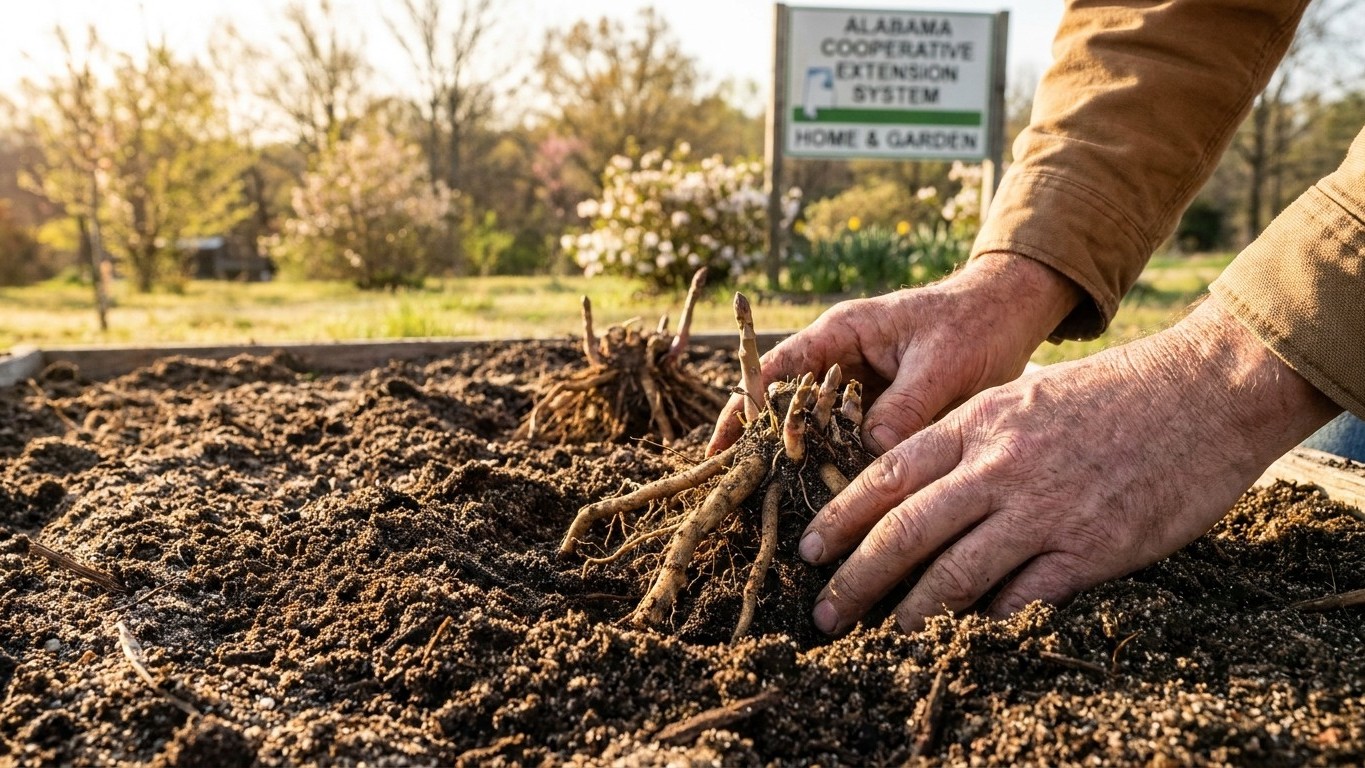

New York asparagus goes into the ground as crowns in early spring, timed to the region’s last frost rather than a fixed date on the calendar. In the New York City area that window runs around March 23 to April 3, based on NOAA’s 30-year normals; gardeners farther upstate wait longer. The crowns settle into 8-inch furrows and won’t yield a single spear until the third year after planting. After that, a well-sited bed keeps producing for 10 to 15 years.
The short answer
Deciding where to sink asparagus crowns matters more than deciding when, because this is the one vegetable bed in a New York garden that isn’t renegotiated every season. Utah State University Extension is direct about the timeline: a newly planted crown produces nothing harvestable in its first two years, and even then the picking starts light, four weeks in year three, extending to six weeks and then eight weeks in later seasons, with the rule for stopping being a simple observation rather than a date, once most spears have gone thinner than a pencil, the cutting for that year is done. After that early stretch, the same row keeps bearing for 10 to 15 years. The extension’s soil advice is equally blunt: almost any soil works, as long as it drains.
New York’s representative soil, mapped by USDA NRCS as the Honeoye series, gives a sense of what “drains” tends to look like across the state. It’s an Alfisol, a forest-derived soil of moderate fertility, running slightly acid at a surface pH near 6.3, with a texture that leans loam to silt (about 26 percent sand, 19 percent clay, and 55 percent silt) and organic matter around 3.0 percent in the surface layer. USDA classifies it as well drained. For a bed that’s going to sit in one place for over a decade, that’s a reasonable working assumption for much of the state.
None of that is a verdict on any one backyard, though. The Honeoye series is what USDA lists as representative of New York, not a survey of every lot in it. Hill country, river bottoms, and any ground a builder has graded or filled can behave nothing like it, holding water long after a storm has passed or drying out within a day. Before committing a spot for over a decade, a soil test, or simply watching how a patch of ground handles heavy rain, tells more than a state-level average ever will. If drainage turns out to be the problem, the practical fix is to raise the bed, mounding soil or building a frame so the crowns sit above the standing water, since a low, waterlogged spot is exactly the failure mode a well-drained soil is meant to avoid over a 10 to 15 year run.
Will the summer here water it for you?
an Asparagus Bed‘s water needs are modest but specific: Utah State University Extension calls for 1 to 2 inches every other week during the first two years while the crowns establish, then a lighter schedule of watering every three weeks once the planting matures. New York’s summer doesn’t deliver that on any fixed schedule, but the region’s rainfall normals give a starting point for figuring out how much a gardener needs to add.
- Total summer rainfall. NOAA’s 1991-2020 normals for the reference station put June, July, and August rainfall at about 13.7 inches combined, which averages out to a little over an inch a week if it fell evenly, which it rarely does.
- Month by month. June is the driest of the three at 4.54 inches, July edges up to 4.6, and August comes in at 4.56, so there’s no single dry month to plan around; the shortfall risk sits fairly evenly across the whole season.
- During the first two seasons. Matching that average against the 1-2 inch every-other-week target for new crowns shows normal rainfall lands close to enough on paper, but summer rain in the Northeast tends to arrive in thunderstorms rather than steady soaking rain, so a share of any single storm runs off instead of reaching the crowns’ roots.
- Once the bed is established. The every-three-weeks target is easier to cover with rainfall alone, though a stretch of dry, hot weather can still outpace what’s falling from the sky.
- The only way to know for certain. A rain gauge on the actual bed, since a rain shadow, a slope, or even a nearby building can push one yard’s real total well off the station average this figure is built from.
When to put the crowns in
Crowns go into the ground in early spring, once the soil has thawed and dried enough to work and the risk of a hard freeze has mostly passed. For the New York City area, NOAA’s 1991-2020 normals put the last spring frost around March 23 to April 3, a range built from 30-year probabilities rather than a guarantee for any single spring. That figure comes from a dense urban weather station; upstate counties and the Adirondacks run on their own, later clock, with frost lingering well beyond that city window. The safest approach anywhere in the state is watching the ground and the forecast in a given year rather than counting on a fixed date on paper.
The planting itself follows a set depth: crowns settle into furrows about 8 inches deep. The furrow isn’t filled in all at once. Soil gets added back gradually over the course of the year, roughly 2 inches every other month, rather than burying the crown completely on planting day. That staged backfilling gives the emerging shoots room to push upward before they’re working against a full 8 inches of soil overhead.
Crowns aren’t the only starting point. Some gardeners start asparagus from seed instead, though the planting depth and harvest timeline described here come from Utah State University Extension’s guidance for crowns specifically. Whichever starting method a gardener picks, the named varieties in that same guidance are distinguished only by sex, not by flavor or yield, since neither is published:
| Variety | Sex type |
|---|---|
| Jersey Giant | All-male |
| Jersey Knight | All-male |
| UC 157 F1 | Male and female |
| Purple Passion | Male and female |
All-male varieties tend to get chosen where a gardener wants to avoid volunteer seedlings sprouting between rows, since female plants produce seed-bearing berries. Past that distinction, the source stays quiet on which variety performs better in a New York bed specifically.
Common questions
Can asparagus crowns be planted in fall in New York?
The guidance behind this article addresses spring planting, timed to the region’s last frost, around March 23 to April 3 near New York City and later upstate. Fall planting isn’t covered in that source, so no timing recommendation is offered for it here.
How long before an asparagus bed actually produces?
Nothing in years one and two. Year three brings a first light harvest of about four weeks, followed by six weeks, then eight weeks in the seasons after that. The cutoff each year isn’t a date, it’s a look at the spears: once most of them run thinner than a pencil, harvest stops for the season.
What if the yard has heavy, slow-draining soil?
The state’s representative soil, the Honeoye series, is a well-drained loam to silt, but that’s a statewide average, not a reading of any particular lot. A soil test or a simple observation of how a spot handles heavy rain settles it. Where drainage is poor, raising the bed, mounding soil or building a frame so the crowns sit above standing water, is the practical workaround for a planting meant to stay put for over a decade.
Does an asparagus bed need watering every week in summer?
It depends on the bed’s age. New crowns want 1 to 2 inches every other week for the first two years; established beds shift to about every three weeks. New York summers deliver roughly 13.7 inches across June through August, close to that target on paper, but rain often falls in storms rather than steady soaking, so a rain gauge on the actual bed is the only way to know if extra watering is needed.