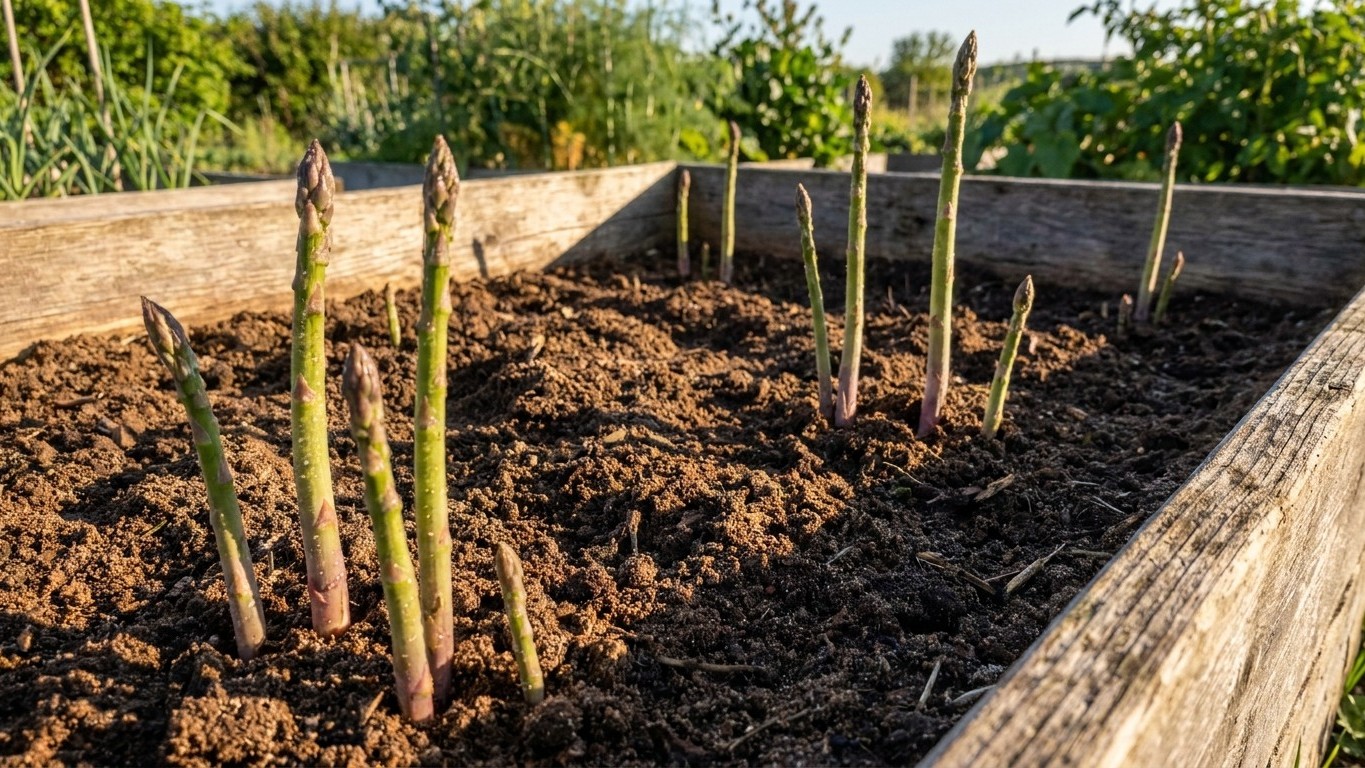

North Dakota’s representative soil, the Williams series, drains well by the book, and that’s the only condition Utah State University Extension attaches to an Asparagus Bed meant to keep producing for ten to fifteen years. So the plain answer is yes, this state’s ground can carry that kind of commitment. What actually decides it, though, is the drainage on one particular lot, not a soil series mapped across an entire state. That distinction runs through everything below.
The short answer
Ten to fifteen years of production is what a properly sited asparagus bed delivers, and the source behind that figure names exactly one soil requirement to get there: the ground has to drain. Not a pH window. Not a texture class. Not an organic-matter target. Just drainage. That single rule carries more weight here than it does for almost any other crop grown at home, because asparagus crowns go into the ground once and then stay in that exact spot through the entire run, with no harvest at all until the third year.
What the Williams series brings to a fifteen-year bed
The soil USDA lists as representative of North Dakota is the Williams series, a Mollisol, which is the deep, dark prairie soil that built the Corn Belt’s reputation. Sampled surface values put it at 38 percent sand, 22 percent clay, and 40 percent silt, a loam-to-silt blend, with organic matter around 4.0 percent and a surface pH near 7.2, close to neutral. USDA classifies it as well drained. On paper, that’s a soil built for exactly this job: enough organic matter to hold nutrients, enough sand and silt to keep water moving rather than pooling.
The pH figure is worth pausing on, but not for the reason it looks useful. USDA Soil Survey does not attach any pH recommendation to asparagus, so a surface reading of 7.2 tells a gardener what the mapped Williams series tends toward, not what sits in their own raised bed or backyard plot. The only way to know a garden’s actual pH, or its actual drainage, is a soil test pulled from that garden. The state soil is a starting point for a conversation, not a diagnosis of one yard.
If the ground doesn’t drain
Plenty of North Dakota gardens sit on soil that isn’t Williams series at all. River bottoms, compacted subdivision lots, and anywhere a builder has scraped and filled will behave nothing like the representative profile above, and some of them hold water long after a rain instead of shedding it. A simple check settles it: dig a hole about a foot deep, fill it with water, and see how long it takes to disappear. If water is still sitting there after several hours, the fix isn’t to abandon asparagus, it’s to raise the bed. A mounded or framed bed built up eight to twelve inches above grade gives roots the well-drained root zone the crop needs, even when the native soil underneath would otherwise drown a crown planted directly into it. That workaround matters more for this crop than for annual vegetables, because there’s no replanting a poor decision here for over a decade.
Will the summer here water it for you?
Utah State University Extension’s schedule is specific: 1 to 2 inches of water every other week for the bed’s first two seasons, then a lighter routine of 1 to 2 inches every three weeks once the crowns are established. Translating that into a monthly figure gives a young bed a need of roughly 2 to 4 inches a month, and a mature bed a need closer to 1.3 to 2.7 inches a month. Set against that, the reference station behind North Dakota’s summer normals reports about 10.0 inches of rain across June, July, and August combined, broken down as follows.
- June averages 4.29 inches. That sits above the top end of even a young bed’s monthly need, so in a typical June the sky is doing the watering and a hose stays in the shed.
- July averages 3.07 inches. Still enough to cover a mature bed’s three-week cycle with room to spare, and it lands inside the range a first- or second-year bed needs too, though closer to the low end than June.
- August averages 2.6 inches, the driest of the three summer months. That’s below the 2 to 4 inches a young bed wants, which means a bed still in its first two years is the one most likely to need a supplemental soak in a normal August, even before factoring in evaporation on hot days.
None of this accounts for how fast the Williams series lets water pass through. A well-drained loam-to-silt soil doesn’t hold an inch of rain the way a heavy clay does, so a dry stretch inside August shows up in the root zone faster than the monthly average suggests. A rain gauge staked next to the bed, checked every week or two through summer, is the only way to know whether a given season is actually meeting the schedule or just averaging out to look that way on paper.
When to put the crowns in
Crowns go into the ground in early spring, set into furrows about 8 inches deep, and the timing lines up with the last frost more than with any date on a calendar. The reference station used for North Dakota’s frost normals puts the last spring freeze at 32°F somewhere between May 4 and May 15, based on 1991-2020 data. That’s an average window, not a guarantee for any particular county, and outlying gardens away from the airport station that generates the figure often see their own last frost run later, sometimes by a week or two, so it’s worth treating May 4 to May 15 as an around-this-time marker rather than a fixed appointment.
Backfilling the furrow over the season
The 8-inch furrow doesn’t get filled in all at once on planting day. Crowns are set at the bottom, covered lightly at first, and then the trench is backfilled gradually, about two inches every other month across the growing season, until the soil level catches up to grade. That staged approach lets the emerging shoots keep pushing through loose soil instead of getting buried under a full 8 inches of packed dirt from the start.
Seed is the other route in, and it’s a slower one. Rather than setting a dormant crown straight into the furrow, seed-grown asparagus spends its early life establishing in a nursery bed before it’s ready to move to its permanent spot, which pushes the whole timeline out compared to buying crowns. Gardeners who go this way still need the same well-drained ground once the plants are transplanted, and the same patience about a first harvest that doesn’t arrive until the third year regardless of which starting method got the bed going.
Common questions
Does North Dakota’s soil pH suit asparagus?
The Williams series reads about 7.2 at the surface, near neutral, but the source behind the asparagus growing guidelines used here is silent on any pH preference for the crop. A soil test from the actual bed site is the only way to know what’s really there, since the state figure describes a mapped series, not any one garden.
Can a bed on heavier, slower-draining soil still work?
Yes, if it’s raised. Building the bed up above grade gives roots a well-drained zone even where the native ground underneath holds water, which matters for a crop that stays in one place for ten to fifteen years.
How early can spears be harvested after planting?
Not before the third year, regardless of soil quality or how well the bed drains. That timeline comes from the crop itself, not from any shortcut in soil preparation.
Is one asparagus variety better suited to North Dakota than another?
Utah State University Extension names varieties only by sex, all-male types such as Jersey Giant and Jersey Knight, and male-and-female types such as UC 157 F1 and Purple Passion, without publishing a flavor, yield, or regional-suitability comparison between them. Choosing among them isn’t a soil question.