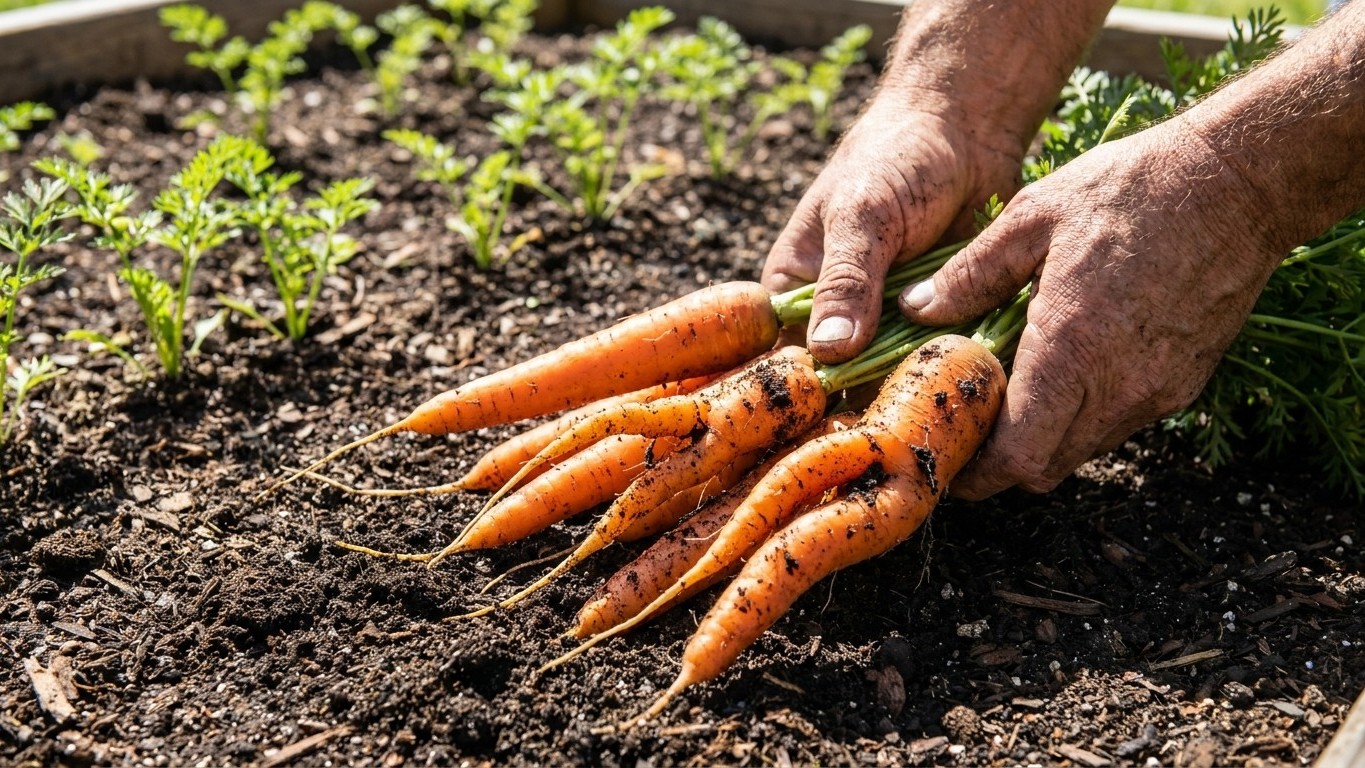

The direct answer depends less on a calendar date than on your soil. Carrots are direct-sown, never transplanted, and mature 70 to 100 days after seeding. In New York, the workable window opens once soil can be raked into a fine bed and closes when you count back 70 to 100 days from your local first fall frost, or forward from your last spring frost, whichever your soil allows first.
The short answer
New York’s representative soil, the one the USDA lists as the state’s benchmark for planning purposes, is the Honeoye series. It’s an Alfisol, a forest-derived soil of moderate natural fertility that holds onto nutrients reasonably well. The surface horizon runs 26 percent sand, 19 percent clay and 55 percent silt, which puts it solidly in loam to silt-loam territory, with a surface pH around 6.3, slightly on the acid side. Organic matter sits near 3.0 percent, and the drainage class is listed as well drained.
That combination is, on paper, close to what a carrot wants. Utah State University Extension is blunt about the crop’s preferences: carrots need deep, sandy, well-drained soil rich in organic matter. Heavy or rocky ground makes the root fork, splitting into two or three legs instead of growing as one clean taproot. A silt-loam with well-drained status and a fair amount of organic matter doesn’t automatically fork a carrot the way a dense clay pan does. Where a Honeoye-type profile tends to trip a gardener up is the silt fraction. At 55 percent silt, this soil can still compact into a crust after a hard rain, and that crust is enough to deflect a young taproot sideways or split it into forks even when the deeper profile is fine.
The extension guidance for any soil on the heavy side, whether clay-dominant or silt-compacted, is the same: work in plenty of compost and double dig the bed, loosening and amending a full spade’s depth rather than just the top few inches. If double digging isn’t practical, a raised bed filled with a loose, sandy blend sidesteps the problem outright and is often the faster fix for a small backyard plot.
None of this is a diagnosis of your yard. New York spans hundreds of mapped soil series, and the Honeoye figures above describe a representative surface horizon as mapped by the USDA, not a number pulled from any one cultivated garden bed. A hillside plot two counties over, a floodplain garden near a river, or a yard built on fill after construction can carry none of these characteristics. Treat this section as a starting point for what the region’s ground tends to do, then confirm it with your own hands.
The test that settles it in your own garden
A soil name on a county map won’t tell you what’s actually under your carrot bed. The only way to know is to dig, look, and watch, and none of it requires lab equipment.
- Dig a hole at least a foot deep where you plan to sow. Note how far down you go before hitting rock, dense clay, or a hardpan layer. Carrots need a clear run of loose soil roughly as deep as the root will grow, so a shovel that stops cold at six inches is telling you something a bag of seed packet advice never will.
- Look at what comes out. Are there stones, gravel, or chunks of broken brick mixed through the dirt? Any obstruction that size will deflect or fork a growing root just as surely as a hardpan does.
- Feel the texture. Grab a handful of moist soil and squeeze it. If it holds a sticky ribbon shape, you’re dealing with clay-heavy ground that will need serious amending. If it falls apart instantly and feels grainy, you’re closer to the sandy end. Something in between, that holds a loose shape but crumbles with a light poke, is closer to a workable loam.
- Watch how water drains. Dig a hole, fill it with water, and time how long it takes to disappear. Water that sits for hours signals poor drainage and a strong risk of forking and rot. Water that vanishes almost immediately suggests a bed so sandy it may need more organic matter to hold moisture evenly, which matters for the next section’s failure modes.
Run this test in more than one spot if your yard has any slope, shade, or history of disturbed ground. Two beds ten feet apart can behave completely differently, and the shovel test costs nothing but twenty minutes.
What goes wrong here
Carrots fail in a handful of predictable ways, and most of them trace straight back to soil structure or watering rhythm rather than the seed itself.
- Forking in heavy ground. When the taproot hits compacted clay, a buried stone, or a silt crust from a hard rain, it splits into two or three legs instead of growing straight. The fix is the one Utah State University Extension gives for any heavy or rocky soil: work compost through the bed and double dig it, or skip the fight entirely and build a raised bed filled with loose, amended soil.
- Poor germination in a hot spell. Carrot seed is slow and finicky to begin with, and a stretch of hot, dry weather right after sowing can dry out the surface faster than the seed can sprout. Keeping the seedbed consistently moist, not soaked, until germination is the standard remedy, since carrot seed simply won’t push through a crusted, bone-dry surface.
- Splitting from uneven water. A root that grows steadily and then gets hit with a sudden heavy soaking after a dry stretch can crack open as it swells too fast. Even, regular watering through the growing season, rather than occasional deep dousing, keeps the root growing at a steady rate and avoids the split.
All three problems share a root cause: carrots are unforgiving about consistency, in soil texture and in moisture, because there’s no transplanting step to correct course partway through. The seed goes into its final bed on day one, and whatever that bed offers for the next 70 to 100 days is what the root has to work with.
Common questions
How do I find my last frost date in New York?
No single statewide frost date applies across New York, since elevation, distance from the Great Lakes, and latitude all shift the timing county by county. A specific date isn’t published in this guide; check your local weather station’s historical records for the frost date that applies to your exact location.
Can I sow carrots directly in Honeoye-type soil without amending it?
The Honeoye series is well drained with a moderate silt-loam texture, which is closer to workable than heavy clay. But the representative figures describe a mapped average, not your bed. Run the shovel and squeeze test first, and add compost if the texture leans sticky or the drainage test showed standing water.
How many days before harvest should I count from seeding?
Carrots are direct-sown and mature 70 to 100 days after seeding, never from a transplant date since there is no transplanting step with this crop. Count that window against your local frost timing to know your latest safe sowing date for the season.
Why did my carrots come up thin and forked this year?
Thin, forked roots usually point to compacted or rocky soil that deflected the taproot as it grew. Dig a test hole where the crop struggled, check for stones or a hard layer, and work in compost or move to a raised bed before the next sowing.