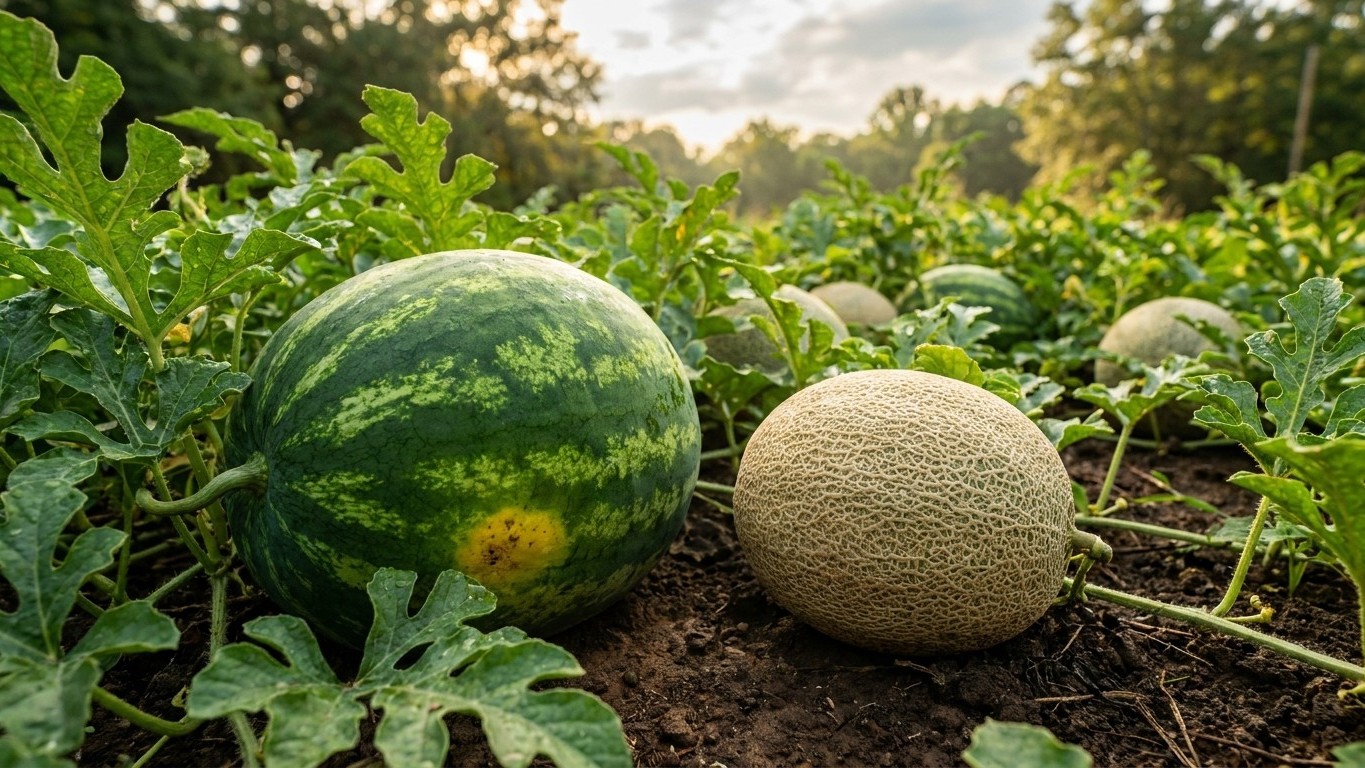

New York’s growing conditions split sharply by region, so the right melon depends on where in the state you’re planting. Short-season muskmelon and cantaloupe varieties (75-85 days to maturity) work almost everywhere in the state. Long-season watermelons and honeydews (85-100+ days) only ripen reliably in the warmest pockets, close to New York City, Long Island and the lower Hudson Valley.
The short answer for New York
New York’s USDA hardiness zones run from 3b to 7b, which is one of the widest spreads of any state in the Northeast. That range alone tells you the melon decision here isn’t about a single “best variety” but about matching a variety’s maturity window to your own slice of the state. At the warm end, near the New York City reference station, the frost-free window runs from a last spring frost of March 23 to April 3 out to a first fall frost of November 14 to November 27. That’s a season stretching past seven months in the warmest zones, plenty of time for a 95-day watermelon to finish.
Nobody upstate gets that window. In the Adirondacks and at higher elevations, sitting closer to zone 3b or 4, the frost-free season shrinks dramatically, and the same 95-day watermelon that ripens fine on Long Island can still be sizing up when the first cold night arrives. That’s why the safe, state-wide default is a fast muskmelon or cantaloupe, something bred to finish in 75 to 85 days from transplant. Varieties in that window give growers in cooler zones a real shot at ripe fruit before frost, while growers in the warmer south end still have time to spare and can layer in a second planting if they want.
Heat matters here too, and New York’s numbers are more moderate than growers might expect. The reference station averages just 12.2 days a year at or above 90F. That’s not the kind of sustained, scorching heat that pushes sugar into a melon fast. It means the classic desert-style cantaloupe, bred for weeks of dry, blistering heat, isn’t working with much margin here. Varieties selected for cooler, shorter, more humid summers, common in Northeastern seed catalogs, are a better match than varieties developed for the Southwest or the Deep South.
So the short answer, by type: muskmelon and cantaloupe types bred for 75-85 days are the safe, state-wide choice. Watermelon and honeydew types needing 85 days or more belong only in the warmest zones near the coast and lower Hudson Valley, and even there, choosing a variety on the shorter end of its category buys insurance against a cool, wet spring that delays transplanting.
What will not work here
The clearest failure mode in New York is planting a slow watermelon in a short-season zone and expecting a repeat of what a Georgia or Texas grower gets. A 100-day watermelon variety, started outdoors after the last frost in an upstate garden with a frost-free window well short of the NYC figure, simply runs out of warm days. The vines will look healthy, may even flower and set fruit, but the melons stay pale and underripe when the first fall cold snap arrives. This isn’t a soil problem or a watering problem. It’s arithmetic: the variety needs more warm days than the zone reliably provides.
Humidity causes the second major failure, and it’s easy to miss because it doesn’t show up as an obvious lack of water. New York’s reference station logs about 13.7 inches of rain across June, July and August, spread fairly evenly (4.54 inches in June, 4.6 in July, 4.56 in August). That’s not a drought pattern. But combined with the state’s summer humidity, that steady rain keeps foliage damp longer than in drier climates, and melons planted too close together lose the airflow that keeps powdery mildew and downy mildew in check. A grower who spaces vines the way a Southwestern gardening guide recommends, tight, because that region’s dry air keeps disease pressure low, will often watch New York vines collapse under mildew by mid-August, well before the fruit finishes ripening.
The third failure comes from treating that 13.7 inches of summer rain as a guarantee against watering. It arrives unevenly, often as thunderstorms that dump an inch in an hour and run off rather than soak in, especially on compacted or clay soil. A gardener who skips supplemental watering because “we get plenty of rain” can still end up with a moisture-stressed vine during a dry stretch in a rainy month, particularly during June, the driest of the three summer months at the reference station. Melons are especially unforgiving about inconsistent watering right as fruit is sizing up, and a stretch of skipped irrigation followed by a heavy storm is a common cause of split fruit.
What changes across New York
A hardiness zone spread from 3b to 7b means New York isn’t one growing region, it’s several stacked on top of each other. There is no single answer to “when do I plant” or “how long a season do I have” that applies from Long Island to the Adirondacks. The 3b end of that range describes short, cool summers and a frost-free window that can be less than half of what the NYC reference station sees. The 7b end, closer to the city and the coast, behaves more like the mid-Atlantic, with a long, warm season that can carry a slower-maturing melon to full ripeness with room to spare.
For a reader gardening in the northern part of the state or at higher elevation, the practical shift is toward shorter maturity numbers across the board, and toward season-extension tools that add effective warm days: black plastic mulch to warm the soil early, row cover to protect young transplants from a late cold snap, and starting seed indoors three to four weeks before the local last-frost date rather than direct-seeding outdoors. These aren’t optional extras in the coolest zones, they’re often what separates a ripe melon from a vine full of green ones in October.
For a reader in the warmer zones near the coast, the shift runs the other direction. There’s enough season length to grow the slower, larger-fruited watermelon and honeydew varieties that simply aren’t realistic further north, and even room in many years to succession-plant a second crop of a fast muskmelon variety after an early one finishes. The point isn’t to guess which zone applies to a given yard. It’s to recognize that the answer changes by a wide margin across the state, and to check the map rather than assume.
Where to check this for your own county
This page gives the state-level picture, built from a single reference station and a statewide hardiness zone range. That’s useful for narrowing down melon type, but it isn’t a substitute for what your county extension office knows about your specific microclimate. Cornell Cooperative Extension maintains county-level offices across New York, and that’s the resource to check next.
Two things are worth pulling up there specifically. First, the local planting calendar for your county, which accounts for local frost dates that can differ by weeks from the NYC reference figures used on this page, especially if you’re inland, at elevation, or near one of the Great Lakes, where lake effect shifts both spring warming and fall cooling. Second, look for any variety trial results specific to your county or region. Cornell’s extension network runs vegetable trials across different parts of the state precisely because a melon variety that performs well in the Hudson Valley may underperform in the Southern Tier or the North Country, and those local results carry more weight than any general variety list.
A county recommendation beats a state one every time, because it’s built on frost data, soil, and trial results specific to a smaller, more consistent area. This page draws on statewide and single-station figures to describe the broad pattern across New York. Your county extension office draws on data collected closer to your actual garden. When the two disagree, especially on planting dates or variety maturity windows, trust the county source.
Checking this against your own garden
Every figure on this page is a normal, an average built from three decades of data at one weather station. Your own garden will deviate from it, sometimes by a lot, and three simple observations tell you more about your actual conditions than any calendar date.
Soil warmth by feel is the first and most direct check. Melon seed germinates poorly in cold soil, and a gardener who can push a finger a couple of inches into the bed and feel real warmth, not just air temperature but soil that’s held heat overnight, has a better read on planting readiness than any date on a chart. Cold, slow-to-warm soil, even well after the average last frost date has passed, means the ground needs more time regardless of what the calendar says.
The first flush of male flowers is the second signal worth tracking. Melon vines produce male flowers before female ones, often by a week or two, and seeing that first flush tells you the plant has moved past establishment and into reproductive growth. It’s an early clue to how the season is tracking relative to a normal year, useful for deciding whether a variety is running ahead of or behind its expected maturity window in your specific yard.
The appearance of the first true leaves, the second set that follows the rounder seed leaves, marks the point where a young transplant has shifted to real vegetative growth and can handle more sun and less coddling. Watching for it tells a grower when a plant raised indoors or under row cover is ready for that protection to come off. None of these three checks require any equipment beyond a finger and a bit of attention, and together they say more about your microclimate than the statewide averages ever could.