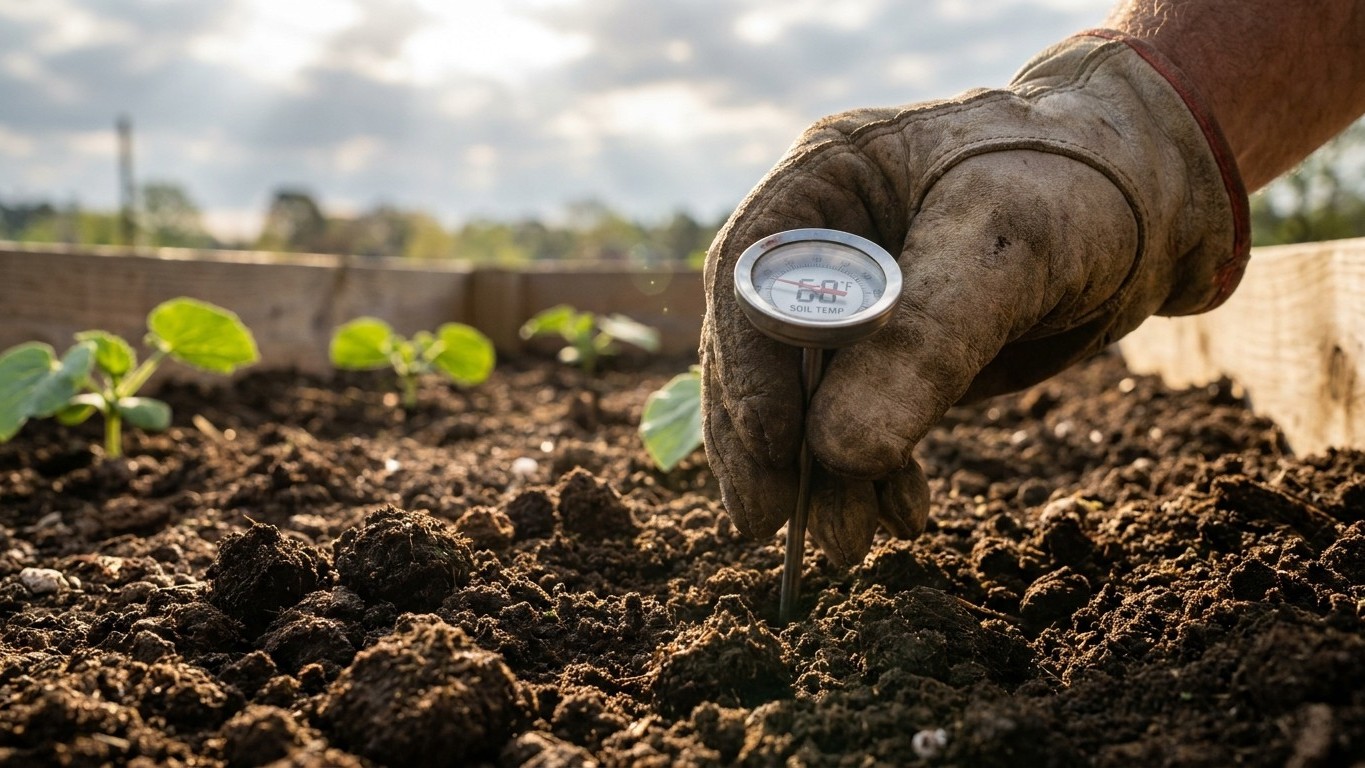

New York gardeners can safely put melon transplants or seeds in the ground once the soil has warmed past 65 degrees, which in the New York City area usually falls in mid-to-late May, roughly three to four weeks after the last spring frost passes. Upstate growers wait longer. The frost date is only the starting gun, not the finish line.
When the soil is warm enough in New York
The question every melon grower asks first is simple: when can I plant? At the NOAA reference station in Central Park (USW00094728), the last spring frost falls between March 23 and March 3, based on the 1991-2020 U.S. Climate Normals. That’s a probability band, not a guarantee, and it belongs to New York City specifically. Upstate valleys, the Southern Tier, and especially the Adirondacks see frost linger much later into spring and arrive much earlier in fall, so a Buffalo or Saranac Lake gardener working from a Central Park date will get burned.
Here’s the part that trips people up: melon seeds don’t care about frost dates. They care about soil temperature. Melon seed germinates poorly, if at all, in soil under 65 degrees, and the roots stall out below that threshold even if the plant survives. Air temperature can clear the frost risk weeks before the ground underneath actually warms up, especially in clay-heavy soils that hold cold longer than sand. That’s why experienced growers in this state don’t mark a calendar date and sow. They check the dirt.
Two practices close that gap. Black plastic mulch laid over the bed a week or two before planting traps solar heat and can push soil temperature up several degrees faster than bare ground left to warm on its own. Floating row cover does something similar for the air around young seedlings, buffering a late cool snap without needing chemical intervention. Neither trick moves the calendar much for gardeners north of the city, where a slower spring simply means transplants started indoors under lights make more sense than direct seeding.
Nobody should treat the frost window as fixed. It’s a 30-to-70 percent probability band drawn from three decades of weather, which means some years bring frost after the “safe” date and some years don’t. For melons, a heat-loving crop with zero tolerance for cold shock, that residual risk is exactly why waiting for warm soil, not just a clear calendar, is the safer bet. For variety-specific guidance suited to a particular county’s soil and microclimate, Cornell Cooperative Extension (cals.cornell.edu/cornell-cooperative-extension) keeps trial data that a statewide article like this one simply can’t replicate.
How long the season lasts here
Subtracting the two frost dates gives a rough frost-free window at the Central Park reference station: from a last spring frost between March 23 and April 3 to a first fall frost between November 14 and November 27, the frost-free stretch runs somewhere between 236 and 238 days. That’s close to eight months, which sounds generous until you remember it’s a New York City figure. Inland and upstate counties lose weeks off both ends, sometimes shrinking the usable window to under five months.
What that length actually buys the gardener is the real question. In the city and nearby coastal counties, a window approaching eight months is long enough to consider a second sowing of a fast-maturing melon type after an early spring crop finishes, provided the second round still has time to ripen before the November frost risk climbs. That’s a meaningful advantage over shorter-season parts of the state, where the first sowing is the only shot the year allows, and where transplants (started indoors four to five weeks before the soil-warming date) become less of an option and more of a necessity.
Succession sowing isn’t automatic just because the calendar allows it. It depends on matching the second planting’s maturity window against the shrinking days of late summer, when cooler nights slow melon ripening even before frost becomes a threat. The mechanics of staggering plantings, spacing them so a garden isn’t overwhelmed at once and isn’t left empty either, are covered in more depth in this site’s succession sowing guide, which applies the same frost-window math to other warm-season crops.
Where the window runs short, the smarter move isn’t fighting for a second sowing. It’s protecting the first one. Row cover at both ends of the season, careful hardening-off of transplants, and choosing the earliest-maturing type available all matter more in a five-month window than in an eight-month one. Length of season should decide the strategy before a single seed goes in the ground.
Heat and water in New York
Melons are a heat-accumulation crop. They don’t just want warm days, they want a season’s worth of them stacked up, and that’s where New York’s numbers tell an honest story. At the New York City reference station, the year averages just 12.2 days at or above 90 degrees. That’s a modest heat load compared with the melon belts of the South or Midwest, and it means the sowing date matters less here than the technique used to bank whatever heat the season offers.
That’s the practical takeaway for this state: black plastic mulch, row cover, and siting melon beds against a south-facing wall or fence to catch reflected warmth do more work in New York than they would somewhere with heat to spare. Growers upstate, where summer heat runs even cooler than the city figure suggests, should lean on these techniques harder than the sowing calendar itself.
What the rainfall numbers add
Summer rainfall at the same reference station runs about 13.7 inches across June, July, and August, with June the driest of the three months.
| Month | Average rainfall (inches) |
|---|---|
| June | 4.54 |
| July | 4.6 |
| August | 4.56 |
Paired with a modest heat load, that rainfall total points to a different risk than the classic hot-and-dry melon problem. New York’s summers aren’t the kind where irrigation alone decides the crop’s size and the last two weeks decide its sugar. They’re closer to the opposite: a cooler, damper season where the bigger threats are powdery mildew, downy mildew, and slow, uneven ripening driven by humidity rather than drought. Spacing vines for airflow and watering at the soil rather than overhead does more for a New York melon patch than any irrigation schedule built for a hot desert climate.
Rain that falls in a single thunderstorm still runs off a clay bed rather than soaking in, so the 13.7-inch summer total doesn’t remove the need to check the soil directly. A rain gauge on the actual plot, not a regional average, is what tells a gardener whether supplemental watering is needed in a given week.
Which melons suit New York
Given a modest heat load and a humid summer, the type of melon matters more here than the exact sowing week. Early-maturing types, the ones bred to finish before the accumulated heat runs out, are the safer bet across most of the state, and especially upstate where the frost-free window runs shorter than the city’s near-eight-month stretch. Types known for compact, bush-like growth also suit smaller New York yards where space and airflow both matter.
Disease resistance should be the first filter, not an afterthought, given how much summer rain and humidity this state carries compared with drier melon-growing regions. Types bred with resistance to powdery mildew hold up better through a damp New York August than types selected purely for size or sweetness. Airflow does the rest: wider spacing between vines and pruning that opens up the canopy reduce the still, humid microclimate where mildew spreads fastest.
This page won’t name a specific variety, and that’s a deliberate choice rather than an omission. A cultivar bred and trialled for the Hudson Valley’s soil and season isn’t necessarily the one performing well in Erie County or on Long Island, and hardiness zone alone, which for New York spans 3b to 7b under the USDA system, a single statewide range covering wildly different climates from the Adirondacks to the city, can’t settle that question either. The only recommendation worth acting on comes from the varieties actually trialled in a reader’s own county, and that’s exactly what Cornell Cooperative Extension (cals.cornell.edu/cornell-cooperative-extension) tracks season over season. A general guide naming a cultivar it has never tested in New York soil would be guessing, and guessing is the one thing a gardener planting a single summer’s worth of melons can’t afford.