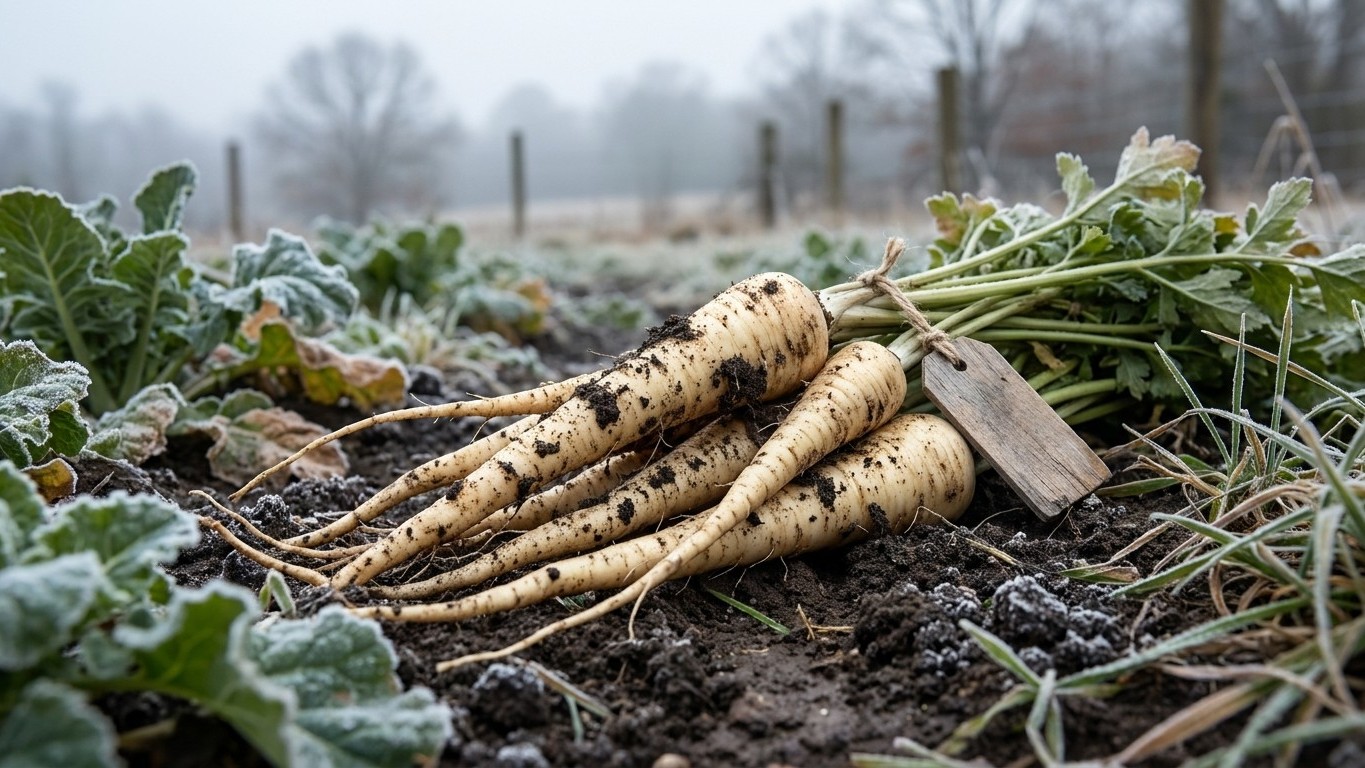

Yes, but only with help from the calendar, not the map. Parsnips grown in New York get the frost exposure they need to turn starchy roots sweet, thanks to a coldest-month average minimum of 27.9°F. The season also runs long enough to grow a full root before that cold arrives. The catch is timing the sowing and the harvest to match what the state’s frost dates actually allow.
The short answer
Start with the number that actually settles this: New York City’s coldest month carries a mean minimum temperature of 27.9°F, according to NOAA NCEI Climate Normals for 1991-2020. That’s not a record low pulled from one brutal night. It’s the average low across the whole coldest month, which means freezing or near-freezing nights aren’t the exception here, they’re the pattern. For a root vegetable that converts stored starch into sugar only after repeated exposure to cold, that pattern matters more than almost anything else on this page.
Parsnips don’t sweeten because a calendar flips to a certain zone or because a gardener waits a set number of weeks. They sweeten because the starch inside the root gets triggered by real, repeated frost. A mean minimum of 27.9°F for an entire month tells you that trigger is present here, and present reliably, not as a fluke. Compare that to a region where the coldest month barely dips below 40°F. In that kind of climate, a parsnip can grow to full size, look perfectly healthy, and still taste flat and starchy at harvest because the root never got the cold snap it needed.
New York, at least at the New York City reference station NOAA uses for these normals, clears that bar. A grower who leaves roots in the ground through the early weeks of the cold season, rather than pulling them the moment they reach size, gives the crop exactly the exposure Utah State University Extension describes as necessary for the starch-to-sugar conversion. This isn’t a one-night event. It’s several weeks of sustained cold, and the 27.9°F figure suggests those weeks are the norm rather than a gamble.
One caution worth repeating here: this number comes from the Central Park station, a dense urban site. Upstate New York, the Adirondacks, and other inland or elevated parts of the state see colder winters and earlier, harder frosts than what this figure describes. A grower in Buffalo or the North Country is working with a different, generally colder profile than the one this NOAA station reports. The New York City figure is a solid answer for that specific area, and a reasonable floor for milder pockets of the state, but it undersells how cold, and how favorably, other regions of New York run.
So the short version: yes, parsnips grown in New York, and especially in and around the New York City area this data describes, will sweeten, because the coldest month here reliably delivers freezing-range nights rather than just occasional dips. The variable that actually needs managing isn’t whether the cold arrives. It’s whether the season is long enough to grow the root before that cold shows up.
Does the season fit?
Utah State University Extension pegs parsnips at 100 to 120 days from seeding to harvest, with sowing recommended 2 to 3 weeks before the last spring frost. Parsnips go into the ground where they’ll grow, not transplanted, so every one of those days counts from the moment seed touches soil. Here’s how that timeline lines up against New York’s frost dates.
- Set the sowing window. NOAA’s 1991-2020 normals put New York City’s last spring frost between March 23 and April 3. Sowing 2 to 3 weeks ahead of that pushes seeding into early to mid-March, roughly the first three weeks of the month.
- Account for slow germination. Parsnip seed is notoriously slow, taking 14 to 21 days to germinate. A grower who sows in early March won’t see seedlings break the surface until late March at the earliest, and possibly not until the first week of April. That’s a long stretch of bare-looking soil, and it’s normal, not a sign of failed seed.
- Add the growing period. From the point of germination, the root still needs its full 100 to 120 days to size up. Counting from seeding in early to mid-March, the minimum 100-day mark lands around mid to late June, and the full 120-day mark lands closer to mid-July.
- Compare that to the frost-free stretch. New York City’s first fall frost arrives between November 14 and November 27. Measured from a last spring frost of March 23 to April 3, that gives a frost-free window running well past 220 days, close to eight months of growing time before the ground freezes hard.
- Weigh the margin. A 100 to 120 day crop dropped into a roughly 225 to 250 day frost-free window has months of slack left over, even after accounting for the slow 14 to 21 day germination. That leftover time isn’t wasted. It’s exactly the stretch where the root sits in the ground absorbing the cold it needs to sweeten.
The arithmetic says this season fits comfortably, not tightly. There’s enough room to sow on the early side, tolerate slow germination without panic, grow a full-sized root, and still leave it in the ground well after the first fall frost arrives, right through the weeks when the coldest month’s 27.9°F average minimum does its work.
What goes wrong here
- Forked roots from heavy or stony ground. Parsnips grow a single long taproot, and anything solid in its path, compacted clay, buried stones, hardpan, splits that root into forks. Utah State University Extension recommends deep sandy soil for this reason, and says heavy soil needs to be double dug before sowing so the root has clear passage straight down. A raised bed filled with loose, stone-free soil solves this where the native ground is heavy.
- Forked roots from overwatering. This is a separate cause from soil texture, and the two get confused often. Even in loose, sandy ground, roots that sit in consistently soggy soil can fork or rot at the tip. The fix is even, moderate moisture rather than heavy, frequent soaking, particularly once the root has sized past the seedling stage.
- A season that runs out. Sowing late, past the early to mid-March window this state’s frost dates call for, eats directly into the margin calculated above. Combined with 14 to 21 days of slow germination, a late sowing can push the 100 to 120 day finish line uncomfortably close to, or past, the first fall frost, leaving roots undersized right when the cold exposure they need begins.
- Winter too mild to sweeten. This isn’t the typical failure in New York, where the 27.9°F coldest-month minimum reliably delivers frost. But sheltered urban courtyards, raised beds against a heated wall, or unusually mild stretches can blunt that exposure in specific microclimates. Where that’s a concern, leaving roots in the ground longer, into and through the coldest weeks rather than pulling them at first frost, gives the crop more chances to hit the cold it needs.
Common questions
When should I sow parsnip seed in New York?
Based on New York City’s last spring frost of March 23 to April 3, sow 2 to 3 weeks ahead of that, which lands in early to mid-March. Growers in colder, upstate parts of the state should adjust later to match their own local frost dates, which run colder than this NYC-based figure.
How long does it take parsnip seeds to germinate?
14 to 21 days, per Utah State University Extension. That’s slow enough that bare-looking soil for two to three weeks after sowing is expected, not a sign the seed failed.
Can I leave parsnips in the ground over winter in New York?
The whole point of sweetening is leaving roots in past the first fall frost, which falls between November 14 and November 27 in New York City, and letting them sit through the following cold weeks. New York’s coldest month averages a minimum of 27.9°F, cold enough to trigger the starch-to-sugar conversion Utah State University Extension describes.
Does heavy clay soil ruin parsnip shape?
It can cause forked roots, but so can overwatering, and the two causes are separate. Utah State University Extension recommends deep sandy soil and says heavy soil should be double dug before sowing to give the taproot room to grow straight.