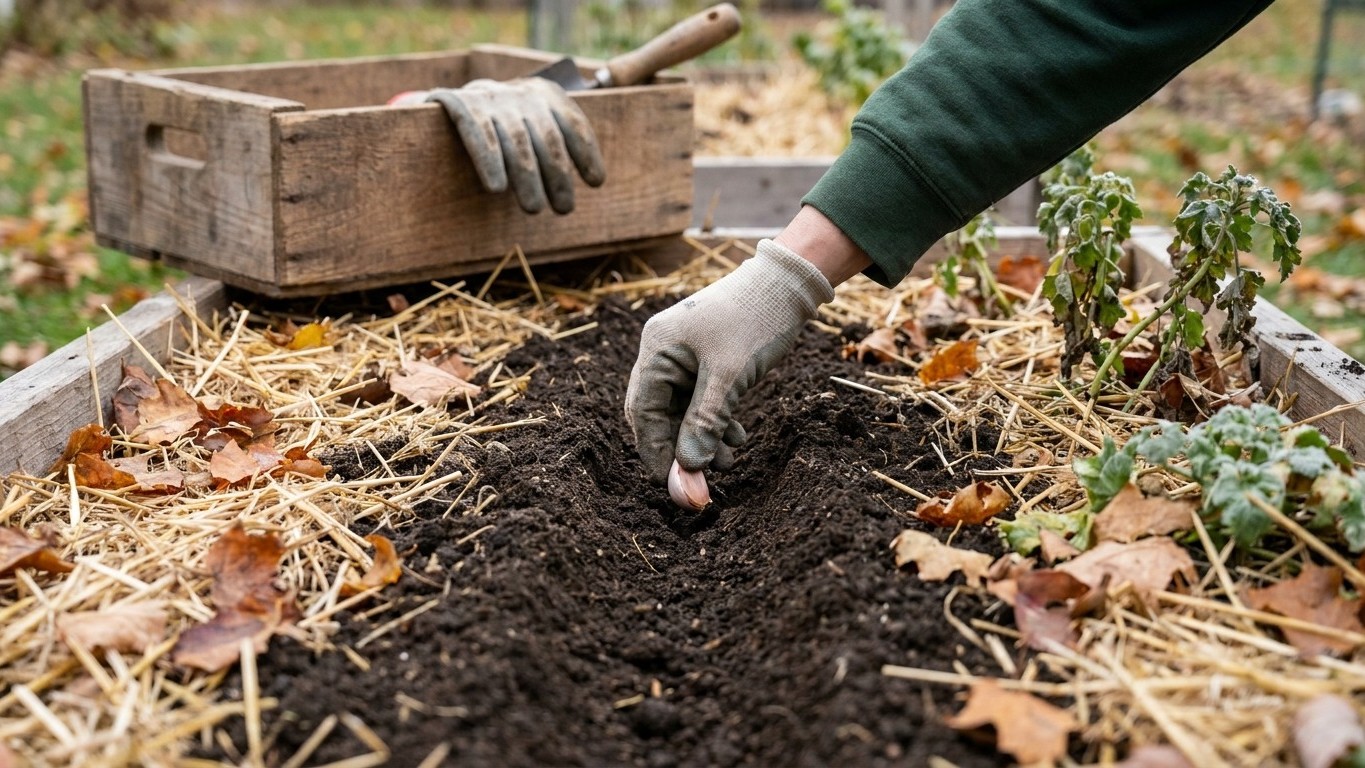

Garlic and shallots are the main crop still going into New York soil this month, and it’s actually prime timing for them. Beyond that, direct-sowing mostly closes down as the ground firms up, though hardy greens under cover and bare-root plantings keep the trowel busy. In New York City, the average first fall freeze falls between November 14 and November 27, so early-month days can still be workable even as the rest of the state has already frozen solid.
What goes in the ground in November

The decision this month isn’t the calendar, it’s whether the soil can still be worked and whether what you’re planting actually wants cold ground. Garlic and shallot cloves are the exception that makes November worth gardening for at all: they need several weeks of cool soil to grow roots before winter locks everything down, and pushing them in too late means weak bulbs come summer. Push cloves 2 inches deep, pointed end up, then bury the bed under 4 to 6 inches of straw or shredded leaves before a hard freeze sets in.
Where you garden inside New York’s official hardiness range matters more than the date on the wall. The USDA Plant Hardiness Zone Map (2023 edition) places New York anywhere from zone 3b in the high Adirondacks and Tug Hill Plateau to zone 7b along parts of the coast and Long Island. That’s not a technicality: a zone 3b garden has almost certainly frozen hard well before November arrives, while a zone 7a or 7b garden near the water can still have loose, workable topsoil into the back half of the month.
For the colder two-thirds of the state, plain talk: nothing new goes into open, unprotected ground this month beyond garlic, shallots, and maybe a rushed planting of spring bulbs before the frost line drops out of reach. Bare-root fruit trees, roses, and dormant perennials can still be moved or planted if the hole can be dug without a pick, which for most of upstate New York gets harder by the week. A cold frame or low tunnel buys real time: mâche, claytonia, and spinach sown under cover in early November will often sit tight through winter and resume growth as soon as light returns. Forcing rhubarb crowns or chicory roots indoors in a dark box is the other honest answer for gardeners who want something growing when the outdoor beds have gone still.
What to start under cover
Do the arithmetic before you touch a seed packet. Onions and leeks started from seed need roughly 10 to 12 weeks indoors before they’re ready to go outside near the last spring frost, which in New York City averages between March 23 and April 3. Counting back from that window lands the sow date somewhere around early January, not November. Starting them now is the classic “too early” mistake: seedlings sit under lights for months, get rootbound in their trays, stretch thin reaching for light, and go into spring soil already stressed.
What actually belongs under cover this month runs on a much shorter clock. Microgreens and sprouts finish in one to two weeks and can be started on a kitchen windowsill on a rolling schedule all winter. Amaryllis bulbs and paperwhite narcissus, potted now in shallow gravel or soil, bloom indoors in four to six weeks, timed for the darkest stretch of the year. If you’re running a heated greenhouse or a sunny enclosed porch, a tray of lettuce or spinach sown now can still reach a usable size before growth slows to a crawl in the low light of deep winter.
The other failure mode, starting too late, shows up differently this time of year: gardeners who wait until the ground has fully frozen to think about forcing bulbs or setting up a sprouting jar end up with nothing growing at all through the darkest months, when a little green on the counter matters most for morale as much as for the table.
What is ready to pick
Frost is an ingredient, not just a threat, for a good part of what’s still in the ground. Kale, collards, and Brussels sprouts sweeten noticeably after a few nights near freezing, as starches convert to sugars in the leaves and buds. Parsnips do the same trick underground and are often better pulled after a hard frost than before it. Carrots and beets left in the ground under a thick mulch blanket can hold for weeks past their usual harvest date, though they should come out before the soil freezes solid enough to trap them.
Leeks are the quiet stars of a November garden bed: hilled up with soil or mulch, they’ll stand through repeated freezes and can be dug as needed well into the season. Cabbage heads that haven’t split can hang on in the field too, though a tarp or row cover overnight protects them from splitting further in a hard freeze.
Once the ground truly locks up, harvest shifts entirely indoors. Check stored squash weekly for soft spots near the stem, a sign of rot starting from the inside. Potatoes and onions in storage should get the same once-a-week glance: pull anything sprouting, softening, or smelling off before it spreads to the rest of the bin. Sprouts and microgreens started on a windowsill fill the gap when the garden itself has nothing left to give.
The jobs that matter this month
A quiet-looking garden still has a full task list, and skipping it now costs real ground come spring. Mulching is the top priority: garlic beds, strawberry crowns, and any perennial that struggled through a hard summer all benefit from 3 to 6 inches of straw, shredded leaves, or wood chips laid down before the ground freezes for good, since insulating already-warm soil works far better than trying to warm frozen soil later.
Dormant pruning of fruit trees and berry canes can start once leaves have dropped, though the bulk of it is usually better held for late winter when the wood is fully dormant and wounds close faster. What’s worth doing now is the cleanup pass: removing dead, damaged, or diseased wood and clearing fallen fruit and leaves from around the base of trees, since both harbor overwintering pests and disease spores that reinfect the same tree come spring.
Seed catalogs start circulating heavily this month, and ordering early matters more than it sounds: popular varieties, particularly regionally bred ones suited to New York’s shorter upstate season, sell out well before planting season arrives. Pair that with planning next year’s rotation on paper while this year’s layout is still fresh in memory.
Soil testing before the ground freezes gives amendments (lime especially) the winter to work into the soil chemistry, rather than waiting until spring when there’s no time. Turn the compost pile one more time before cold slows the microbes down, clean and oil hand tools before they sit idle, and walk the fence line and raised bed frames for repairs that are far easier to make now than after the first heavy snow.
What not to do in November
The most common mistake is treating a mild afternoon as permission to skip protection. A cold frame or row cover opened to vent on a warm day has to be closed again before nightfall, every single time; forgetting once during a sharp overnight drop can wipe out weeks of growth in hardy greens that would otherwise have sailed through winter.
Nitrogen fertilizer is the other classic error this time of year. Feeding it to garlic, perennials, or anything else now pushes soft, tender new growth right when the plant should be shutting down for winter, and that new growth is the first thing a hard freeze kills. If a bed needs feeding at all, compost or a balanced amendment worked in at soil-testing time serves the plant far better than a nitrogen boost timed wrong.
Delaying garlic planting because the soil “still feels warm enough to wait” backfires too. Garlic actually wants cool soil, not warm, to root in without putting up top growth that a hard freeze would only damage. And leaving root crops in the ground past the point the soil turns solid means digging through frozen dirt with a pick, or simply losing the crop until a spring thaw that may leave it mushy and inedible. Better to pull, sort, and store what’s ready than gamble on one more week outdoors.
Checking this against your own county
Everything above is a New York-wide starting point, and the state is too varied for one calendar to fit every yard. Elevation change in the Adirondacks and Catskills, lake effect snow and cold pooling around Lake Erie and Lake Ontario, and the simple north-south stretch of the state can shift frost timing by weeks in either direction from the New York City figures used here. A garden in the Finger Lakes or the North Country should expect the ground to firm up well ahead of the city’s average window, while a sheltered spot on Long Island or in the lower Hudson Valley often has more workable days left than this page assumes.
Cornell Cooperative Extension runs county-level offices across the state and is the most reliable place to check local frost data, soil test results, and planting timing against your own zip code: https://cals.cornell.edu/cornell-cooperative-extension.
Common questions
Is it too late to plant garlic in New York in November?
Not in most of the state, especially in the first half of the month or in the warmer zones (6a to 7b) along the coast and Long Island. Garlic needs cool soil to root before it stops growing for winter, and a heavy mulch layer after planting protects the cloves through the freeze that follows. In the coldest upstate zones (3b to 5b), check that the ground is still soft enough to dig before committing.
Can I still start seeds indoors in November?
Long-season transplants like onions and leeks are better started in January, counting back 10 to 12 weeks from the last spring frost window of March 23 to April 3 in New York City. What works well now is anything with a short turnaround, like sprouts, microgreens, or forced bulbs such as amaryllis and paperwhites.
What vegetables get sweeter after a frost in New York?
Kale, collards, Brussels sprouts, and parsnips all convert stored starches to sugar in response to cold, which is why gardeners often leave them in the ground for a few frosty nights before harvesting rather than pulling them at the first sign of cold weather.
Should I fertilize my garden beds in November?
Hold off on nitrogen specifically, since it encourages tender new growth that a hard freeze will kill. If a soil test done this month shows a need for lime or other amendments, working those in now gives them the winter to take effect before spring planting.