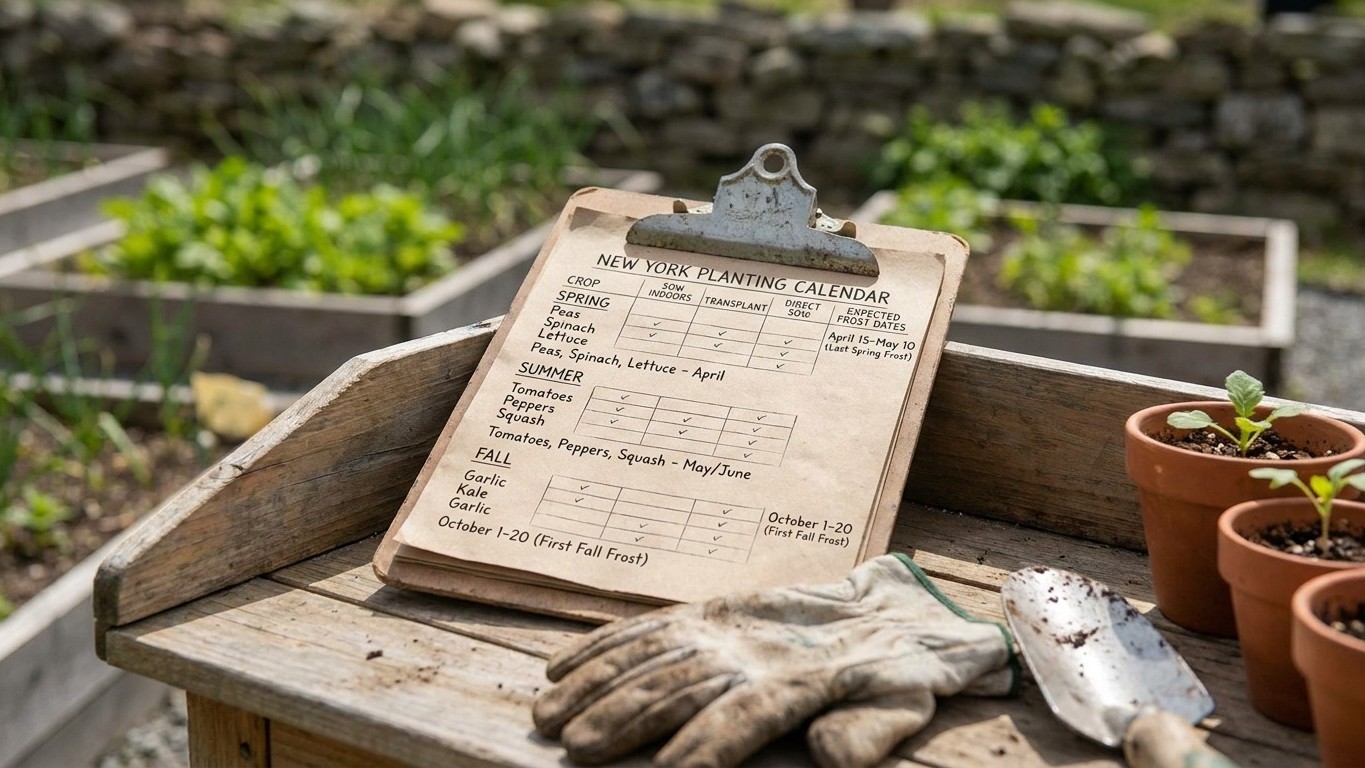

Frost is the thing that decides everything else in a New York yard, and here the safe range runs from March 23 to April 3 in spring, with fall frost landing back between November 14 and November 27. That gap between the early and late dates is your cushion — if your own spring is running a week behind what the calendar says, you still have room before anything tender is at risk. So before you plant a single seed, walk your yard, note what the soil actually feels like underfoot, and hold off on tomatoes and peppers until that spring window has fully closed — see What to Plant in New York in March for what can go in the ground early, and by June, most of the state is safely past that risk, so you can check What to Plant in New York in June for a detailed rundown, and once the heat of midsummer sets in, What to Plant in New York in July covers what still has time to mature before fall frost, with What to Plant in New York in August picking up right after for the last quick-maturing crops, then as that first fall frost approaches, What to Plant in New York in November walks through the last tasks before the ground closes down, while What to Plant in New York in December looks ahead to indoor growing and planning once the outdoor season has closed for good.
The frost window in New York

The two dates that govern everything else come from NOAA’s National Centers for Environmental Information, using the 1991-2020 climate normals for the Central Park station. Their 32°F freeze probability data puts the last spring frost between March 23 and April 3 and the first fall frost between November 14 and November 27, using the 30 to 70 percent probability band, the range within which a freeze is neither a rare event nor a safe default to plan around.
Run the arithmetic on those two ranges and the frost-free season at this one station spans somewhere from about 225 days, if spring frost lingers into early April and fall frost arrives in mid-November, to about 249 days, if the last frost clears by March 23 and the first fall frost holds off until late November. That is not a single number to circle on a calendar. It is a window, and the width of that window tells you how much slack you have if your own spring runs a week behind schedule.
Why the rest of the state runs differently
Central Park sits at low elevation, close to open water, inside a city that holds heat long after the surrounding countryside has cooled. All three conditions push its frost dates the same direction: a later first fall frost and an earlier last spring frost than almost anywhere else in New York. The Hudson Valley, the Southern Tier, and especially the higher ground of the Adirondacks see their last spring frost arrive considerably later and their first fall frost arrive considerably earlier, which shortens the frost-free season in those regions compared with the city figures above.
None of this makes the Central Park numbers useless outside the five boroughs. Long Island and the lower Hudson Valley track reasonably close to them. But if you garden in Plattsburgh, Saranac Lake, or the hill towns above Ithaca, use these dates as a starting point and adjust for what you actually observe in your own yard. For a month-by-month breakdown of what these frost dates mean in practice, see What to Plant in New York in January and What to Plant in New York in February, or see What to Plant in New York in April or What to Plant in New York in September.
A frost date is a probability, not a guarantee. Even within the 30 to 70 percent band NOAA uses here, a freeze can still land outside those dates in an unusual year, which is why experienced gardeners keep row cover on hand well into April regardless of what the calendar says.
Cool-season crops
Cool-season crops go into the ground on a schedule set by the last spring frost, not by a date on the calendar. Many of them tolerate a light frost outright, and some taste better for it. The trick is knowing which ones tolerate a hard freeze at the seedling stage and which only shrug off a passing frost once they have hardened off.
Peas and spinach can go into the ground as soon as the soil can be worked, often well before the last spring frost, because both germinate at cool soil temperatures and the seedlings survive a light freeze without much trouble. Lettuce is nearly as tolerant once it has two or three true leaves, though very young seedlings are more vulnerable and appreciate cover on a hard-frost night.
Brassica transplants, meaning broccoli, cabbage, and kale started indoors four to six weeks earlier, go outside around the last spring frost date itself rather than well ahead of it. Their leaves handle a light frost, but a hard freeze right after transplanting can still stunt young plants that have not fully hardened off.
Root crops split into two groups. Carrots, beets, radishes, and turnips are direct-sown from seed and go into the ground a few weeks before the last frost, since the seed itself is not at risk, only the seedling once it emerges. Radishes in particular move fast enough that a full crop can come and go before the last frost date even arrives.
A rough order for cool-season sowing
Working from most frost-tolerant to least, a typical sequence looks like this:
- Peas and spinach: sow as soon as soil can be worked
- Radishes and lettuce: sow a few weeks before the last frost
- Carrots, beets, and turnips: sow a few weeks before the last frost, covering lightly for even germination
- Brassica transplants: set out around the last frost date itself
None of these crops need warm soil to succeed. What stops them is a hard freeze at a vulnerable growth stage, not the printed frost date on a seed packet. Watch the extended forecast rather than the calendar in the two weeks around your expected last frost, and keep row cover on hand for seedlings already in the ground when a late cold snap moves through.
Warm-season crops

Warm-season crops care less about the frost date itself than about soil temperature. Tomatoes, peppers, squash, beans, and corn all stall or rot in cold, wet soil even when the air temperature sits well above freezing. That is why the usual practice is to wait past the last spring frost, giving the soil time to catch up with the air, before setting out transplants or direct-sowing seed.
For tomatoes specifically, catalogue days-to-maturity figures are counted from the transplant date, not from seed, and they assume average conditions that shift by a week or two either way depending on the season. Cross that catalogue number against New York City’s last frost window of March 23 to April 3 and a transplant date of early to mid April gives most short and mid-season tomatoes plenty of room before the first fall frost arrives in mid to late November.
Counting back for indoor starts
Tomatoes and peppers are started indoors rather than direct-sown, so the sowing date is set by counting backward from the transplant date. Most tomato varieties need roughly six to eight weeks of indoor growth before they are ready to go outside. Counting six to eight weeks back from an early-to-mid April transplant window lands seed-starting at mid to late February for New York City gardeners, and earlier still upstate if your county’s transplant window runs later than the city’s.
The table below lines up a handful of named tomato varieties against that transplant window, using each variety’s published days-to-maturity figure.
| Variety | Days to maturity | Type | First ripe (calculated) |
|---|---|---|---|
| Sakura | 55 days | Indeterminate | Mid June |
| Sun Gold | 57 days | Indeterminate | Mid June |
| Juliet | 60 days | Indeterminate | Mid June |
| Amalfi | 68 days | Determinate | Late June |
| Cherokee Purple | 72 days | Indeterminate | Late June |
| San Marzano II | 78 days | Indeterminate | Early July |
Peppers follow a similar indoor-start pattern to tomatoes but germinate more slowly and generally establish more slowly once transplanted, so many gardeners start pepper seed a week or two ahead of their tomato seed. Squash, beans, and corn are direct-sown and gain little from an early indoor start the way tomatoes and peppers do. Beans in particular resent root disturbance and do better sown straight into warmed soil once frost risk has passed rather than started in trays.
The fall planting window
Fall planting works backward from the first fall frost instead of forward from the last one. Take a crop’s days-to-maturity figure, add a margin for the slower growth that comes with shortening autumn days, and count back from New York City’s first fall frost window of November 14 to November 27, per NOAA’s 1991-2020 normals, to find the latest reasonably safe sowing date.
That margin matters more than it sounds. A 60-day crop sown in late summer does not actually mature in 60 days once daylight shortens and temperatures drop through September and October. The size of that slowdown varies by crop and by county, which makes it a question for your local Cornell Cooperative Extension office rather than a single number that holds true across the state.
Crops that improve after a light frost
Several fall crops are better for a touch of cold, not damaged by it. Kale and Brussels sprouts convert starches to sugars after a light frost, coming out sweeter than they would if harvested in warm weather. Carrots and parsnips left in the ground through the first frosts do the same thing underground, which is why many gardeners deliberately delay harvest until after the first hard frost rather than pulling roots early. Spinach and mâche can overwinter under a cold frame or heavy mulch in much of the state and resume growth the following spring.
Crops without that frost tolerance need to finish and be harvested before the first fall frost, not after it. That includes the same warm-season crops discussed above: tomatoes, peppers, beans, squash, and corn all stop producing, and in most cases suffer real damage, the first time the temperature drops to freezing. Watch your local forecast closely in the two to three weeks before your expected first fall frost and plan to pull or cover tender crops rather than trusting the calendar date to hold exactly.
Reading a planting calendar properly
A statewide planting calendar, this one included, is built from one weather station’s data and applied to a state running from sea level on Long Island to over 5,000 feet in the Adirondacks. That is a lot of variation to compress into two dates.
Elevation, lakes, and urban heat
Elevation alone shifts frost dates measurably from valley floor to hilltop, and the Great Lakes influence western New York in ways Central Park’s data cannot capture, delaying spring warm-up near the shoreline while moderating the timing of fall’s first freeze. Urban heat works the same way at a smaller scale. A garden against a south-facing brick wall in Brooklyn will see frost arrive later in fall and clear earlier in spring than an open field forty miles north in Westchester, even though both sit in the same general reporting region. Low spots collect cold air on clear, still nights and frost first, while a garden on a gentle slope often stays a few degrees warmer at ground level on the same night.
If you garden in a different state, the same logic applies with different numbers. Gardeners just across the border should check the Pennsylvania planting calendar rather than assume New York’s dates transfer directly, and gardeners farther south will find the Virginia planting calendar runs on a noticeably different frost window because of that state’s milder normals.
The most reliable fix is not a better calendar. It is a notebook. Track your own garden’s last spring frost and first fall frost for two or three years running, noted at the bed rather than the nearest weather station, and you will end up with a figure more useful to you than any state or even county average, because it already accounts for your elevation, your soil, and your microclimate.
Local help
Frost dates, soil temperatures, and planting windows all vary by county across a state this size, and the most reliable source for numbers specific to your address is Cornell Cooperative Extension. Its county offices publish local frost data, run soil testing, and can tell you whether your particular hollow or hilltop runs ahead of or behind the Central Park figures. For more on growing across the state generally, see our other New York guides.
Common questions
What zone is New York for planting?
New York spans several USDA Hardiness Zones because of its range in elevation and latitude, from milder zones on Long Island and in New York City to considerably colder zones in the Adirondacks and the Tug Hill Plateau. Hardiness zone describes winter minimum temperatures for perennials and woody plants, not the sowing dates, which are set by frost dates instead.
Can I trust these dates for upstate New York?
Not directly. These dates come from NOAA’s Central Park station in New York City, and upstate counties see their last spring frost arrive later and their first fall frost arrive earlier than the city does. Use the frost window here as a rough baseline and check county-level data through Cornell Cooperative Extension before committing to a transplant date.
Is it safe to plant tomatoes right on the last frost date?
It is risky. Tomatoes are damaged by any frost at all, and soil is usually still cold right around the average last frost date, which slows root growth even when the air stays above freezing. Most gardeners wait past the last frost window, letting the soil catch up, before setting tomato transplants outside.
What happens if I sow cool-season crops too early?
Seed sits in cold, wet soil and either rots or germinates slowly enough that weeds get ahead of it. Peas and spinach tolerate this better than lettuce or brassica seed, which is exactly why they are the crops recommended for the earliest sowing dates.
How do I find my own last frost date instead of relying on a state average?
Keep a simple log of the date of your last spring frost and first fall frost for a few years running, noted right in your own garden rather than at the nearest weather station. Over two or three seasons that log tells you more about your specific yard than any state or county figure ever will, since it already reflects your elevation, your soil, and whatever shelter or exposure your particular beds have.
Some gardeners layer an older custom on top of frost dates: planting by the moon, which we explain as almanac tradition, not fact.
Related guides
- Vermont Planting Calendar: When to Sow and Plant, Frost Dates Included
- Massachusetts Planting Calendar: When to Sow and Plant, Frost Dates Included
- Pennsylvania Planting Calendar: When to Sow and Plant, Frost Dates Included