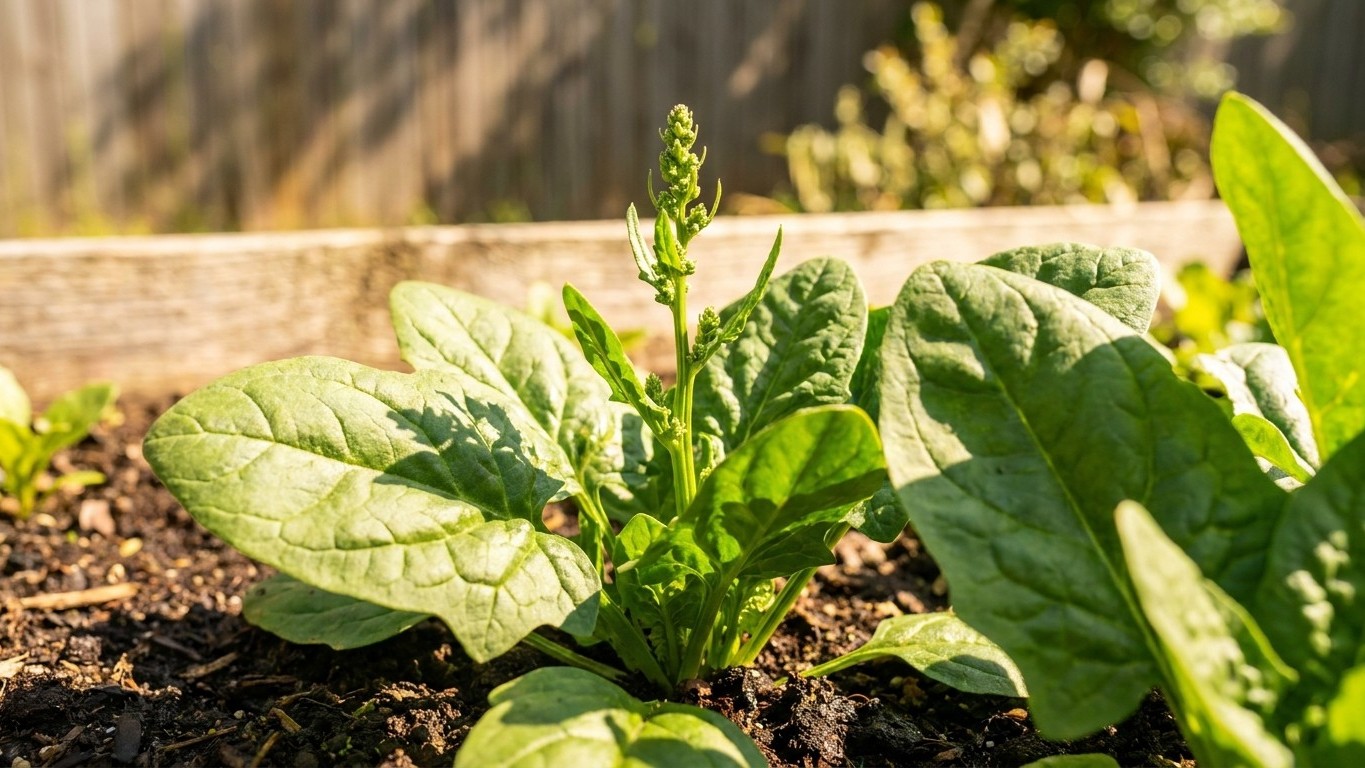

In New York City, spinach gets cut in two short windows. Spring leaves come from seed sown in early to mid March. A fall crop is sown from late summer into early October, counted back from frost. Summer’s long days and heat close both ends. Once it’s cut, spinach is a short-lived crop: two weeks is the ceiling at 32 F, and much less in a fridge door. These dates are for the city itself, and upstate shifts them.
The short answer
The longest day of the year in New York City delivers 14 h 56 of daylight. Spinach reads that as a signal to flower. Utah State University Extension states that spinach bolts during long days and warm temperatures, and that it grows best where temperatures do not exceed 75 F. Long days alone are enough to trigger flowering. A cool, wet summer therefore buys no extra weeks, because the sun still stays up nearly fifteen hours in late June. The detail of that mechanism sits in Will Spinach Bolt Early in New York?
Both limits apply here
The limit in New York is day length and heat together, and they stack. The city averages 12.2 days a year reaching 90 F or more, according to NOAA NCEI climate normals. That count describes the extremes. The 75 F ceiling is crossed on many more days, and it does two things at once: growth stalls and leaves turn bitter. A bed that looked perfect in April can be a bitter, stalk-raising mess by the time the 90-degree days arrive.
One caution on geography. The 14 h 56 figure and the frost dates in this article come from the New York City reference station, a dense urban site. Upstate New York and the Adirondacks sit farther north, so their longest day is longer still. They frost earlier in fall and later in spring, which squeezes both windows from both sides.
How long it keeps once cut
UC Davis Postharvest gives the ideal conditions: 32 F and 95 to 98 percent relative humidity. Its verdict is blunt: spinach is highly perishable and will not maintain good quality for more than 2 weeks. That is a ceiling, not a plan. Wilting, yellowing and decay increase after 10 to 14 days of storage, and they come faster at 41 to 50 F, which is about what a fridge door holds. Store it at the back of the bottom shelf, the coldest spot, and not in the door. Plan to eat it within a few days and treat anything beyond that as a bonus. The full figures are on the UC Davis spinach fact sheet.
How long the spring window really is
Counting it out takes five steps, and one of them comes with an honest gap.
- Start from the last spring frost. For New York City, the 32 F freeze probabilities in the NOAA NCEI normals put it between March 23 and April 3. That is a band, not a single day, and it describes the city, not the state.
- Count back two to three weeks for sowing. Spinach goes in before the last frost, not after it. From those dates, the sowing window runs from about March 2 to March 20, as soon as the ground is workable. That is a stretch of nearly three weeks in which seed can go in.
- Add the weeks after the frost date. The plants keep growing through the last frost and into April and beyond, until the weather stops cooperating. They stop growing well when temperatures climb above 75 F. That is a growth ceiling and a bitterness line, not a calendar date, and the normals used here carry no date for when New York crosses it. So the usable spring is the two to three weeks before the last frost, plus however many weeks follow before 75 F becomes routine. That second number changes from year to year, and this page will not pretend to fix it.
- Watch the daylight, not only the thermometer. Days keep lengthening toward that 14 h 56 at the solstice. The source gives no hour count at which spinach flowers, so there is no clock to set. Watch the plants.
- Cut as you go. Pick leaves as they reach a size worth eating, and harvest the whole plant once the window is closing.
Cutting before the flower stalk
Waiting for a bigger harvest is the usual mistake. A spinach plant that has started to bolt sends up a central stalk, and its leaves turn bitter. Once that stalk rises, the crop is over, so cut every bed you can before it does. Young leaves taste better than old ones anyway, and cutting earlier just means the same row gets eaten sooner.
Utah State Extension names four varieties: Bloomsdale, Melody, Teton and Olympia. It publishes no data on any of them, so nothing here can say which holds longest, and the seed packet’s own claims are not independent evidence. For the wider picture of the crop in this state, see Growing Spinach in New York.
The autumn crop, and when the soil lets you sow
Fall spinach is the easier crop in theory and the trickier one in practice. Days are shortening, which removes the long-day trigger. Two other things stand in the way, and neither is cold.
Warm soil blocks the sowing
Utah State Extension reports that seed germination is reduced above 80 F soil. Late August and early September in a sunny New York bed can still be on the wrong side of that number, even after the air has begun to cool. The soil, not the calendar, decides when the window opens. A cheap soil thermometer pushed an inch or two into the bed settles the question. Shading the bed and keeping the seed row watered can help bring the surface down, though no source here quantifies the effect. Where summers run hot, the opening comes when the soil falls, and sowing a week too early wastes seed.
Frost ends the season
The first fall frost in New York City falls between November 14 and November 27, again from the NOAA NCEI 32 F freeze probabilities for the Central Park station. Treat the frost as the end of your harvest, which is the cautious reading, and work backward. Utah State Extension’s rule for a fall crop is to plant 50 to 75 days before the date you want to harvest. The source publishes no days-to-maturity figure for spinach itself, so that rule is the only count available.
Run the arithmetic from the frost band:
- Harvest by November 14: sow between August 31 and September 25.
- Harvest by November 27: sow between September 13 and October 8.
Put together, the paper window runs from August 31 to October 8, and warm soil trims the front end of it. In a mild year, that first week or two of September is the earliest practical start. Upstate, where frost arrives sooner, the same counting back puts the sowing dates earlier, so use your own local frost date instead of the city’s. Leaves are also not safe from pests just because the weather has cooled. What Eats Spinach in New York, and When covers the timeline for that.
Common questions
How long does cut spinach last in the fridge?
UC Davis says it will not maintain good quality for more than 2 weeks, and that is under ideal conditions of 32 F and 95 to 98 percent humidity. Home refrigerators run warmer, and at 41 to 50 F the leaves yellow and decay faster. Use it within days and keep it on the back of the bottom shelf.
Does a cool summer let spinach grow longer?
No. Long days trigger flowering on their own, and New York City gets 14 h 56 of daylight on the longest day. Cool weather helps with bitterness, since 75 F is a growth ceiling, but it does not cancel the day length.
How many days until I can cut my first leaves?
The source publishes no days-to-maturity figure for spinach, so there is no honest number to give here. The only timing it states is for a fall crop: plant 50 to 75 days before the date you want to harvest. For spring, cut when the leaves are big enough to eat and before a flower stalk appears.
Which spinach variety should I plant?
Utah State Extension names Bloomsdale, Melody, Teton and Olympia. It gives no data about any of them, so nothing published here supports choosing one over another. Pests are a separate calendar from bolting, and pressure on the crop does not follow the same dates, which is why the pest timeline gets its own article.