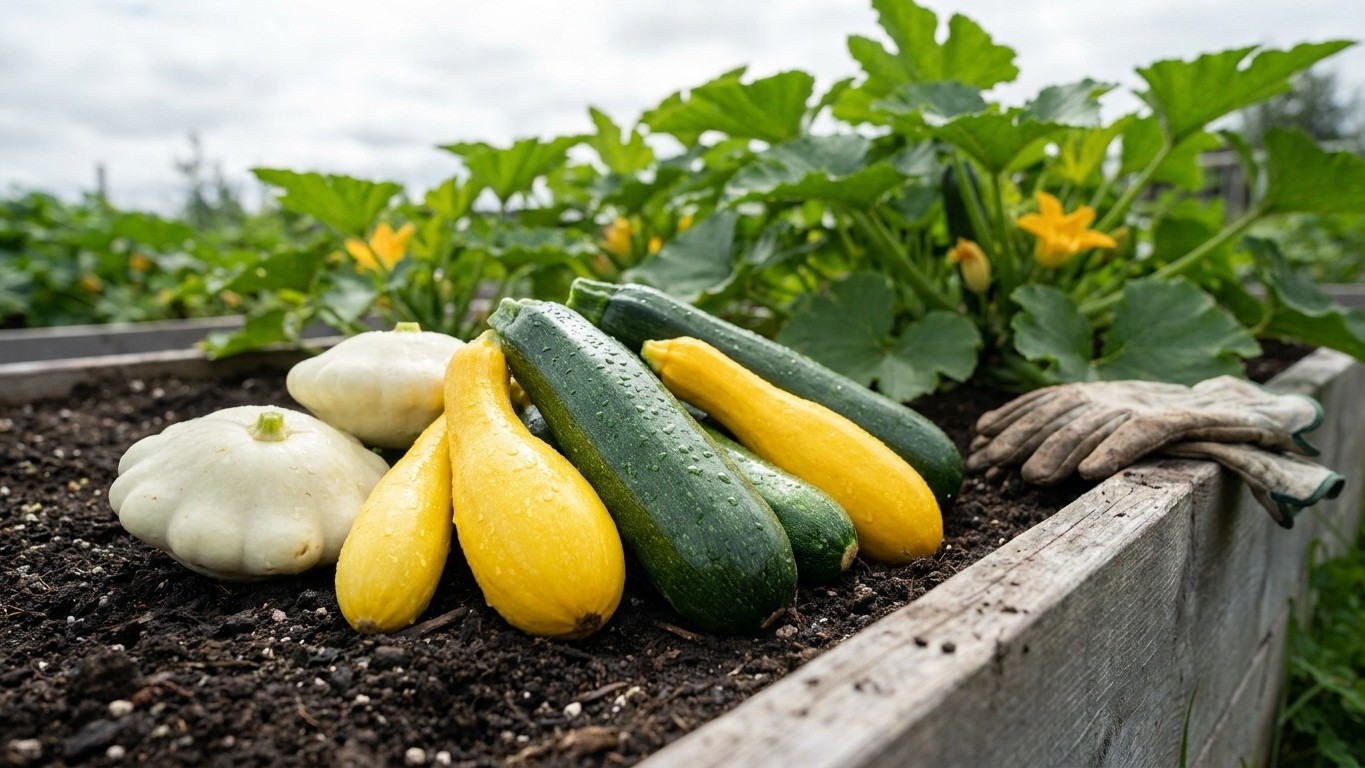

New York’s growing conditions swing from Long Island’s warm coastal air to the short, cool summers of the Adirondacks, so the right summer squash depends less on a single “best variety” and more on matching maturity speed to the season length where you garden. Fast bush types win almost everywhere; slower trailing types only pay off downstate.
The short answer for New York
Bush-type summer squash, the kind bred to fruit fast and stay compact, is the safe default for New York gardeners. That includes standard zucchini, yellow crookneck and straightneck squash, and patty pan types bred as bush plants rather than sprawling vines. These varieties typically start setting fruit within six to eight weeks of germination, which matters because New York’s frost-free window is not uniform across the state and a fast plant gives you room for error no matter where you are.
The reasoning starts with the reference numbers Cornell’s home region actually sees. In New York City, the last spring frost typically falls between March 23 and April 3, and the first fall frost arrives between November 14 and November 27. That’s a long frost-free stretch by New York standards, and it means a downstate or Hudson Valley gardener close to the coast has enough season to grow almost any summer squash type, including slower vining varieties or heirloom types that take closer to nine or ten weeks to reach full production.
Heat load backs that up. The reference station averages 12.2 days a year at or above 90°F, which is enough warmth to push squash through its fruiting cycle quickly once soil temperatures rise, but not so much heat that blossom drop or heat-stress becomes the dominant problem the way it can in the mid-Atlantic or the Southeast. Summer squash is not fighting extreme heat here so much as it’s fighting a clock, and that clock runs differently depending on where in New York you’re standing.
The catch is that these frost and heat figures come from the New York City reference station, and they describe conditions in a dense urban site on the coast. They are not a statewide figure. A gardener in the Adirondacks, the Tug Hill Plateau, or high elevations in the Southern Tier works with a frost-free season that closes much earlier in fall and opens much later in spring than what’s cited above. For those regions, the bush-type recommendation isn’t just the safer choice, it’s close to the only one that reliably finishes before frost.
What will not work here
Slow-maturing summer squash is the first thing to cross off the list outside the state’s warmest pockets. Varieties bred for a long, leisurely fruiting window, often trailing or vining types that take nine to ten weeks to hit full stride, are built for regions with a much longer frost-free season than most of upstate New York offers. Push one of these into a short-season county and you’re racing a fall frost that, away from the coast, can arrive weeks before the November dates recorded at the city reference station. The plant may flower fine and still run out of time before it sets a real harvest.
Watering on a weekly schedule and calling it done is the second failure point, and it trips up gardeners who look at the summer rainfall total and assume it’s generous. New York’s reference station averages about 13.7 inches of rain across June, July and August, roughly 4.5 inches each month, which sounds like plenty. But that rain doesn’t arrive in even, gentle doses. It tends to come as thunderstorms, and a hard summer downpour runs off the surface faster than it soaks into the root zone, especially once 90°F days start pulling moisture out of the soil through evaporation. A squash plant that only gets water when a storm happens to roll through, with nothing in between during a stretch of heat, will stall out or drop blossoms even in a summer with normal rainfall totals on paper.
Tight spacing is the third trap, and it’s a direct consequence of that same rainfall pattern. Frequent summer moisture combined with warm nights keeps foliage damp longer than it would in a drier climate, and summer squash planted too close together loses the airflow that dries leaves out between storms. Powdery mildew and other fungal problems move fast through a crowded squash bed in a humid New York summer, and once it takes hold in a dense planting, air can’t move through to slow it down. Wider spacing than the seed packet’s minimum, and rows oriented to catch prevailing wind, do more work here than any spray.
What changes across New York
New York spans USDA hardiness zones 3b through 7b, and that’s about as wide a spread as a single state gets in the eastern U.S. Zone 3b shows up in pockets of the high Adirondacks; zone 7b belongs to sheltered parts of Long Island and New York City itself. That range is built from a single measurement, the average annual extreme minimum temperature, so it speaks to winter survival more than summer growing conditions directly. But it’s also the clearest signal available that this state does not have one answer to “which summer squash,” it has several, and the spread between them is enormous.
A gardener working land closer to the 7b end of that range, generally the coastal and New York City area, is working with the longer frost-free season and milder heat load described in the reference figures above. That’s the zone where slower, longer-season summer squash varieties have room to finish, and where a gardener can afford to direct-seed rather than start plants indoors.
Move toward the 3b and 4a end of the range, generally higher elevations and the state’s northern reaches, and the frost-free window narrows sharply compared to the New York City dates cited earlier. Soil also stays cooler longer into spring at elevation, which matters for squash specifically since the seed germinates poorly in cold soil regardless of what the calendar says about frost. A gardener in these zones gets more reliable results starting transplants indoors a few weeks ahead, then setting them out once soil has actually warmed, rather than direct-seeding on a date that assumes New York City’s spring.
There is no single zone assignment this page can give you, and it shouldn’t try. The spread from 3b to 7b is the point: check where your specific property falls before leaning on any date or variety choice drawn from a single reference station.
Where to check this for your own county
This page describes New York at the state level, built from a single reference station and a statewide hardiness zone range. That’s useful for understanding the general shape of the problem, bush types versus vining types, watering rhythm, spacing under humidity, but it is not a substitute for what your specific county has actually tested. A state-level page like this one should lose to a county-level recommendation every time the two disagree.
Cornell Cooperative Extension is the place to get that county-level answer. The statewide directory is your starting point, and from there you can find the local office covering your specific county. What to look for once you’re there falls into two categories worth asking about directly.
- The local planting calendar for your county, which will reflect your actual frost dates rather than the New York City station cited on this page.
- Any summer squash varieties Cornell’s local trials or county educators have specifically recommended for your growing conditions, since variety performance can differ between the coast, the Hudson Valley, the Finger Lakes and the North Country.
A county office can also tell you which fungal and pest pressures are running high locally in a given season, information a statewide page simply can’t carry. If your county’s guidance conflicts with anything written here, follow the county.
Checking this against your own garden
None of the dates or figures above beat what your own soil and plants are telling you in a given spring. Three signs are worth watching before you commit seed or transplants to the ground, and each one tells you something a calendar date can’t.
Soil warmth, checked by feel rather than a thermometer, is the first. Summer squash seed sits and rots in cold soil no matter what the frost-free date says. Push a finger a couple of inches into the bed in mid-spring; if it still feels cold and damp rather than just cool, wait. A patch that warms up faster than the rest of the yard, maybe a raised bed or a spot against a south-facing wall, is often ready before the general date for your area.
The first flush of male flowers is the second signal, and it’s an easy one to miss the meaning of. Summer squash typically produces male flowers before female ones, sometimes by a week or two, and a strong early flush of males followed by female flowers with tiny fruit at the base tells you the plant has moved into its fruiting phase on its own schedule, not the seed packet’s.
First true leaves, the second set that appears after the initial round leaves, mark the point where a seedling has enough root and leaf structure to handle a modest cold snap without collapsing. A garden where true leaves show up faster than expected is running warmer than the regional average that year; one running slower is a sign to hold off on that vining, longer-season variety and lean toward the fastest bush type available instead.