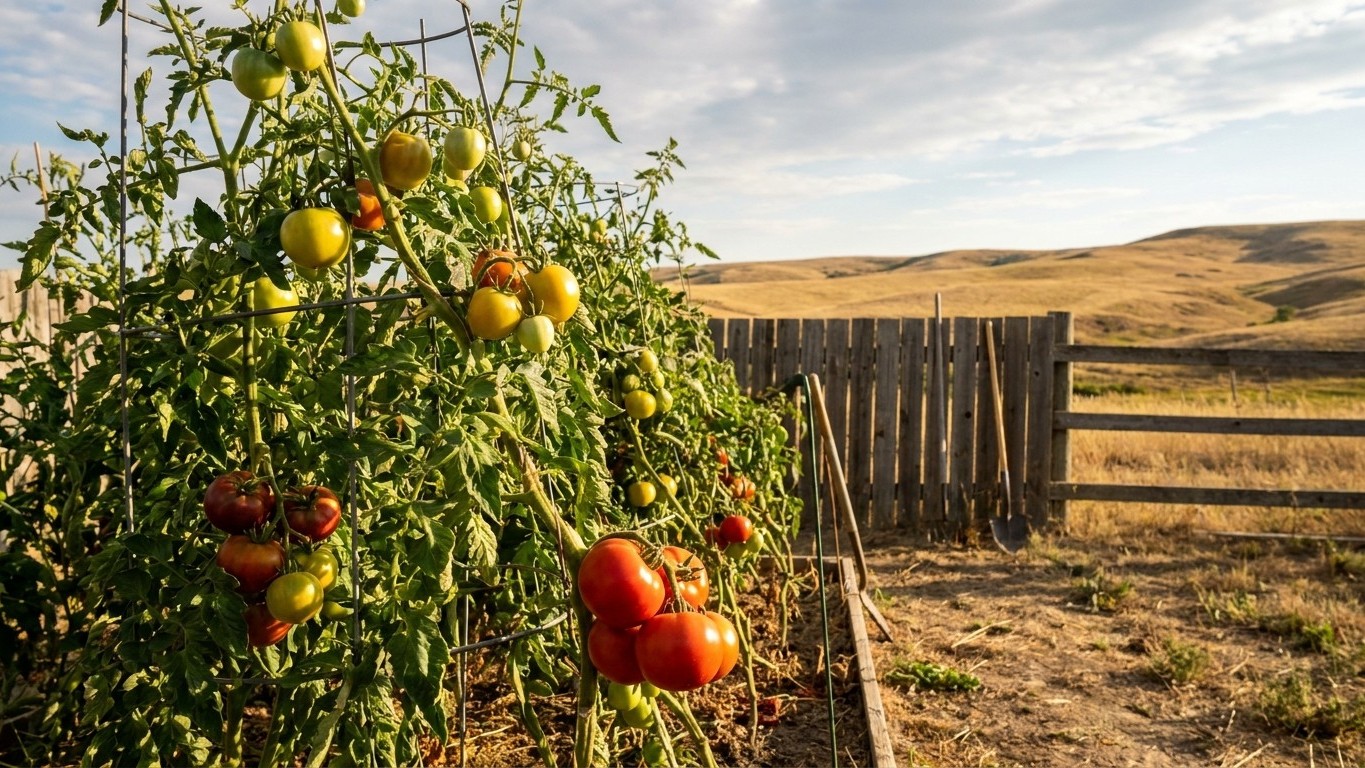

Tomatoes come off the vine in New York when the fruit shows the first blush of color, not when it’s fully red, and the deadline for that decision is the first fall frost. After that, any tomato left outside is a lost tomato unless you’ve covered the plants. Everything still green or partly colored at that point can finish ripening indoors instead of rotting on the vine.
When to pick tomatoes in New York
The trigger for picking isn’t a date on the calendar. It’s the “breaker” stage: the fruit stops being solid green and shows a faint pink, yellow, or tan blush at the blossom end. Once a tomato hits that stage, it has already started the internal chemistry that turns starches into sugars and softens the flesh. Pulling it at breaker and finishing the process on a counter costs you almost nothing in flavor compared with leaving it on the vine, and it protects the fruit from splitting, cracking, or getting picked off by a raccoon the night before you planned to harvest it.
What does force a real deadline is the first fall frost. In Central Park, that freeze risk (32°F) lands between November 14 and November 27, based on 1991-2020 climate normals from NOAA’s National Centers for Environmental Information. That’s a two-week window, not a single date, and it describes New York City specifically. Upstate counties and the Adirondacks see their first freeze considerably earlier in the fall, sometimes by a month or more, so a grower in Plattsburgh or Old Forge can’t borrow the city’s calendar. Cornell Cooperative Extension offices maintain county-level guidance for growers who need numbers closer to home than a citywide average.
The week before frost
Once a frost date is within a week, treat every tomato on the plant as a harvest candidate, ripe or not. Full-size green fruit, even fruit with no color at all, will usually still ripen indoors if it reached mature size before the cold hit. Small, marble-sized green tomatoes won’t finish well; they lack the seed and gel development to trigger ripening after picking. Strip the plant of anything mature-sized, leave the immature stuff for the compost pile, and don’t wait for a forecast to firm up. A light frost that only nips leaves can still chill fruit enough to break down the cell walls and turn it mushy within days.
Growers working in the milder end of the state’s hardiness range (the USDA Plant Hardiness Zone Map puts New York across zones 3b to 7b, with the warmer numbers concentrated on Long Island and in New York City) sometimes get an extra week or two of outdoor ripening before frost forces the issue. Zone alone won’t tell you your local frost date, though. It’s built from just one variable, the average annual extreme minimum winter temperature, and says nothing about spring or fall frost timing.
What to do with the green ones
Not every green tomato is the same tomato. Before you decide what to do with a bin of them, sort by maturity, because that single step determines whether a fruit ripens on the counter or just sits there and eventually rots.
Sorting by maturity
A mature green tomato has reached full size for its variety, the skin has turned from dull to slightly glossy, and the shoulders near the stem have started to lighten from dark green to a paler shade. Cut one open and the gel around the seeds should look fully formed, not watery or immature. Those fruits will ripen indoors with reasonable reliability. Immature green tomatoes, the small, hard, dull-skinned ones still growing in size, generally won’t ripen properly once picked. They may soften over time, but they won’t develop real color or sugar, and they’re better used while still green.
That’s where the classic green-tomato dishes come in: fried green tomatoes, green tomato relish, chow-chow, or pickled green tomato slices all use the fruit for its firmness and tartness rather than waiting for it to become something it can’t become. If your plants get hit by an early frost with dozens of small green fruit still on them, cooking or pickling them is often a better use of your time than trying to ripen them all.
For the mature green tomatoes, keep them out of direct sun and off the compost pile, and set aside any with soft spots, cracks, or insect damage. A single tomato that’s already starting to break down will speed up decay in whatever you store it near, so damaged fruit gets used first, in the kitchen, not stashed with the ripening batch. This sorting step matters more with a big end-of-season harvest than with the occasional straggler; a few tomatoes are easy to check daily, a bushel basket is not.
Ripening indoors, and how long they keep
Tomatoes ripen off the vine because of ethylene, a gas the fruit produces itself once it starts to mature. Warmth speeds that process along; cold slows or stops it. That’s the whole mechanism behind every kitchen-counter ripening method.
Setting up the ripening spot
Room temperature, out of direct sunlight, works better than a sunny windowsill, which can heat the fruit unevenly and encourage soft spots rather than even coloring. Spreading tomatoes in a single layer, not stacking them, cuts down on bruising and lets you spot problems early. Some growers wrap each mature green tomato individually in newspaper or place them in a paper bag with a ripe banana or apple; both release ethylene and can shorten the wait. A cardboard box or shallow tray works fine as a container as long as air can move around the fruit.
Check the batch every couple of days rather than letting it sit untouched for a week. Tomatoes ripen at different rates even from the same picking, so pull out anything that’s turned red and move on the ones still lagging behind. Fruit that’s fully ripe and not being eaten right away can go in the refrigerator to buy a few extra days, but tomatoes still ripening should stay at room temperature; cold air below roughly 55°F stalls the ripening process and can leave the interior mealy even if the skin eventually colors up.
How long a green tomato takes to turn red varies by how mature it was at picking and by the temperature it’s stored at. Fruit picked at the breaker stage, already showing color, moves fastest. Fully mature green fruit with no color yet takes longer and is less predictable. There’s no single published timeline that covers every variety and every kitchen, so treat any ripening estimate as a guide, not a guarantee, and judge each tomato by touch and color rather than by the calendar.
What goes wrong here
The most common failure isn’t rot, it’s rushing. Tomatoes pulled too early, before they reach mature size or before the gel around the seeds has set, simply won’t ripen. They soften eventually because bacteria break them down, not because sugars developed, and the texture and flavor show it.
Temperature swings cause the second most common problem. A ripening spot that’s too warm, especially above roughly 75°F, can cause uneven coloring where the outside looks ripe while the inside stays hard and pale. Too cold, and the fruit stalls entirely or develops a mealy, watery texture once it does turn red, a symptom of chilling injury that doesn’t reverse itself.
Rot spreads fast in a batch of ripening tomatoes because one bruised or cracked fruit releases moisture and sugars that mold and bacteria use immediately. That’s the practical reason for sorting out damaged fruit before storage rather than after: a single soft tomato left in a box of two dozen others can take several neighbors down with it within days. Stacking fruit deeply, rather than spreading it in a single layer, makes this worse by trapping moisture and cutting off airflow.
Splitting and cracking, meanwhile, usually trace back to conditions before picking rather than after: a heavy rain or sudden watering following a dry stretch swells the fruit faster than the skin can stretch. That’s a growing-season issue rather than a storage one, and it’s covered in more depth on this site’s guide to tomato growing problems in New York rather than here. Once cracked fruit is picked, though, it belongs in the kitchen right away rather than in the ripening box, since a split skin is an open door for decay.
Common questions
Can I ripen tomatoes on a sunny windowsill?
It works, but unevenly. Direct sun heats one side of the fruit faster than the other, which can produce soft, discolored patches. A spot at room temperature out of direct light generally ripens fruit more evenly.
Do I need to wrap each tomato individually?
No, but wrapping in newspaper or a paper bag traps the ethylene gas the fruit produces, which can speed up ripening slightly compared with leaving tomatoes uncovered on an open tray.
Should I pick everything before the first frost, even fruit with no color at all?
Only if it’s reached full mature size. Small, immature green tomatoes rarely ripen after picking regardless of how they’re stored, so they’re better used in a green-tomato recipe than saved for the counter.
Is the New York City frost date useful if I garden upstate?
Not directly. The November 14 to November 27 window comes from Central Park data and describes a dense urban site. Upstate counties and the Adirondacks typically see their first fall freeze considerably earlier; contacting a local Cornell Cooperative Extension office is the more reliable way to get a county-specific estimate.