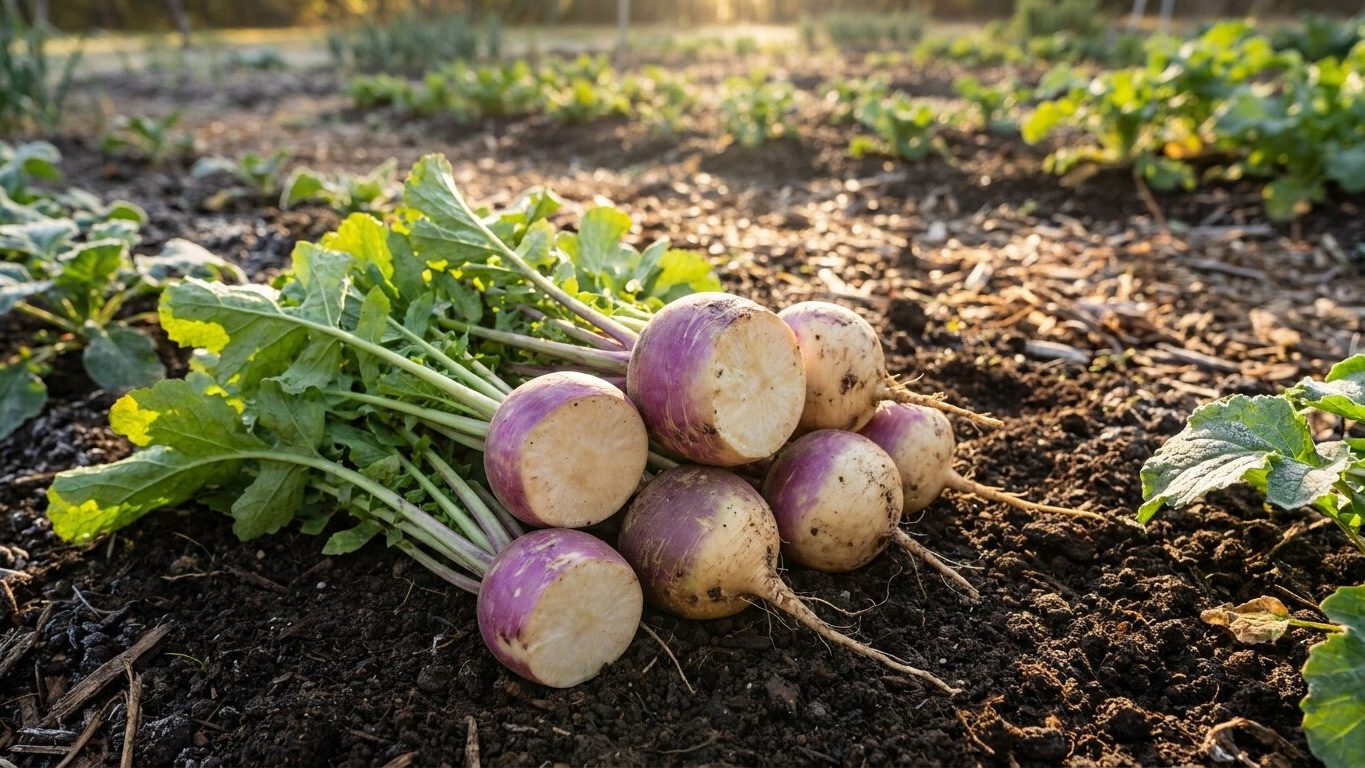

Turnips and rutabaga can go in the ground in New York twice a year: in early spring once the soil has thawed and dried, and again in late summer for a fall harvest. The fall crop is the one worth planning around, because frost sweetens these roots. The calendar depends heavily on where you garden, since the state runs from New York City to the Adirondacks.
When the soil is warm enough in New York
The last spring frost at the New York City reference station (Central Park) falls between March 23 and April 3, according to the NOAA NCEI U.S. Climate Normals 1991-2020. That range is the 30-70% band for a 32°F freeze, so it is a probability and not a promise. A cold snap after April 3 is entirely possible.
Central Park is also a dense urban site, and the figure belongs to New York City, not to the state. Upstate and the Adirondacks frost later in spring and earlier in fall, sometimes by weeks. A gardener in the Southern Tier or the North Country should treat the city date as the earliest the calendar could possibly start.
Why the frost date is only a proxy
Frost date answers a question about air. Turnips and rutabaga care about soil. Soil lags behind the air: it thaws from the top down, stays cold and soggy after snowmelt, and warms only after the nights stop dropping below freezing. So the soil is ready after the frost risk ends, not on the day it ends.
A cheap soil thermometer pushed 2 to 3 inches deep in the morning tells you more than any date. Seed sown into cold, wet ground sits and rots, or comes up unevenly and bolts to flower when the weather swings. I can’t give you a reliable seed-germination threshold from this page’s sources, so check the one your state extension service publishes. Handfuls of soil are a useful second test. If it crumbles and doesn’t smear into a ribbon, it is dry enough to work.
What to sow in spring, by type
Spring sowing suits the quick, small-rooted turnips, the kind harvested young for greens and tender roots before summer heat arrives. Rutabaga is a slower crop that wants a long stretch of cool weather to finish, so it fits fall better than spring. The varieties trialled in New York conditions are listed by Cornell Cooperative Extension, and I’d rather send you there than guess at names this page can’t source.
One more thing about the spring bed: flea beetles chew small holes in young brassica leaves, and a floating row cover over the seedbed is the usual defense. It is a practice, not a product, and it works because the beetles never reach the leaves.
How long the season lasts here
The first fall frost at the same reference station falls between November 14 and November 27 (same NOAA 1991-2020 normals, same 30-70% band). Set the two ranges side by side and the New York City window comes into focus.
| Reference point | Date range |
|---|---|
| Last spring frost, New York City | March 23 to April 3 |
| First fall frost, New York City | November 14 to November 27 |
Counting from the late end of spring (April 3) to the early end of fall (November 14) gives 225 days. Counting from the early end of spring (March 23) to the late end of fall (November 27) gives 249 days. So the frost-free stretch in the city runs from roughly 225 to 249 days, depending on which end of each band you land on. Those are my subtractions from NOAA’s dates, not a published growing-season figure.
What a long window allows
A window that size is generous for a cool-season root. It allows a spring sowing and a separate late-summer sowing, with room to stagger either one. It also changes the transplant question: with this much time, direct-sowing is almost always the better route. Turnips and rutabaga form a taproot, and disturbing it during transplanting can leave forked or stunted roots. Where a short season pushes people to start seedlings indoors, a long one removes the excuse.
The 225-to-249-day figure has a catch, though. It describes New York City, not Buffalo, Watertown or Lake Placid. Upstate, both ends of the window close in, and the first sowing may be the only practical spring one. In that case the fall crop becomes the main event, and working backward from your own local first-frost date matters more than any number printed here.
For the mechanics of timing each sowing, the succession sowing guide on this site walks through spacing batches so the harvest doesn’t arrive all at once.
Heat and water in New York
This page does not carry a verified count of days above 90°F or a summer rainfall total for New York, and I won’t make one up. What can be said honestly is that this is an autumn crop, and the facts that govern it are cold ones. Heat matters mostly for the spring sowing, which can stall or bolt if warm weather arrives early. Water matters for even root growth, but the extension service’s local weather data is the better source for it.
A cool, damp summer brings its own trouble in the northern part of the state: powdery and downy mildew on the leaves, slow ripening, and fungal or bacterial rots at the root. Because turnip and rutabaga are brassicas, they share these diseases with cabbage, kale and mustard. A gardener who rotates them into a bed that held cabbage last year has rotated nothing. Give them a bed that has been free of the whole cabbage family for several seasons, and use the rotation guide on this site to plan it. Spacing for airflow helps too, as does watering at the soil line instead of over the leaves.
The cold facts that decide the fall crop
The mean daily minimum of the coldest month at the New York City reference station is 27.9°F (NOAA NCEI Climate Normals 1991-2020). That is below freezing but not brutally so. Roots left in the ground under a thick mulch have a decent chance of staying usable through much of winter in the city, and that same cold is what drives starch into sugar and gives the frost-sweetened flavor.
Upstate changes the math. The USDA Plant Hardiness Zone Map 2023 puts New York anywhere from zone 3b to 7b. That system is built on one variable, the average annual extreme minimum temperature, and the range is territory-wide. In the colder zones, ground freezes hard before the crop has had much frost sweetening, and the sensible plan is to lift roots ahead of the freeze and store them.
Storage touches food safety, so inspect every root before it goes in. Look at the crown, the shoulders and the skin. A soft patch, a weeping spot or a moldy crown ends the question: discard that root. A root that looks sound is not a guarantee, so I won’t promise a keeping time. Check stored roots regularly and pull any that turn.
Gardeners elsewhere face different calendars entirely. See Growing Turnips and Rutabaga in Utah and Growing Turnips and Rutabaga in Arkansas for how the same crop behaves in other climates, or Growing Turnips and Rutabaga: An Autumn Crop, Sweetened by Frost for the general approach.
Which turnips and rutabaga suit New York
I’m not naming a single variety here, and that is deliberate. The only recommendation that carries weight is one backed by local trials, and this page doesn’t have those results. Cultivar names copied from a seed catalog rarely tell you how a variety behaved in a damp Hudson Valley August or a short Adirondack season. Cornell Cooperative Extension and your county office can tell you what has been trialled where you live.
What this page can do is reason by type. Start with the length of your own season. Near the city, with a long window, you have room for both a spring and a fall sowing, and for a slower rutabaga that needs the extra weeks to size up. Upstate, a short season favors the earliest-maturing types, because a root that needs every last day before freeze leaves no margin for a cold September.
Moisture comes next. In humid or rainy stretches, disease resistance should be your first filter, ahead of flavor or size. Seed descriptions list resistances, and the extension service can tell you which diseases actually show up in your area. Types that hold their leaves upright and open, and that you can space generously, give mildew less to work with.
Finally, think about where you plan to keep the roots. If you intend to leave them in the ground under mulch, favor types that tolerate cold and hold up in the soil. If you plan to lift and store, choose types known for firm, dense roots. Whatever you pick, remember that these are brassicas, so the bed must be new to the family.
Common questions
When should I sow turnips in New York in spring?
When the soil is workable and no longer waterlogged, which comes after the last frost risk. In New York City that risk ends between March 23 and April 3 (NOAA 1991-2020 normals), but upstate it runs later. Use a soil thermometer and your extension office’s guidance, not the calendar alone.
Can I leave rutabaga in the ground over winter?
Sometimes, under a thick mulch, especially near the city where the coldest month’s mean minimum is 27.9°F. In colder zones, lift the roots before the ground freezes hard. Inspect anything you store: a soft patch, a weeping spot or a moldy crown means discard it.
Can I plant turnips where I grew cabbage last year?
No. Turnips and rutabaga are brassicas, and they share pests and diseases with cabbage, kale and mustard. Rotate them to a bed that has been free of the whole family for several seasons.
Which variety should I buy?
Ask Cornell Cooperative Extension for the varieties trialled in your county. This page does not name cultivars because it has no local trial data, and a guessed name is worse than none. Sort by type: early maturity for short seasons, disease resistance for humid ones.
One last detail for the planner: the frost dates cited here come from a single city station, and a garden twenty miles upstate can run weeks off them. Keep a note of your own first and last frosts for a few seasons, and they will outperform any published normal.