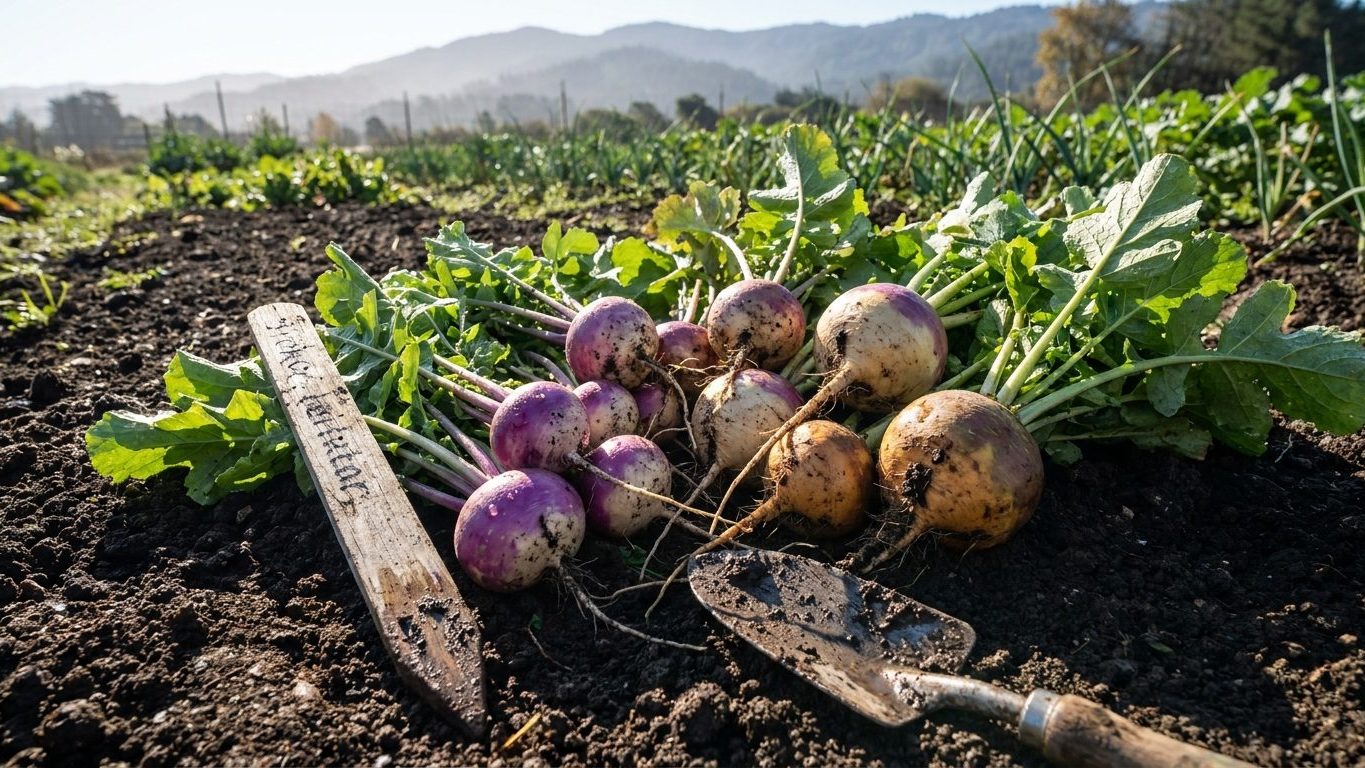

Fast turnips like Purple Top White Globe or Hakurei suit nearly all of New York, since they mature in 45 to 55 days and fit both a spring and a fall crop. Rutabaga needs the long, cool stretch that only the Hudson Valley, Long Island, and the Capital Region reliably provide.
The short answer for New York
New York’s growing season is long enough in most counties to grow turnips twice, but it’s the fall crop that produces the best roots. Turnips planted in late summer mature into the cool, moist weather of October and November, when sugars concentrate and bitterness fades. Rutabaga is the pickier crop here: it needs 90 to 100 days of mild, consistently cool growth, which only works if it goes into the ground by early July across most of the state.
The decision by type comes down to how much season a variety demands versus how much the state actually offers. Around New York City, the freeze-free window runs from roughly April 3 to November 14, close to 225 days, plenty for two turnip crops and one rutabaga crop. Upstate, at higher elevation or closer to the Adirondacks, that window shrinks fast, and a 100-day rutabaga can run into trouble if it’s started even two weeks late.
| Crop / Variety | Days to maturity | Best sowing window | Fits well in |
|---|---|---|---|
| Purple Top White Globe (turnip) | 45-55 | Spring and again in late summer | Nearly all of New York |
| Hakurei (salad turnip) | 38-45 | Spring or fall, quick succession | Zones 4b-7b, shorter upstate seasons too |
| Golden Ball / Amber Globe (turnip) | 50-60 | Late summer for a fall harvest | Hudson Valley, Long Island, Capital Region |
| American Purple Top (rutabaga) | 90-100 | Late June to early July | Zones 5a-7b with reliable summer moisture |
For most home gardeners, the practical answer is this: treat turnips as a two-season crop and rutabaga as a single, carefully timed fall crop. Trying to force rutabaga into a second planting, or trying to push a slow turnip variety into a short upstate window, is where most New York turnip patches go wrong.
What will not work here

A short season defeats the slowest varieties before they ever fill out. New York’s statewide hardiness range runs from 3b to 7b, and in the coldest pockets, that means a growing season barely long enough for one turnip crop, let alone a 100-day rutabaga. Anyone gardening near the Adirondacks or at higher elevation who sows rutabaga after the Fourth of July is racing a fall frost that can arrive well before the coastal date of November 14, and rutabaga sown too late simply stalls in cold soil without sizing up.
A hot, dry summer defeats anyone watering on a weekly schedule. Turnips and Rutabaga are shallow-rooted brassicas built for steady, cool moisture. New York summers aren’t reliably hot and dry the way the Southeast is, but a week without rain in July or August, paired with weekly watering instead of watching the soil, produces woody, sharp-tasting roots and encourages the plant to bolt to flower instead of bulking up. This is the single most common complaint about home-grown turnips in the state, and it’s almost never a variety problem. It’s a moisture-consistency problem.
A humid stretch defeats tight spacing. New York’s summers carry enough humidity, especially near the Great Lakes and the coast, that Turnips and Rutabaga planted too close together trap moisture around the leaves and invite downy mildew and root rot. Rutabaga in particular, with its longer time in the ground, is more exposed to a wet August than a quick 45-day turnip that’s already been harvested. Crowded rows are the second most common reason a New York rutabaga crop disappoints, right behind starting it too late.
The coldest month’s average low in the New York City area sits at 27.9°F, which tells you turnips left in the ground past a hard freeze without mulch won’t survive a true upstate winter the way they might in a milder coastal pocket. Treat any planting date on this page as a starting point, not a guarantee, and adjust based on the specific microclimate of the yard.
What changes across New York
New York is not one garden, and the state’s hardiness range makes that obvious. Stretching from zone 3b to 7b on the USDA map, the difference between the coldest pocket and the mildest one is enormous, roughly the same spread as the difference between central Minnesota and coastal Virginia. A single statewide planting date simply cannot serve both ends of that range.
In the milder zones, closer to the coast, the Hudson Valley lowlands, and western New York near the lake-moderated areas, gardeners get a longer shoulder season on both ends. That means more room for a second turnip planting and a realistic shot at rutabaga without rushing the sowing date. In the colder zones, at higher elevation, and closer to the Adirondacks and the Tug Hill Plateau, the frost-free window compresses hard. Fall crops need to go in earlier, and rutabaga becomes a genuine gamble unless the reader treats early July as a hard deadline rather than a suggestion.
Altitude matters as much as latitude here. Two counties at the same latitude can differ by two or more hardiness zones simply because one sits in a valley and the other sits on a ridge. Cold air pools in low spots on clear, still nights, so a garden at the bottom of a slope can see frost weeks earlier than one just a few hundred feet higher and upslope, where cold air drains away.
Because of that spread, there is no single “New York” planting date that fits everyone. A reader in a milder zone can lean on the later end of any date range mentioned here; a reader in a colder or higher zone should shift everything earlier and treat the fall frost date as arriving sooner than the statewide average suggests. The right move is checking the current USDA Plant Hardiness Zone Map for the specific county rather than assuming a number from this page.
Where to check this for your own county
This page describes New York at the state level, which means it smooths over exactly the kind of county-by-county variation described above. The reliable next step is Cornell Cooperative Extension, the land-grant university extension service for New York, which maintains local offices in nearly every county.
Once there, two things are worth looking for specifically. First, the local planting calendar for the county’s office, since Cornell Cooperative Extension staff build these around actual frost data and soil conditions for that specific area, not a statewide average pulled from a single reference station. Second, look for any list of turnip and rutabaga varieties that have been trialled locally, since county extension offices frequently run variety trials adapted to their own soil type, disease pressure, and season length, information that a state-level page like this one simply cannot capture.
A county recommendation beats a state one every time, because it accounts for the specific microclimate, soil, and frost pattern of that piece of New York, rather than averaging across zones as different as 3b and 7b. Treat the numbers on this page as a starting framework, useful for understanding why Turnips and Rutabaga behave the way they do here, and treat the county extension office as the authority on the actual dates to use.
Many Cornell Cooperative Extension county offices also run a master gardener volunteer program and a phone or email line for home garden questions, which is often the fastest way to get a straight answer about whether a particular fall is running early or late compared to normal, something no static planting chart can tell in real time.
Checking this against your own garden
Every date on this page is a probability built from decades of averages, and a reader’s own soil will always outrank it. Three things are worth watching directly, and each one tells something specific about the microclimate of that particular yard.
First, soil warmth by feel. Turnip and rutabaga seed germinates reliably once the soil is workable and no longer cold and wet to the touch, generally in the mid-40s and rising. A garden that warms up two weeks ahead of the county average, because it’s south-facing or sheltered from wind, can be sown that much earlier than any calendar suggests.
Second, watch for the first true leaves, the second set that appears after the small rounded seed leaves. Their appearance marks the point where the plant has shifted from surviving to actively growing, and it’s a better signal for thinning seedlings to their final spacing than counting days from the sowing date.
Third, watch for the first flush of flower stalks, especially on turnips planted too late into rising spring heat. A plant that bolts to flower early, sending up a tall central stem instead of bulking its root, is signaling that the local season is running warmer or drier than the reader expected, and it’s worth noting for next year’s timing. Bolting is not a variety failure; it’s the plant reading conditions the gardener may have missed. A gardener who tracks the date of first bolt over even two seasons builds a far more accurate local calendar than any statewide chart can offer.