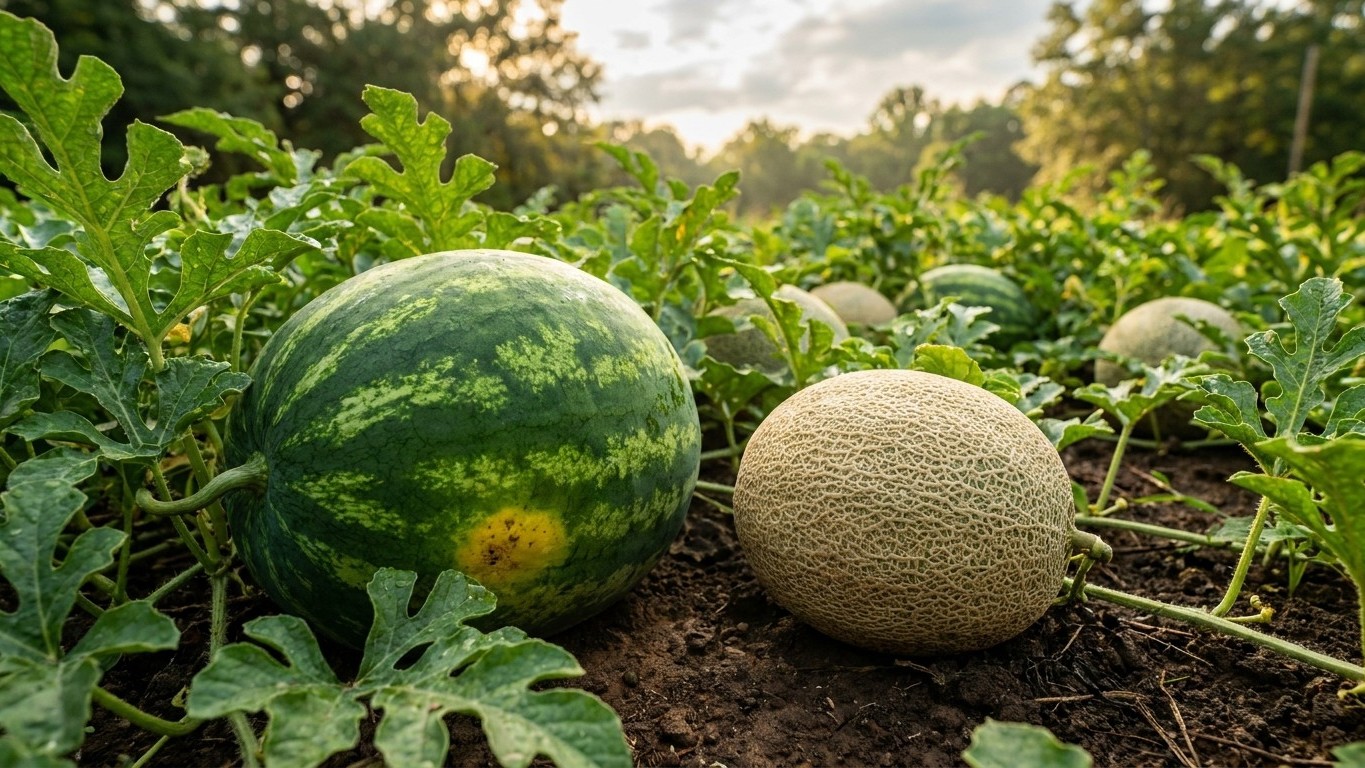

Melons are a stretch crop for Newfoundland and Labrador, not a given one. The honest answer is that only the fastest-maturing, cool-tolerant types have a real shot outdoors, and even those usually need help from plastic, row cover, or a small hoop house to get anywhere near a harvest before the season closes.
The short answer for Newfoundland and Labrador
Start with what the season actually offers. The mean last spring frost at the St. John’s A reference station is May 30, and the mean first fall frost is October 17, a gap of roughly 140 days on paper. But those are averages, not guarantees: in one year out of two, frost arrives later than May 30 or earlier than October 17, which means the real usable window is often shorter than the calendar suggests, and it can vary sharply between a mild coastal pocket and an inland or upland patch of ground.
The bigger constraint isn’t the calendar, it’s the heat. The reference station records 0.0 days a year at or above 90°F. Melons are a heat-accumulation crop, they don’t just need frost-free days, they need warm days and, just as important, warm nights to push sugar into the fruit. A province that never sees a 90°F day is a province where open-field melons will struggle to ripen even if they technically survive to the calendar’s end.
That combination points to a decision by type, not by brand name. Slow, large-fruited melons bred for hot inland summers are a poor match. Fast, small-fruited types bred for short, cool seasons are the only realistic candidates, and even they do better with some kind of season-extending cover to compensate for the missing heat.
| Melon type | Typical need | Fit for NL conditions |
|---|---|---|
| Short-season, small-fruited muskmelon/cantaloupe types | Fewer cumulative heat units, tolerant of cooler nights | Best available option, ideally under cover |
| Icebox-type watermelons (smaller fruit, shorter season) | Moderate heat, shorter maturity window | Marginal; needs black plastic mulch and cover |
| Full-season cantaloupe or large watermelon | Long stretch of consistent, high heat | Not realistic outdoors here |
| Honeydew and other high-heat melons | Long season plus sustained warmth for sugar development | Essentially ruled out |
The Canadian hardiness zone for the reference city is 6a, but that number describes winter cold survival, not summer heat, and it’s built on a seven-variable system that doesn’t convert to the USDA scale used elsewhere. Don’t lean on the zone number to judge melon suitability, the frost dates and the heat data above are the ones doing the real work here.
What will not work here
Full-season melons are the clearest failure. A variety that needs 90 to 100-plus days of warm, steady weather is already fighting the mean frost-free window, and it’s fighting it twice over once you account for how often frost arrives outside those mean dates. Add in the fact that spring soil stays cold well past the calendar date, since a mean frost date is not a soil-temperature guarantee, and germination and early growth get delayed on top of an already tight schedule.
The heat gap is the second failure point, and it’s the one gardeners underestimate. Zero days above 90°F means a melon plant here almost never gets the burst of hot, dry weather that concentrates sugars in the final weeks before harvest. A melon can reach full size and still taste flat and watery if it never got that heat pulse, this is a real risk in Newfoundland and Labrador even for a variety that technically “matures” within the season length available.
Rainfall creates a third, less obvious problem. Summer isn’t dry here: the region sees about 11.4 inches of rain across June, July, and August, with even the driest month, July, still bringing 3.61 inches. That’s not desert-dry weather that melons tolerate well with wide spacing and good air movement, it’s damp, cool, humid summer weather, and melons planted at the tight spacing that works in a hot, dry climate are far more prone to powdery mildew, vine collapse, and fruit rot in conditions like these.
Put those three together and the failure pattern is specific to this province: not enough reliable warm days to finish the fruit, combined with more humidity and rain than a melon vine wants at typical spacing. A gardener who copies a spacing chart or variety list built for a hot, dry inland state is copying advice built for the opposite problem.
What changes across Newfoundland and Labrador
Newfoundland and Labrador is not one climate wearing one label. The 6a Canadian hardiness zone cited here applies to the reference city tied to the weather station behind these numbers, generally reflecting the milder Avalon Peninsula conditions, it is not the zone for the whole province, and it should not be treated as one. Labrador’s interior, the west coast, and higher inland ground all run colder, with shorter frost-free windows and less accumulated warmth than the coastal reference point suggests.
The Canadian zone system itself makes this spread explicit at a national level: Natural Resources Canada notes that a single Canadian zone can overlap nine different USDA zones once you look at the full range of places that share it. That’s a reminder that one zone number, even accurately reported, compresses a huge amount of local variation, coastal fog, elevation, and distance from the moderating effect of the ocean all shift the real growing conditions a melon experiences, sometimes by weeks of season length.
What this means practically: a reader gardening on the Avalon Peninsula near the reference station is working with something close to the frost dates and heat figures above. A reader further into Labrador or at higher elevation inland should assume a shorter frost-free window and even fewer warm days than the numbers here describe, not the same ones. This page can’t tell an individual reader which zone applies to their own yard, that call belongs to Natural Resources Canada’s Plant Hardiness map, which lets a reader check the zone for their specific municipality rather than borrowing the provincial reference point.
Where to check this for your own county
This page describes provincial-level conditions built from one reference weather station. That’s useful for a first read, but it isn’t a substitute for local guidance, and Newfoundland and Labrador’s growing conditions vary too much region to region for a single set of numbers to fit every backyard.
The right next stop is the Newfoundland and Labrador Department of Fisheries, Forestry and Agriculture. Two things are worth looking for there specifically:
- A local or regional planting calendar, which will reflect actual frost patterns and season length for a specific district rather than the single reference station used on this page.
- Any list of melon or vegetable varieties that have actually been trialled in the province’s growing regions, since a variety proven to set fruit under local conditions is worth more than a general recommendation built from heat and frost data alone.
A county-level, or in this case a regional, recommendation beats a provincial one every time, because it accounts for local microclimate quirks that a single weather station simply can’t capture. This page gives the provincial picture: the frost dates, the heat load, the rainfall pattern, and what that combination rules in and out by melon type. The extension service’s regional information is the layer that narrows that picture down to a specific place, and it’s the layer that should have the final say before a gardener commits a season to melons in a marginal climate like this one.
Checking this against your own garden
Every date and figure on this page is a regional average, and a gardener’s own observations will always beat it. Three things are worth watching directly, without needing any equipment beyond a hand and a bit of patience.
Soil warmth by feel is the first and most useful check. Press a hand a few inches into the planting bed in late spring, if it still feels cold and damp rather than mild, melon seed or transplants will sit and sulk regardless of what the mean frost date says, since melons germinate and grow poorly in cold soil even after the air has warmed.
The first flush of male flowers is the second signal. Melon vines typically produce male flowers before female ones, and a strong early flush suggests the plant has banked enough warmth to start reproductive growth, a late or weak flush suggests the season’s heat is arriving slower than usual, which matters directly in a province with zero days above 90°F to spare.
The appearance of the first true leaves, the second set that emerges after the initial seed leaves, marks the point where a seedling is genuinely established rather than just surviving. A vine that’s slow to push true leaves is telling a gardener something the reference station’s averages can’t: that this particular spot, this particular spring, is running behind the province’s typical pace, and the harvest timeline should shift to match it.