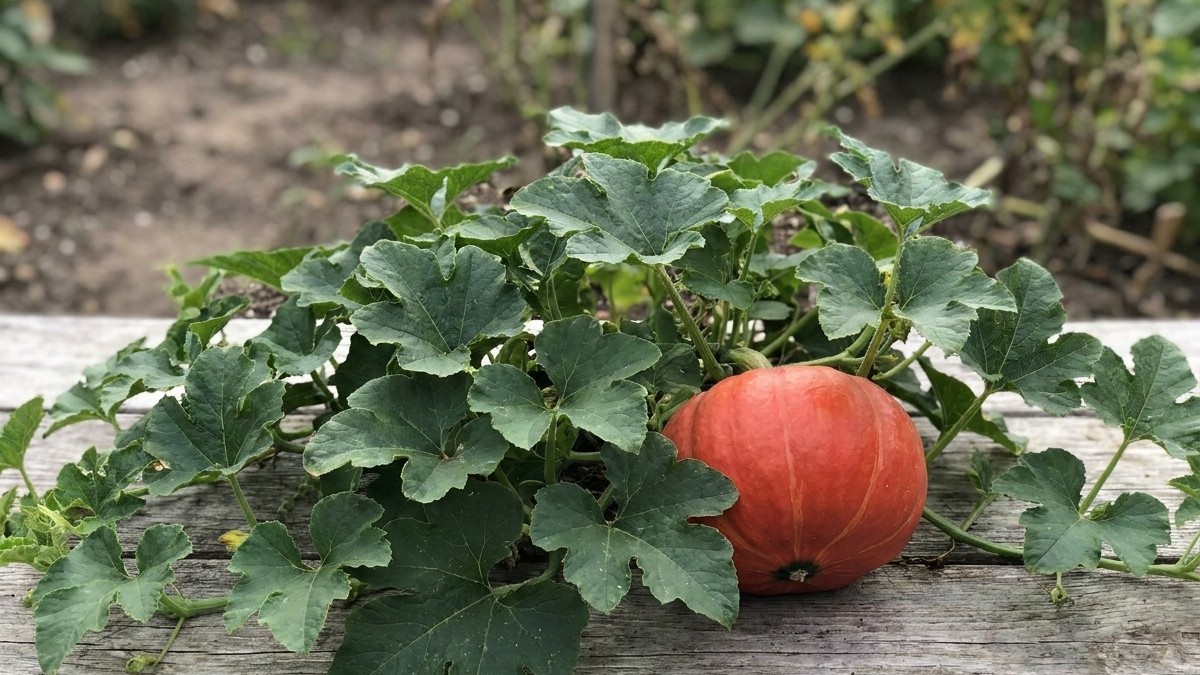

Cut a pumpkin when the rind has hardened, the color is fully set and the stem has gone dry and corky, and always before frost. In Newfoundland and Labrador that points to late September through mid-October. Stored whole in a cool, dark spot, a pumpkin can keep for several months, but that is a ceiling. The details below depend on when your plants flowered and where in the house you put the fruit. For the full growing picture, see Growing Pumpkins in Newfoundland and Labrador.
When pumpkins are ready in Newfoundland and Labrador
Look at the fruit first: a pumpkin is ready when the color is deep and even all over and the rind resists a thumbnail pressed hard into it. The calendar comes second, and it runs on a clock that starts at flowering, so count 45 to 55 days after the flower opens.
Utah State University Extension gives that figure for pumpkins, and the starting point matters. Seeding date tells you very little. The same source says to sow when the soil reaches 65 F, and soil warms weeks after the air does, so 65 F soil is not the same thing as the last spring frost. At the St. John’s airport station, Environment and Climate Change Canada puts the average last spring frost at May 30 and the average first fall frost at October 17, which leaves about 140 frost-free days between them. Each of those dates is a midpoint. In one year out of two the spring frost comes later than May 30, and in one year out of two the fall frost comes earlier than October 17.
Now lay the clock against the fall date. A flower that opens in mid-August is ready roughly between September 29 and October 9, which already crowds the average first frost. A flower that opens in early September is not going to finish. It will sit on the vine as a small green fruit until frost kills the plant. Because half of all years bring frost before October 17, the flowers that count are the ones open by early August. Any fruit set after that is a bonus if the fall is mild and a loss if it isn’t. Will Pumpkins Ripen Before Frost in Newfoundland and Labrador? goes deeper into that gamble and what you can do about it.
A province is not one climate. The St. John’s airport station sits on the milder east coast of the island of Newfoundland, and northern districts, higher ground and Labrador run weeks behind it. If you garden away from the Avalon, shift every date above later, and ask a nearby grower or the provincial agriculture office when frost usually arrives in your valley.
Harvest with the stem attached, before frost. Use pruners, leave the stem on the fruit, and never carry the pumpkin by it. A pumpkin cut without its stem has an open wound at the top, and that is where rot gets in. Walk the patch a few days before a frost forecast, too. Fruit that has its full color and a hard rind is worth cutting early, since a night at the wrong temperature can undo months of work. If you read this in the second half of October with fruit still in the field, don’t wait for it to look better.
Keeping them, and for how long
University of Illinois Extension says a whole pumpkin keeps for three to six months in a cool, dark location between 45-50 F. That is the best case. It assumes a sound pumpkin, harvested at the right time with its stem on, and held in exactly those conditions. A fruit with a soft spot, a gouge or a cut stem will not last anything like that long. Plan on the low end and treat anything beyond it as a bonus.
Why the neighbors in the storage room matter
The same Illinois source adds a second instruction that most people never hear: store pumpkins away from ripening fruit and vegetables such as apples, potatoes or tomatoes. Ripening produce gives off a gas that ages the pumpkin faster. That makes the cold room with the apple crate and the potato bin a poor choice, even when the temperature is right, and it makes a porch shelf beside a bowl of tomatoes just as bad. Give the pumpkins their own corner, and move them away from anything that is still ripening.
Utah State University Extension, the source for the harvest timing above, asks for one thing in storage: a place where the pumpkins will not freeze. A frozen pumpkin turns to mush when it thaws, and no number of months will save it. In practice, freezing is the main danger in this province, because a spell in late fall or winter can drop an unheated space below freezing overnight.
The 45-50 F range applies to a whole pumpkin with an unbroken rind. Once a pumpkin is carved it is a different thing entirely, with exposed flesh that breaks down far faster, and the three-to-six-month window does not apply to it. Carve close to the day you want to display it, and treat whole pumpkins as the ones you store.
Check each fruit before it goes into storage. Look over the rind for soft spots, cuts and chewed patches, and set damaged ones aside to use first. If you are not sure what made a mark, What Eats Pumpkin in Newfoundland and Labrador, and When covers who chews on pumpkins here and in which season. Once the pumpkins are in, look at them every couple of weeks. One bad fruit can spoil the ones beside it, and the sooner you find it the more of the crop you save.
Where in the house that actually is
Few homes have a spot that sits at 45-50 F all winter, so the practical question is which room comes closest. A domestic refrigerator runs well below that range, and a whole pumpkin rarely fits in one anyway. A heated kitchen or living room runs far above it, and a pumpkin there will age quickly. A garage follows the weather, and in a province where late fall and winter nights drop below freezing, it can easily slip into the one condition a pumpkin cannot take.
The best candidates are the cooler, unheated rooms inside the house envelope. A basement room away from the furnace, an unheated spare room with the door closed and the vent shut, or a cold room under the stairs all tend to land nearer the target than the rest of the house. Many older Newfoundland and Labrador homes also have a root cellar, which suits pumpkins as long as it stays above freezing and is not shared with a heap of ripening fruit. An enclosed porch can work in early fall, but it follows the outdoor temperature closely and is the first place to freeze in a cold snap.
Dark matters as well, since the Illinois guidance asks for it. A shelf in a basement corner with the lights off most of the day will do. Set pumpkins on a shelf or a board instead of a bare concrete floor, leave space between them for air, and keep them well away from the potato bin and the apple crate.
Don’t guess at the temperature, because rooms in the same house can differ by ten degrees or more. Put a min-max thermometer beside the pumpkins for a few days, including a cold night, and read the lowest and highest numbers before you commit the crop. If the low dips toward freezing, move them. If the high climbs well above 50 F, try another room. Skipping this check is how a whole harvest ends up soft by December.
Common questions
Can pumpkins stay on the vine after the first frost in Newfoundland and Labrador?
Cut them before it. Utah State University Extension says to harvest with the stem attached, before frost. At the St. John’s airport station the average first fall frost is October 17, and in one year out of two it arrives earlier. Inland and northern areas often see frost sooner, so watch the forecast from mid-September on.
How do I tell a pumpkin is ripe if I don’t know when it flowered?
Go by the fruit. The color should be deep and even, the rind hard enough that a thumbnail will not break it, and the stem dry and corky. If you did note the flowering date, count 45 to 55 days forward from it for a check on the calendar.
How long will a whole pumpkin keep indoors?
University of Illinois Extension gives three to six months, in a cool, dark place between 45-50 F, away from ripening fruit like apples and tomatoes. That is the upper limit under good conditions. A bruised fruit, a warm room or a cut stem will shorten it, and a frozen pumpkin is lost.
Is an unheated garage a good place to store pumpkins here?
Sometimes, early in the fall, but it swings with the weather and can drop below freezing overnight once the cold sets in. Test it with a min-max thermometer first. If it dips to freezing at any point, move the pumpkins to a basement or cold room inside the house.