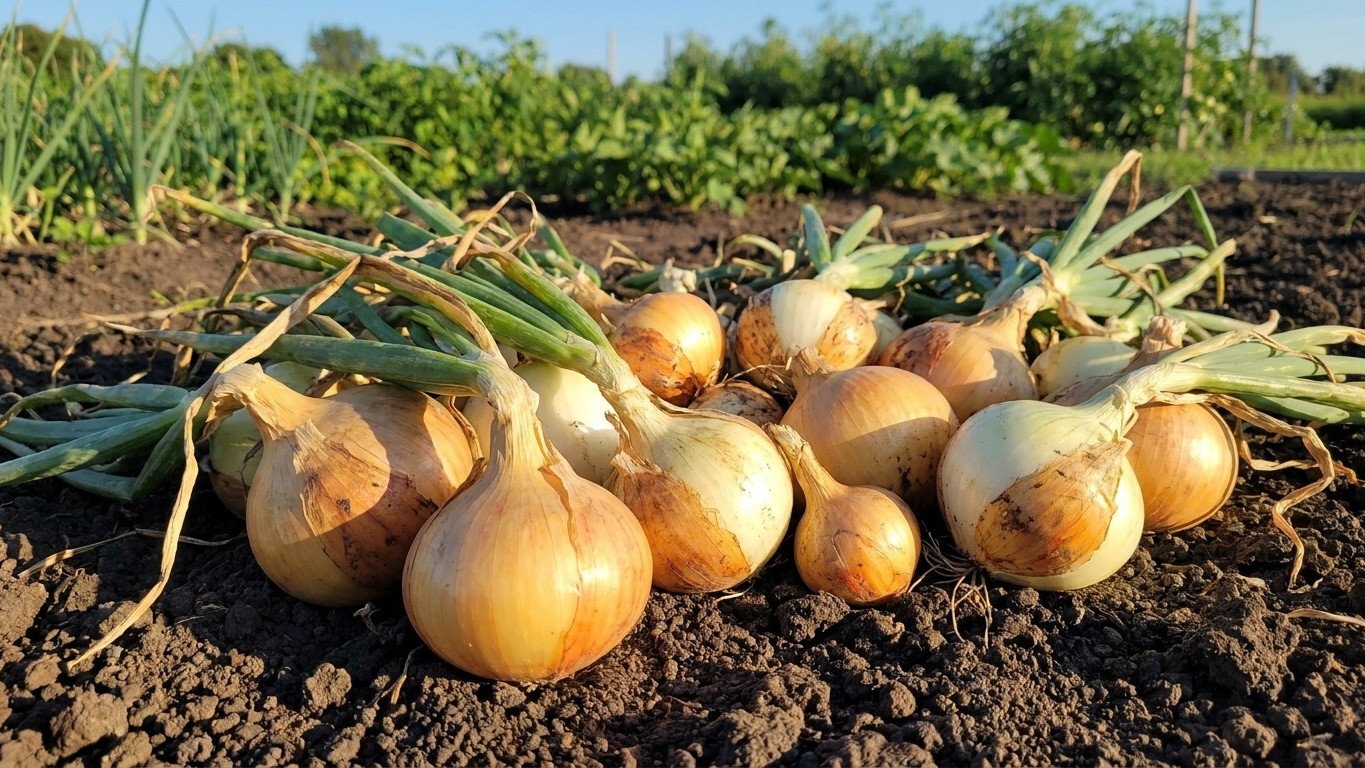

Lift onions in Newfoundland and Labrador once the tops have flopped over and turned yellow, then cure them in a dry, airy spot until the necks are tight and the skins papery. Only then do they go into storage, ideally at 45 °F to 55 °F with 50 to 60 percent humidity. The sequence matters more than the calendar date. A bulb pulled early or stored damp will rot by midwinter, however good it looked in the bed.
The short answer for Newfoundland and Labrador
Daylight sets the clock here, not warmth. The reference point for this page is St. John’s, where the Environment and Climate Change Canada station (ST JOHN’S A) sits at 47.62 degrees north. At that latitude the longest day of the year offers 15 h 47 of daylight, a figure calculated for the geometric horizon, so real daylight runs about seven minutes longer. Long-day onions need 14 to 16 hours before they switch from making leaves to making a bulb, and 15 h 47 lands inside that band. Short-day onions start bulbing at about 12 hours, a threshold published by Clemson Cooperative Extension. They trigger early and stay small.
That is why the harvest signal is the plant itself. Once bulbing is done, the plant stops feeding the leaves, the necks soften, and the tops fall over. Lift when most of the row has bent and the leaves are yellowing, not when the neighbor’s row looks ready. Choosing a variety that suits this day length is half the job, and The Best Onion Varieties for Newfoundland and Labrador covers which ones to pick.
Lifting on the right day
Pull or fork the bulbs on a dry day, ideally after a few rain-free days so the soil falls away without washing. Loosen the soil with a fork first if the bed is heavy, because yanking by the tops can snap the neck and leave an open wound for rot. Leave the tops attached. They pull moisture and energy back into the bulb as they dry down.
Don’t wash the bulbs. Brush off loose soil with your hand and nothing more. Water on the skins is the opposite of what you want over the coming weeks.
Curing: where the island’s weather gets in the way
Curing is controlled drying. Spread the bulbs in a single layer, not heaped, somewhere sheltered from rain and fog with air moving across them. A garage with the door cracked, a shed, a covered porch, or a spare room with a fan all work. Mesh racks, old window screens, or slatted crates let air reach the undersides. Bulbs left out in the open are a gamble in a climate where a dry afternoon can turn to drizzle by supper.
Curing is finished when the neck is tight and dry, with no give when you squeeze it, and the outer skins rustle like paper. How long that takes depends on the weather, so judge by the neck, not by a fixed number of days. Then trim the roots, cut the tops short (or leave them long if you plan to braid), and move the bulbs to storage. Clemson Extension puts the ideal storage conditions at “between 45 °F and 55 °F, and 50 to 60 percent humidity” (Clemson Cooperative Extension, Home & Garden Information Center).
What will not work here
Planting late does not push the harvest back. It shrinks it. Whatever size the plant has reached when day length triggers bulbing is the size the bulb will be, and a late-planted set or seedling has less leaf to feed that bulb. The same logic runs in reverse at harvest: you can’t coax extra size out of a bulb by leaving it in the wet ground for another month, because bulbing already happened. All that waiting does is invite rot.
Several common habits fail for the same reason, which is that they ignore how onions actually finish. These are the ones to skip:
- Lifting by the calendar. Tops still green and upright mean the bulb is still being built, and unripe bulbs with fat, wet necks will not keep.
- Storing straight from the ground. Uncured onions carry moisture in the neck, and that is where rot enters. Curing always comes first.
- Curing in the rain or fog. Damp air stalls the drying. Bulbs that stay wet at the neck turn soft in storage even if they looked fine.
- Washing the bulbs. Water on skins and necks is a head start for mold. Brush, don’t rinse.
- Packing them in plastic bags or sealed tubs. Onions want dry air moving around them, not trapped humidity.
- Sharing a cellar corner with carrots. Roots want cold and damp. Onions want 50 to 60 percent humidity. One space cannot hold both well.
- Storing short-day types for the long haul. They bulb early at this latitude and stay small, and they are generally bred for eating fresh, not for keeping.
Pests are the other quiet threat to storage. A bulb that has been chewed at the base, or one with a soft, collapsing neck, will rot and take its neighbors with it. Sort those out at lifting and eat them first. The What Eats Onion in Newfoundland and Labrador, and When page explains what to look for and when the damage happens.
Skipping the sort at harvest is the single most expensive shortcut. One bad onion in a crate can spoil the whole batch by January.
What changes across Newfoundland and Labrador
The 47.62 degrees north figure belongs to St. John’s, not to the whole province. Newfoundland and Labrador reaches from the island’s southern coast to a much higher-latitude Labrador, and the longest day lengthens as you go north. A gardener in Labrador has more summer daylight than the St. John’s figure shows, and a gardener on the western side of the island may be a degree or so from the reference point. Day length is what triggers bulbing, so the further you are from the reference city, the less you should lean on its numbers.
| Location | Latitude | Longest day | What it changes |
|---|---|---|---|
| St. John’s (reference station) | 47.62 degrees north | 15 h 47 of daylight | Inside the 14 to 16 hour range long-day onions need; short-day types bulb early and small |
| Elsewhere on the island | Check your own | Not published here | Close to the reference, but verify before shifting any timing |
| Labrador | Check your own, higher than the reference | Not published here | Longer summer days; the growing season itself, not day length, becomes the limit |
Harvest timing shifts with the season, too. A cooler, shorter summer in the north means the plants finish later in the year and the window for drying them outdoors narrows, so indoor curing is not a backup plan there, it is the plan. Coastal sites with frequent fog will dry bulbs more slowly than sheltered inland gardens, which is one more reason to cure under cover with a fan.
The general guide to Onions in Newfoundland and Labrador covers the growing season as a whole, and this page picks up where the bulbs come out of the ground.
Checking this against your own garden
None of these numbers is a promise about your plot. The latitude is one weather station’s, the day length is calculated from it, and your site’s frost dates, exposure and soil will shape the rest. These checks take a week or less:
- Look up your own latitude. Any mapping tool will give it from your address. If it is far from 47.62 degrees north, treat the 15 h 47 figure as a rough guide, not as your day length.
- Find your local frost dates from your provincial agriculture or local extension office. This page does not publish them, and a frost date from another town can be off by weeks.
- Check what variety you planted. If the label or packet says short-day, expect an early, small bulb and a shorter storage life.
- Walk the bed and note how many tops have fallen. Lift when most have, not when the first few do.
- Pick your curing spot now: somewhere dry, shaded and ventilated. Test it by leaving a towel there overnight, and if it feels damp in the morning, so will your onions.
- Check the storage space with a cheap thermometer and hygrometer. You are aiming for 45 °F to 55 °F and 50 to 60 percent humidity, and a cellar that holds the carrots may well be too damp.
Newfoundland and Labrador has no counties, so the nearest equivalent to a county extension office is the provincial agriculture department’s advisory staff, or a local gardening group that has kept records for your area. Ask what the first fall frost has done in your garden in recent years, then work backward from that.
Common questions
Can I leave onions in the ground if it keeps raining?
For a short spell, yes, if the tops have already fallen. Bulbs sitting in saturated soil start to rot, though, and they won’t grow any bigger. Lift on the first dry day and cure them under cover.
Can onions share a cellar with carrots and potatoes?
Poorly. Onions want 50 to 60 percent humidity, while carrots and other roots want it far damper. If you only have one space, keep the onions on a high shelf, away from the damp corner, in a mesh bag or open crate.
Which onions should I eat first?
Any with thick, wet necks that never fully tightened, any with nicks or insect damage, and any short-day types. Cured, thin-necked bulbs with firm, papery skins are the ones to keep for winter.
Do I need to braid or bundle the tops?
No. Braiding is a tidy way to hang bulbs where air moves freely, but trimmed onions in mesh bags or slatted crates keep just as well. What matters is that the neck is fully dry before you tie or trim anything, since a braid made of still-moist tops just holds the damp in.