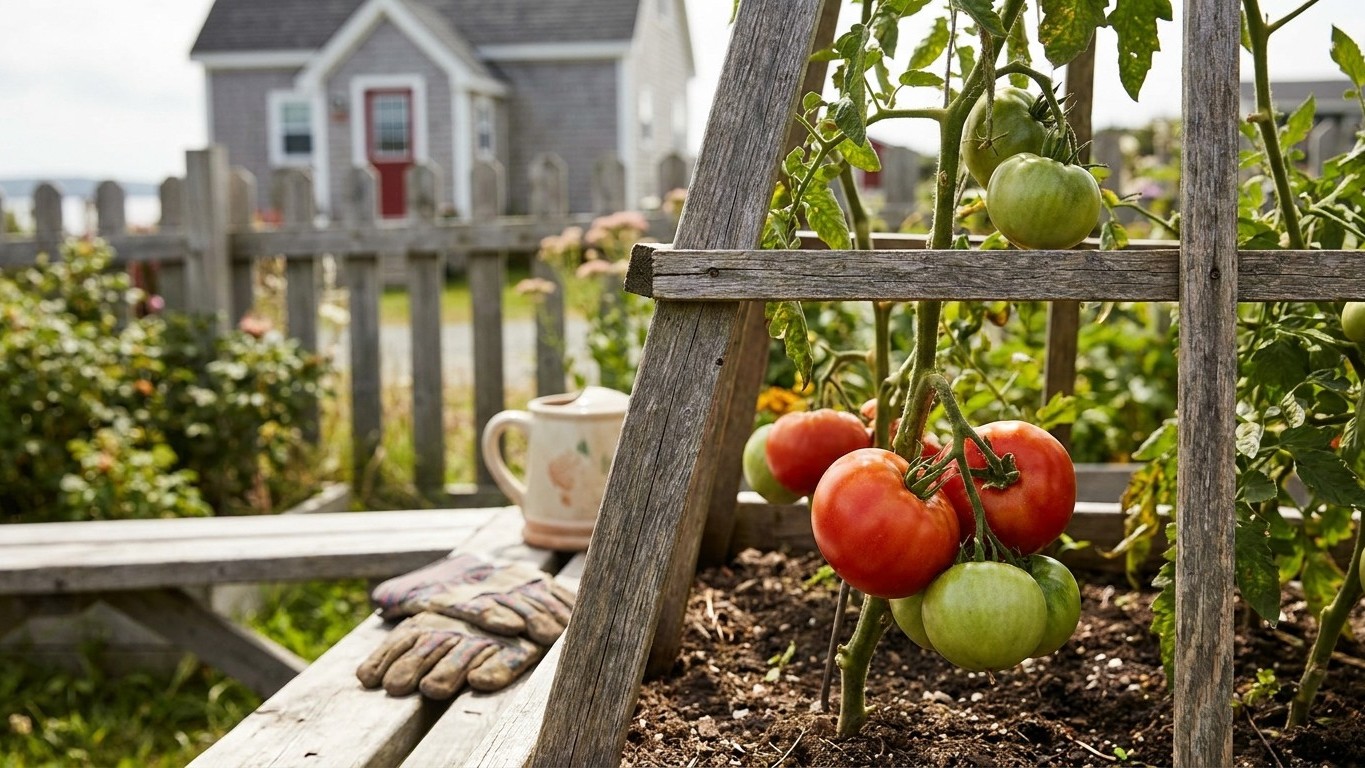

Environment and Climate Change Canada’s 1981-2010 climate normals put the average last spring frost at St. John’s on May 30, and the average first fall frost on October 17. That leaves a mean season of roughly 140 days, though the real number moves from year to year and from coast to coast. The action that follows: hold tomato transplants until soil and night temperatures have settled well past May 30, and pick a variety whose days to maturity leave real margin before October 17, not just a paper fit.
What this comes down to in Newfoundland and Labrador

The frost-free window at St. John’s runs, on average, from May 30 to October 17, according to Environment and Climate Change Canada’s 1981-2010 climate normals for station ST JOHN’S A. Tomatoes here go out as transplants rather than as direct-sown seed, so the planting date question splits in two: when is it safe to set plants outside, and does the variety on hand have enough days left in the season to ripen fruit before the first fall frost shuts the garden down.
The mean date is not a guarantee
An average frost date is built from thirty years of records, and by definition frost falls after May 30 in about half of those years. Treat that date as the middle of a window that can run a week or two later, never as a green light on its own. Gardens further inland from St. John’s, or at higher elevation, should expect their own last frost to fall later still, since this figure is read from one coastal station and the province is not one climate.
The same caution holds at the other end of the season. October 17 is the average first fall frost at St. John’s, and some years bring it earlier, some later. A garden set back from the ocean’s moderating effect can see frost arrive with less warning than a coastal plot gets. This is why the margin a variety carries past its expected ripening date matters as much as the raw days-to-maturity figure on the packet, a comparison worked through in full on Tomato Varieties That Ripen in Time in Newfoundland and Labrador.
Working it out for your own garden
Start from the last spring frost window at St. John’s, May 30, and work forward rather than backward, since tomato transplant timing is set by soil warmth as much as by frost risk. Transplants raised indoors, a step already covered in growing tomatoes in Newfoundland and Labrador, are traditionally set outside around mid June in this province, once night temperatures have settled clear of the frost window and the soil itself has warmed through. That gives a working range: mid June transplant, October 17 average first fall frost, which is roughly 120 days of growing season to work with in an average year, less in a year that runs cold early or ends with an early fall frost.
Running the arithmetic on two real varieties
The method is the same for any cultivar, so work it through once with real numbers. Sakura, a cherry tomato, is listed at 55 days from transplant. Set out in mid June, it should reach its first ripe fruit in early August, leaving about 71 days of margin before the October 17 average frost date, plenty of room even in a year that runs two or three weeks colder than normal.
Now do the same for San Marzano II, a paste tomato listed at 78 days from transplant. The same mid June transplant puts first ripe fruit at late August, roughly 48 days ahead of the average frost date, a narrower margin than Sakura’s. In a year where fall frost arrives on the early side, or in a garden further from the coast where the season runs shorter than at St. John’s, that margin can close before much of the crop has coloured. Run this same subtraction for any variety before committing a whole bed to it:
- Find the average last spring frost for your own station or county office.
- Wait past that date until soil has genuinely warmed, not just the calendar.
- Add the variety’s catalogue days to maturity, counted from transplant.
- Check the resulting ripening date against the average first fall frost, and see how many days of margin remain.
The mistakes this state punishes

The most common mistake is reading a warm stretch in late May as permission to plant. St. John’s can run a string of mild days well before its average last frost of May 30, and tomatoes set out into that warmth get knocked back, or killed outright, when the cold returns behind it. A warm week is not a season change, and the mean frost date from Environment and Climate Change Canada is a thirty-year average, not a forecast for this particular spring.
The second mistake is choosing a variety on days-to-maturity alone, without checking it against the season this climate actually allows. A long-season slicer with a catalogue figure that looks fine on paper can still fail to ripen more than a handful of fruit before frost closes the season. The margin before frost matters more than the raw number printed on the packet, especially past 70 days from transplant, where a slow spring and an early fall frost eat into ripening time from both ends at once.
The third mistake is treating the whole province as one climate zone. A grower in a sheltered garden near St. John’s and one well inland, at higher ground, or on a colder stretch of coast are not working with the same season, even reaching for the same headline frost date. Cold soil after transplant sets tomatoes back for weeks, not days, and a plant checked early in the season rarely makes up that lost time later on.
Checking this against your county
The May 30 and October 17 averages come from a single station, ST JOHN’S A, and are meant as a starting point, not an instruction for every garden in the province. Growers well inland, at higher elevation, or along a colder stretch of coast should expect their own frost window to open later in spring and close earlier in fall than these figures suggest.
For a check against local conditions, the Newfoundland and Labrador Department of Fisheries, Forestry and Agriculture publishes tomato growing guidance at gov.nl.ca/ffa, and a regional extension office can speak to frost patterns specific to your own valley or shoreline. Local knowledge beats a provincial average whenever the two disagree.
The Moon calendar is a separate, older custom: see when to plant tomatoes by the moon, written as tradition rather than fact.
Common questions
Can I just direct sow tomato seeds outside instead of starting transplants?
Not in this climate. The season between the average last and first frost at St. John’s is short enough that tomatoes need a head start indoors to have any real chance of ripening fruit before fall frost arrives.
What happens if I miss the mid June transplant window?
A late start eats directly into the margin a variety has before frost. A short-season cultivar can often still ripen a worthwhile crop, but a longer-season one that was already tight on time may not finish at all.
Is the frost date the same in Labrador as it is around St. John’s?
Labrador and other inland or northern districts run on a different, generally shorter season, so check with your own regional extension office rather than applying the St. John’s dates directly.
Does a greenhouse or cold frame change these dates?
It can extend the season on both ends, but open-garden timing follows the St. John’s frost normals. Ask your local extension office how much of a head start or extension a covered structure typically buys in your specific area.