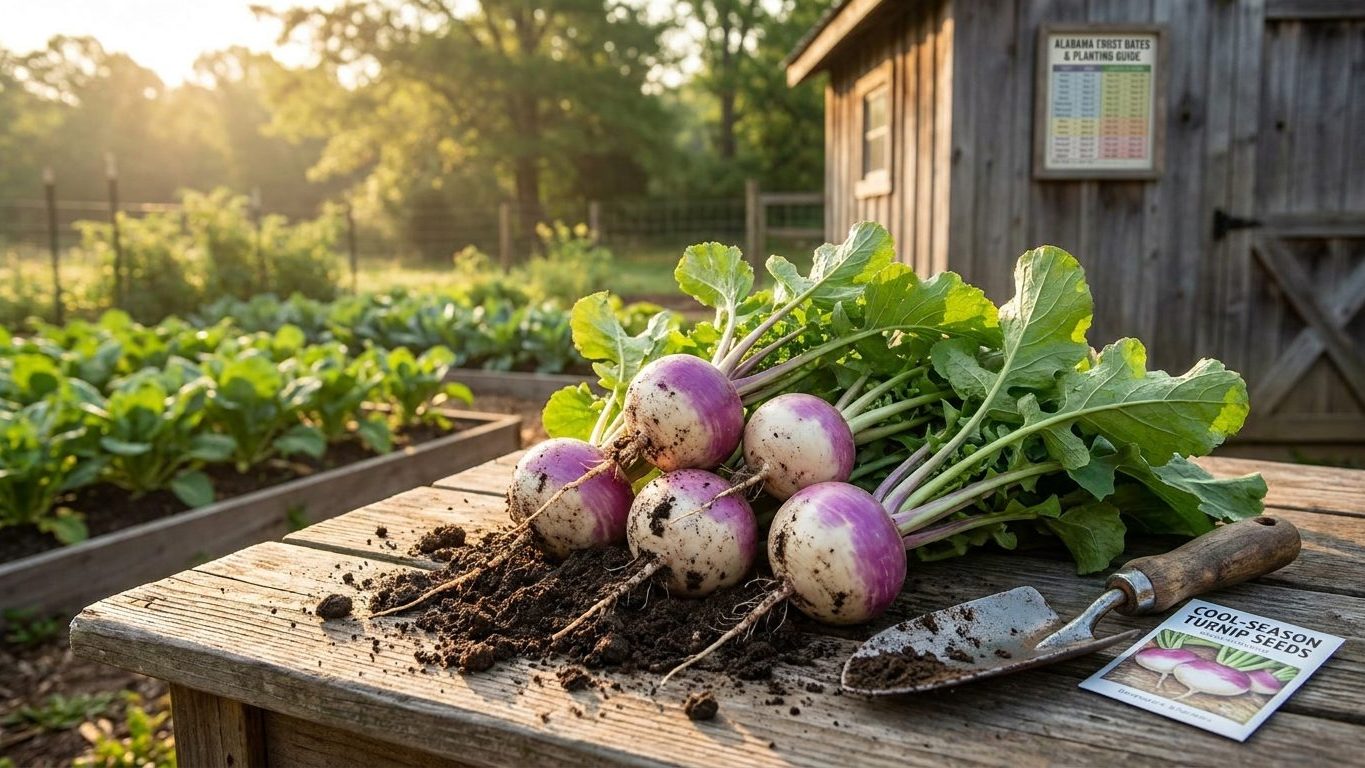

In Newfoundland and Labrador, turnips go into the ground from late May through mid-June for a summer harvest, then again in late July or the first days of August for a crop that finishes ahead of fall frost. Those windows are built around a mean last spring frost of May 30 and a mean first fall frost of October 17 at the St. John’s reference station, figures that are averages rather than promises, and every gardener on the island or in Labrador needs to read them that way.
The short answer for Newfoundland and Labrador
Turnip seed germinates once the soil has warmed past roughly 40°F, and the crop tolerates a light frost on either end of the season, which is exactly why it works here at all. The mean last spring frost date of May 30 is not a line you can plant right up against with confidence, because in one year out of two the real frost lands later than that. Treat it as the midpoint of a window rather than a green light, and hold off direct-sowing the main crop until the last week of May, easing toward mid-June if the spring has run cold.
A second sowing makes more sense of this climate than a single spring planting does. Turnips typically size up in five to eight weeks, so seed started in late July or the first days of August lands its harvest before the mean first fall frost of October 17, and often improves in flavor once nights cool. That second window is the one local gardeners lean on hardest, because it sidesteps the uncertainty of a late spring freeze entirely and uses the cooling autumn to sweeten the roots.
The reference point behind all of this is the ST JOHN’S A weather station, and Newfoundland and Labrador is not one climate radiating out from St. John’s. Coastal fog belts, the Avalon’s damp summers, and Labrador’s shorter, harder season all shift these dates in ways a single provincial page cannot capture. What this page gives is the provincial midpoint; what your own soil gives you on a given spring is the real answer, and the two rarely land on the same day.
None of this changes the basic math of the season: roughly 140 days separate the mean last and first frosts here, which is workable for a fast crop like turnip but leaves little room for delay, replanting, or a slow-maturing rutabaga squeezed in after a late spring.
What will not work here

A short, cool growing season punishes anything slow. Rutabaga, turnip’s close relative, typically needs closer to 90 days to bulk up properly, and against a 140-day mean window that only works if the seed goes in almost immediately after the spring frost risk clears and nothing sets it back. A cold, wet start to June, which is common on the Avalon Peninsula, can eat two or three weeks of that margin before a single true leaf appears, and at that point a rutabaga sown on the same date a turnip would tolerate is already behind schedule.
Waiting too long into summer for the second sowing is the other common failure. Push a fall crop past the first week of August and you are racing the mean first frost of October 17 with a plant that still needs five to eight weeks to finish. Because that frost date is itself just a midpoint, half of all years bring the freeze earlier than October 17, not later, and a late-sown fall turnip has no buffer left when that happens. The first week of August is a reasonable outer limit for the second sowing in most of the province, not a target to aim for.
Winter survival of anything left in the ground is its own separate problem, and the coldest-month numbers here are blunt about it. The mean daily minimum of the coldest month sits at around -8.7°C (16.4°F), which is cold enough that unmulched roots left in open ground through winter are gambling against real damage, not theoretical damage. Gardeners hoping to overwinter turnips or rutabaga in place, the way some milder regions do, are working against a climate that does not support it reliably.
Close spacing is a smaller but real failure point in the damper parts of the province. Coastal humidity around bays and headlands keeps foliage wet longer after rain or fog, and turnips crowded tightly into a bed hold that moisture at leaf level, inviting the fungal issues that show up as spotted or rotting leaves before the roots ever size up.
What changes across Newfoundland and Labrador
Newfoundland and Labrador is officially rated at Canadian hardiness zone 6a for its reference city, but that single number badly understates how much the province actually varies. The Canadian zone system is built from seven separate climate variables, not just a minimum temperature, and it does not translate to the USDA zones used across the border. What matters practically here is that a zone rating drawn from the St. John’s area tells you almost nothing about conditions in central Newfoundland, on the west coast, or across Labrador, where winters run longer and colder and the growing season compresses hard.
The frost dates behind this page’s sowing windows come from one coastal station, and coastal St. John’s runs noticeably milder than inland or northern districts thanks to the moderating effect of the ocean. Move away from that coastline, gain elevation, or head north toward central and coastal Labrador, and both the last spring frost and the first fall frost can shift by two to three weeks in the conservative direction, meaning a later spring thaw and an earlier fall freeze. That compresses an already tight 140-day mean season into something closer to 90 or 100 days in the harder parts of the province, which is a real problem for anything slower than a quick-maturing turnip.
There is no single sowing date that fits both a sheltered garden on the Avalon Peninsula and a plot in Labrador City, and this page cannot tell an individual reader which zone or microclimate they actually sit in. That determination depends on local elevation, distance from the coast, and exposure, all of which vary within a few miles in this province. The right move is to check the hardiness zone map itself for the specific area in question, rather than assume the provincial reference figure applies where you garden.
Where to check this for your own county
A provincial page like this one is built from a single reference station and a single reference zone, and it is meant to be a starting point, not a final answer for any specific community. The Newfoundland and Labrador Department of Fisheries, Forestry and Agriculture publishes provincial growing guidance, and it’s the right next stop for anyone trying to narrow this down past the averages given here.
What’s worth hunting for on that site is any local or regional planting calendar that breaks the province down by district rather than treating it as one climate, along with notes on which turnip and rutabaga varieties have actually been trialled successfully in local conditions. Provincial agriculture offices often track this kind of regional performance data even when it hasn’t made it into a glossy public calendar, and a phone call or email asking specifically about frost dates and variety trials for your district can surface information this page simply does not have.
The general rule holds regardless of province: a district-level recommendation beats a provincial one every time, because it accounts for the local coastline, elevation, and microclimate quirks that a single reference station cannot. This page works from the ST JOHN’S A station and a zone rating tied to one reference city, which makes it useful for the province as a whole but blunt for any one garden. If your community keeps its own frost records, whether through a local agricultural society, a nearby research station, or long-time gardeners comparing notes, that local record should override the provincial mean date given here.
The Moon calendar is a separate, older custom: see when to plant turnips by the moon, written as tradition rather than fact.
Checking this against your own garden
Frost dates and hardiness zones are useful for planning, but the soil in front of you settles the question every single spring, and it settles it more reliably than any calendar figure. Three things are worth watching, and none of them require anything beyond your own hands and eyes.
Soil warmth by feel is the first and most direct check. Push a finger a couple of inches into the bed on a dry morning; if the soil feels cool and heavy rather than merely damp, it likely hasn’t crossed the roughly 40°F threshold turnip seed needs to germinate reliably, whatever the calendar says about the date. A bed that warms a week or two ahead of the provincial mean is telling you something real about its own drainage, sun exposure, and shelter from wind.
The second signal comes once seedlings are up: watch for the first true leaves, the second set that appears after the small rounded seed leaves. Their arrival timing, fast or slow relative to what you’d expect from the sowing date, is a direct readout of how favorable that particular bed’s conditions have been, and it’s a better predictor of harvest timing than counting days on paper.
Male flowers appearing on any bolting plants nearby, including leftover brassicas from a prior planting, are a signal too, since early bolting in a normally cool season points to a warmer, drier microclimate than the provincial average assumes. Taken together, these three observations tell you more about your own garden’s actual season than any single date this page can offer.